
ANALYSIS
Its not
your problem.
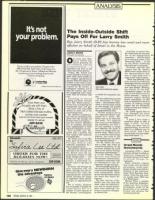
The Inside-Outside Shift
Pays Off For Larry Smith
Rep. Larry Smith (D-Fl) has become less vocal and more
effective on behalf of Israel in the House.
JAMES D. BESSER
Washington Correspondent
0
But you made it your problem. You gave to the
1989 United Way Torch Drive. And because you
did, 153 agencies in Wayne, Oakland and Macomb
counties can continue helping those in need.
Thank you for giving.
United Way
for Southeastern WNW
Michigan State Solicitation M1CS 2123
/411/415
Show them your
thoughts are with them
Send a tray of
fresh baked bite-size muffins,
scones and cookies
(sugar-free and fat-free baked goods available)
ready to serve
689-8638
s- nn 1
ORDER FOR THE
HOLIDAYS NOW!
24370 W. Ten Mile Rd., Just W of Telegraph
136
FRIDAY, MARCH 15, 1991
...Certiffed Kosher
Metropolitan
Koshruth Council
ne year ago, Rep.
Larry Smith was
known primarily for
his volatility and his
outspokenness — a
legislative pit bull in the
arena of pro-Israel politics.
Today, Mr. Smith has
recast himself as a House in-
sider with a firm handle on
the complex appropriations
process. That new status was
evident in last week's inten-
sive bargaining over Israel's
request for $1 billion in
emergency military aid to
help the country cope with
the staggering costs assoc-
iated with the Persian Gulf
war.
According to several
leading pro-Israel activists
here, Mr. Smith played a
pivotal role in brokering the
compromise that will pro-
vide Israel with some $650
million in extra aid in the
current fiscal year.
Mr. Smith's transforma-
tion tells an interesting tale
about how the foreign aid
process works in Congress —
and how Israel's defenders
are, by necessity, becoming
more sophisticated in their
exercise of legislative power.
Two months ago, Mr.
Smith took a political risk
that raised a few eyebrows
on Capitol Hill.
Mr. Smith, now in his fifth
term, gave up seats on the
Foreign Affairs and
Judiciary committees for a
slot on Appropriations.
The primary reason for the
shift had to do with the way
the House uses the ap
propriations process to help
shape foreign policy — and
foreign aid policy in par-
ticular, a politically ex-
plosive issue in the best of
times.
In theory, the Foreign Af-
fairs committee sets aid
policy through the aid au-
thorization bill, while the
Appropriations committee
merely allocates the money
to implement those policies
through an appropriations
bill.
But in reality, Congress
has not passed a foreign aid
authorization bill in a
number of years because of
the Senate's unwillingness
Rep. Smith:
More active behind the scenes.
to tackle the unpopular sub-
ject.
So the authorizing process
has diminished in impor-
tance — and members inter-
ested in leaving their stamp
on the foreign aid process
have increasingly turned to
the appropriations bills.
"I'd been trying to get on
the Appropriations com-
mittee for a while," Mr.
Smith said in an interview
last week. "It's apparent
that if you're on an authoriz-
ing committee, you have a
lot less capability to shape
and influence the kinds of
issues I've always been con-
cerned about. When you're
on a committee like Foreign
Affairs, you tend to get
frustrated because you don't
have that final impact."
For Mr. Smith, the move
was a risky one; when he
switched committees, he did
not know whether he would
land on the critical Foreign
Operations subcommittee —
or on the Treasury, Postal
Service and General
Government subcommittee,
a legislative backwater with
no connection to the all-
important foreign aid issue.
But the gamble paid off. In
late January, Mr. Smith won
a seat on the Foreign Opera-
tions subcommittee, where
he now has his hands close to -
the levers that control for-
eign aid.
The first real test of Mr.
Smith's new role came last
week, when the administra-
tion and the Israeli govern-
ment were dickering over
Israel's request for emergen-
cy military aid.
According to sources here,
Mr. Smith used his new posi-
tion on the Appropriations '
committee — and his status
as an emerging power in the
Democratic party — to line
up the House leadership
behind Israel's aid request.
Pro-Israel activists here
suggest that Mr. Smith's
efforts were a major factor in
the administration's deci-
sion to step back from a
major tussle with Congress.
"What was different in his
style was that he worked the
leadership and the corridors
in the House as an insider,"
said Jess Hordes, Washing-
ton director for the Anti-
Defamation League. "In the
past, he was much more of a
public advocate — trying to
generate support through
public statements. In this
case, he played the role of an
insider in making things
happen but not necessarily
being out front and visible in
his advocacy."
Mr. Smith agreed that he
has changed his style
somewhat to suit his new
role.
"I guess I have made a
conscious effort to take it
down a notch," he said.
"When you move over to
Appropriations, you see that
there is a different way to
move policy. And I have
moved more into the leader-
ship of the House."
❑
NEWS l'• ■■ •
Israel Needs
Investments
Jerusalem (JTA) — Israel
has been advised to adopt an
American blueprint for
economic recovery if it hopes
to attract foreign in-
vestments.
Fight inflation, expand
free trade and privatize
government- owned enter-
prises, Israelis were told at a
meeting of the American-
Israel Joint Economic Com-
mittee, which has met every
six months since 1985 here
or in Washington.
Herbert Stein, a member
of the American delegation,
suggested that further
privatization would rid the
government of an economic
burden and advance the
economy generally.
Scanned image of the page. Keyboard directions: use + to zoom in, - to zoom out, arrow keys to pan inside the viewer.
March 15, 1991 - Image 148
- Resource type:
- Text
- Publication:
- The Detroit Jewish News, 1991-03-15
Disclaimer: Computer generated plain text may have errors. Read more about this.