

HARDER LINE
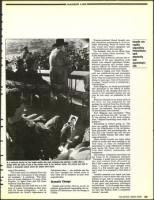
At a memorial service for two Israeli youths who were murdered last summer, a rabbi offers a
eulogy while the sister of one of the victims looks at her brother's photo. The service was held in
Ramot, a Jerusalem suburb where the bodies were found.
item of the charter.
"The Land must be cleansed from the
impurity and viciousness of the tyranni-
cal occupiers," it continues. "The Mus-
lims are under obligation, by order of the
Prophet, to fight Jews and kill them
wherever they find them."
The intifada and the Gulf war is a rich
brew of events. Coinciding as they have
with the Soviet immigration — and its
implications for Israel's dependence on
Palestinian labor — the intifada and the
war have changed the Jewish state in
ways that are as insidious as they were
unpredictable.
Dramatic Change
Despite poll results, there is, as yet, no
political groundswell demanding the ex-
pulsion of Palestinians. But the change is
evident.
Western-oriented, liberal Israelis now
find themselves acquiescing in, if not ac-
tually advocating, forms of action that
they would have found repugnant and
unacceptable just a few years ago.
For example, they do not flinch from
notices on stores which proclaim: "No
Arabs Employed Here."
In fact, they positively welcome the re-
placement of the once ubiquitous Arab
worker who cleaned apartment blocks,
delivered groceries and stocked super-
market shelves by Soviet newcomers,
high school kids and yeshiva students.
"Misha is taking over from Ahmed,"
said one middle-of-the-road Jerusalem
lawyer who supported Israel's Labor
Party when he emigrated from the United
States 14 years ago. "And, in the process,"
he added, "Israeli society is undergoing a
radicalization."
Noah Milgram, an Israeli psychologist
who specializes in the effects of stress,
was struck by the changes that had oc-
curred in his homeland during the one
year he was away on sabbatical in the
U.S.
When he returned to his home north of
Tel Aviv, he was surprised by the
apology he received from his Jewish gar-
dener: "I do still have one Arab working
for me," he confessed. "But in the spring
I'll hire Russian Jews instead."
Prof. Milgram was astonished. "This
guy is a real Peace Now-nik," he said. "If
he was getting rid of his Arab workers,
then I realized something must really be
going on."
Something is indeed going on. The
Jews are rapidly separating themselves
from the Palestinians of the territories,
both physically and psychologically, an
idea that only months ago was the pre-
serve of Rabbi Kahane and other right-
wing extremists.
Many Jewish Israelis are today either
afraid of Arabs and want nothing to do
with them, or they are belligerently
determined to push Palestinian workers
back across the Green Line and away
from their streets, restaurants and
workplaces.
One woman, waiting for renovations on
her home to be completed, declared:
"Normally, I would move in and let them
(the Arab workers) finish off around us.
But I don't want to be in the house with
them. I wouldn't have thought twice
about it a few months ago, but now I
don't want to be exposed to that kind of
risk."
Another asserted over lunch just how
important it was to know who was in the
kitchen of any cafe or restaurant. Arab
kitchen staff, she said, have been known
to put glass and poisonous substances
into the food. "A lot of people have either
stopped eating out or go only where they
are sure the kitchen staff is completely
Jewish," she said.
Israelis are
rapidly
separating
Palestinians,
both
physically
and
psychologic-
ally.
THE DETROIT JEWISH NEWS
25