

NEWS
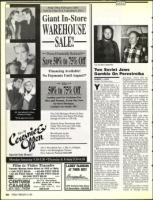
Yuli and Boris Kagarlitsky.
TWo Soviet Jews
Gamble On Perestroika
ROBERT J. LEVY
Special to The Jewish News
uli Kagarlitsky is a
Soviet Jew, whom I ar-
ranged to meet, both
to learn about Jewish life in
Soviet society and to seek in-
formation about locating
family members in the
Moscow area.
Yuli gave me memorable
directions for my visit to his
flat on Red Army Street. He
said, "It's very simple. You ex-
it your hotel (the Rossiya) on
the west, walk through Red
Square (past Lenin's Tomb),
cross Prospect Marxa and
enter the Sverdlovsk Metro
Station, where you'll take the
train to the Aeroport exit. I
will be sitting on a bench next
to where the very last car
always stops."
I had read of his Red Army
Street neighborhood in Kevin
Klose's Russia and the Rus-
sians. The district is well
known as a writers' colony,
where Mr. Klose had oppor-
tunities to meet many of the
intellectuals of Moscow, in-
cluding Yuli and Yuli's son,
Boris.
Red Army Street proved to
be a group of grimy, crumbl-
ing tenements surrounded by
fields of mud. As Yuli and I
walked through the neighbor-
hood to his building, we pass-
ed blocks of empty stores. Yuli
insisted that I enter several,
which had few goods and long
lines for what little was
available.
Our trek to Yuli's flat in-
cluded several other stops. We
visited the neighborhood's
y
All furs labeled to show
country of origin.
*With approved credit.
The Cold Michigan Winter Is Here.
So Buy Now! And Enjoy The Huge
Savings Of 50% to 75% Off.
Giant In-Store Warehouse Sale!
Today Thru February 16th Only,
Only At Ceresnie & Offen.
We will pick-up the
Federal Luxury Tax
on all applicable items.
181 S. Woodward Ave., 1 Blk. S. of Maple,
Next to the Birmingham Theatre
Free Adjacent Parking. 642 1690
-
Monday-Saturday 9:30-5:30 •Thursday & Friday 9:30-8:30
Film to Video Transfer
Transfer Movies 8mm-16mm to VHS or Beta
• 401-600 FEET $39.00
• 1-200 FEET $20.00
• 201400 FEET $26.00 • 601-800 FEET $52.00
wu .1
801-1000 FEET $65.00
LADIES' FASHIONS
AT THEIR BEST
I Film over 1,000 feet add 6t a foot. Tape $8.00 Additional
conruros
ciA\ m E. RA
BUY—SELL—TRADE
50
FRIDAY, FEBRUARY 8, 1991
3017 N. W oodward
(3 Blks. Sou
th of 13 Mile)
Daily & Sat. 10--6, k Fri. 10-8
288-5444
6919 Orchard Lake Road
W. Bloomfield • 855-5528
Dr. Levy is professor of
pediatrics, communicable
diseases and pharmaceutics
at the University of Michigan.
He recently attended the All
Union Congress on Cardiac
Surgery in Moscow.
pharmacy, where Yuli at-
tempted unsuccessfully to fill
a prescription. I was surpris-
ed to see the pharmacist us-
ing an abacus as a cash
register-calculator, but I later
learned that this practice is
commonplace in the Soviet
Union.
Yuli and I also stopped at
the stationery store, where he
is entitled, as a writer, to
purchase typing paper. There
was none available, and this
had been the case for weeks.
Once in Yuli's flat I was fur-
ther saddened to see his used
manuscript pages recycled as
bathroom tissue.
Despite these and other
hardships, Yuli and his son
Boris are not planning on
emigrating, unlike most
Soviet Jews. Yuli holds
memberships in both the
prestigious Writers Union
and the Theater Union. He
has lectured extensively in
the West and is a well known
authority on H.G. Wells.
Yuli has lived with anti-
Semitism all of his life. He
relates that things are better
now, but that the most signifi-
cant progress has only been
since 1988. Yuli and Boris
fear that the collapse of the
Soviet Union could be accom-
panied by pogroms.
We spoke of some of the
quotas that have been drop-
ped since 1988: before then
only 1-2 percent of medical
students could be Jews, now
admissions are unrestricted.
Furthermore, until 1988,
Yuli's own Theater Union,
which is responsible for par-
ticipation in all aspects of
theater including writing,
performing, and critiquing
drama, maintained a quota of
one new Jew admitted every
other year.
Yuli has also been a victim
of Soviet censorship; his own
works on George Orwell,