

most appropriate Shabbat,
he believes, to teach the
world about an 80-year-old
song nearly as fundamental
to Judaism as the Torah
itself.
Moshe Nathanson was a
third-generation Jerusa-
lemite. His grandparents
had emigrated from
Lithuania before the turn of
the century. Unlike many in
the Jewish yishuv, or com-
munity, in Palestine, Mr.
Nathanson spoke Hebrew as
a first language.
After serving in the
Turkish army in World War
I, he left Palestine in 1919 to
study law at McGill Univer-
sity in Montreal. It was a
chance encounter with a
Russian opera singer that
changed Mr. Nathanson's
career course. Hearing Mr.
Nathanson sing at a social
gathering, the opera singer,
named Dopkin, convinced
the young law student to
make music his career.
He moved to New York to
attend what is now the
Juilliard School of Music. In
1928, Rabbi Mordecai
Kaplan, the founder of Re-
constructionism, chose Mr.
Nathanson as cantor of the
Society for the Advance-
ment of Judaism, the syna-
gogue-community center the
rabbi had established. It
was a position Mr. Nathan-
son held for 46 years until
his retirement. In the 1930s,
Mr. Nathanson was known
as the "Voice of Palestine."
In his music classes and on a
weekly radio program in
New York he popularized
the new songs that were be-
ing written in pre-state Isra-
el. He recorded one album,
"Sing, Palestine!" The per-
formances reveal a voice
unlike what is now thought
of as Israeli or Ashkenazi.
Mr. Nathanson's voice was
high, tremulous, with a ro-
mantic attention to the
mysterious sounds of the
Hebrew letters chet and
ayin. It is a Yemenite voice.
"That was his natural in-
flection," says his daughter,
Deena Starr, who lives in
New York. "He was very
much against Hebrew music
with a Germanic or Russian
inflection."
Throughout his life, Mr.
Nathanson continued to
write. Many of the so-called
anonymous melodies of the
Pho to courtesy of Carol Nemo
that the whole world sings,
many of whom don't know
its background and its
meaning," says Sheldon
Feinberg, a New York chaz-
zan and an expert on Hava
Nagilah and Moshe Nathan-
son.
Cantor Feinberg admits to
having been surprised when
he learned how the song
came to be. He heard the
story from Mr. Nathanson
himself. At the time, Mr.
Nathanson was in his 70s, a
cantor and music teacher at
the Reconstructionist
movement's Society for the
Advancement of Judaism in
New York City.
Mr. Nathanson told the
story matter of factly one
night in class. Cantor
Feinberg, a student of Mr.
Nathanson's since youth,
was stirred by the story.
He eventually wrote a
book about the song and his
mentor, called Hava Nagila!
The World's Most Famous
Song of Joy!
"When you hear the song
you just feel the spirit,"
Cantor Feinberg says from
his home in New York.
The cantor attributes the
song's popularity to its
"complete, total exultation.
It gets into your bones. It
captures the spirit of anyone
who hears it."
The words begin with an
adaptation of a line from the
Hallel prayer of praise:
Nagilah v'nismechah bo —
"Be happy and rejoice in it."
Moshe Nathanson wrote the
rest of the words himself,
ending the song with what
Cantor Feinberg says is an
implicit Zionist message.
Uru achim balev
sameyach — "Rise,
brothers, with a happy
heart."
The message was directed
both to the Jews of Palestine
and the Diaspora. To Mr.
Nathanson's fellow Jews in
Palestine the song said: Rise
"because this soil you toil is
being returned to its former
glory," according to Cantor
Feinberg. And to the Jews
of the Diaspora, the song
commanded: Rise in behalf
of your homeland.
Cantor Feinberg, 69, is on
a crusade to tell the world
the story of Hava Nagilah
and its creator, who died in
1982. Cantor Feinberg
would like to turn the
Shabbat of Jan. 26-27, called
Shabbat Shirah or the Sab-
bath of Song, into Hava
Nagilah Weekend. It is the
A message to Jews in the Diaspora: Rise in behalf of your homeland.
synagogue were written by
Mr. Nathanson, Ms. Starr
said. He wrote a melody used
for Birkat Hamazon, the
grace after meals.
Ms. Starr remembers a
visit to Israel 15 years ago
with her father. It was a
Friday night and a couple
next to the Nathansons were
singing the Birkat.
"My father asked them,
`Whose melody is this?' It's
just traditional,' they an-
swered. When my father
told them he had written it,
they looked at him skepti-
cally."
Ms. Starr remembers her
father "going around the
house humming. He was a
lively, charismatic man. He
was a life-of-the-party type."
But he was no business-
man. Did he ever get offers
to leave the synagogue aisle
for Tin Pan Alley? "He
wasn't in that market," she
says.
The family gets no roy-
alties from Mr. Nathanson's
songs. But far from feeling
she is owed by an unknow-
ing world every time Hava
Nagilah is played, "I have a
feeling of great pride," she
says.
Moshe Nathanson, like
Naphtali Herz Imber, the
creator of that other great
Hebrew song, Hatikvah,
spent most of his life in
America, not Israel. It was a
fact that always bothered
her father, Ms. Starr says.
In the 1930s, it was the
'Let us
Be Happy'
What does the song Hava
Nagilah mean?
Here are the words:
Hava nagilah
v 'nismechah
Hava n'rananah
v'nismechah
Uru achim b'lev
sameyach
rirctvn ri'rn mmm
nmn
nrintrn
crritit 11117
not'
Let us be happy and re-
joice
Let us sing and rejoice
Arise, brothers, with a
joyous heart
— David Holzel
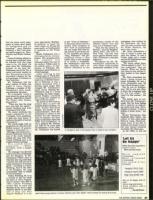
Jewish folkore group performs in Lithuania. Members sang "Hava Nagilah" without knowing the meaning of the words.
THE DETROIT JEWISH NEWS
37