

UP FRONT
For Some Palestinians,
Scud Strikes Too Close
GIL SEDAN
Special to The Jewish News
D
eir Balut, West Bank
—The Scud missile
launched from Iraq
on Monday night was
targeted at Tel Aviv, but it
exploded instead on the out-
skirts of this Arab village.
Saddam Hussein may still
be a hero to the Palestinians.
But it is doubtful that many
here still regard him as their
savior. They know too well
he might have been the
agent of their destruction
had the range of his missile
been a few hundred yards
longer.
It left its crater in an olive
orchard at the end of town,
near the front door of Taleb
Ali Abdullah, who lives with
his family in the southern-
most house in Deir Balut.
"We were lucky," 30-year-
old Abdullah admitted to a
visitor Tuesday morning.
"We feel the pain of those
who are victims of such at-
tacks."
One wonders. The young
man's attire was traditional.
He sported a short beard
that is a trademark of
Hamas, the fundamentalist
Islamic Resistance Move-
ment, whose followers are
generally the most zealous of
the intifada activists.
But he sounded genuine.
After all, God and Saddam
Hussein's erratic missile
launchers had allowed him
and his family to continue to
live.
"We heard a loud shriek,
then an explosion, and the
entire building was shak-
ing," Mr. Abdullah re-
counted. "We did not dare
"We feel the pain
of those who are
victims of such
attacks."
leave the sealed rooms until
the radio assured us that it
was not a chemical missile.
Then we looked outside and
we saw smoke coming from
the direction of the fields."
On Tuesday morning,
there was nothing more than
a huge • trench between the
orchard and a wheat field.
The missile fragments were
gone, probably scooped up by
Israeli army experts who
reached the site long before
the news media.
The fields surrounding Mr.
Abdullah's house were
deserted, as were the streets.
But it was not fear of a mis-
sile attack that kept
residents of Deir Balut and
every other West Bank
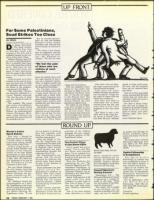
Artwork by Cathorow Kann, Co0Wch,
bY ib.Attotles Twos SynOcat e.
village and town indoors.
They are confined to their
homes by the curfew that
has been in effect in the ad-
ministered territories since
Jan. 17, the day war began
in the Persian Gulf. The
army is enforcing the curfew
strictly because the local
population supports Iraq.
For nights on end, Palesti-
nians have climbed to their
rooftops at the first sound of
the air-raid sirens. They
have chanted and rejoiced at
the knowledge that missiles
were landing in the heart of
the Jewish state.
After their close call Mon-
day night, some here may be
having second thoughts.
That does not mean
Saddam Hussein has become
any less popular. People are
not quick to argue with the
Palestinian consensus.
But they now have a
respectable fear of death
raining from the sky and
some idea of how their
neighbors to the west must
feel.
Deir Balut is only a few
miles east of the large Jew
ish towns of Petach Tikva
and Rosh Ha'ayin. Missiles
aimed at them could easily
fall here, and the residents
have not yet received their
gas masks.
They sit in their gas-sealed
rooms, praying that the next
missile does not strike here
and that it does not carry a
chemical warhead.
Nor does it seems likely
they still wait in happy an-
ticipation of another missile
attack on Tel Aviv. It is too
close •to home, and after
Monday night, they know
better.
❑
Jewish Telegraphic Agency
ROUND UP
Martyr's Ashes
Spark Debate
New York — Though he
died more than 45 years ago,
a Jewish martyr is causing
controversy among Jewish
labor circles in New York.
Arthur ,Zygielbaum, a
Jewish Labor Bundist and
member of the national
council of the free Polish
government in exile during
World War II, killed himself
in May 1943. His ashes are
now contained in an urn at
the Workman's Circle
Cemetery in New York.
But now Marek Edelman,
the only known surviving
commander of the Warsaw
Ghetto Uprising, has pro-
posed transferring Mr.
Zygielbaum's ashes to
Poland.
Mr. Edelman based his
recommendation on a letter
Mr. Zygielbaum wrote hours
before he died. Mourning the
. Jews just killed in the War-
saw Ghetto Uprising, Mr.
Zygielbaum wrote ; "It was
12
FRIDAY, FEBRUARY 1, 1991
not my destiny to perish as
they did, together with
them, but I belong to them
and their mass graves."
After his suicide in Lon-
don, Mr. Zygielbaum was
cremated and his ashes kept
at Golder's Green Cemetery
in England. Later, several
Jewish socialist and labor
organizations brought the
remains to New York.
Mr. Zygielbaum's son,
Joseph, told The Jewish
Forward he believes the
Jewish Labor Bund should
be part of any decision to
move the ashes.
Bund spokesmen say they
oppose taking Mr.
Zygielbaum's remains to
Poland. New York counts
"thousands of Arthur
Zygielbaum's comrades and
friends who will always
honor his memory," a Bund
Coordinating Committee
letter said.
Other Jewish organiza-
tions including the
Workmen's Circle and the
Forward Association,
publisher of the Yiddish
language Forverts, support
the Bund's position on Mr.
Zygielbaum's ashes.
in grades nine through 12.
Fiction, non-fiction, poetry,
prose and drama will be ac-
cepted.
For contest rules, write the
Holocaust Memorial Con-
test, 2000 L St. NW, Suite
588, Washington, D.C.,
20036.
The Perfect Place
To Get Some ZZZs
You've tossed and you've
turned. You've read War
and Peace and counted
sheep. You've watched Love
Boat reruns until 3 a.m. and
drank hot milk. But still you
can't fall asleep?
Then the Technion has
something for you. The
Technion Research and De-
velopment Foundation, in
cooperation with Hadassah
University Hospital, has es-
tablished a new sleep labor-
atory in Jerusalem.
About 15-20 percent of all
adults suffer from sleep
problems at some time in
their lives; of these, 5-7 per-
cent may need sleep treat-
ment, Technion researchers
say.
One of the most serious
sleep disorders is called
Baa baa black sheep, have you
any sleep?
apnea, caused by excess
tissues blocking the air
passage. To alleviate the
problem, Technion officials
have developed a mask- that
forces air into the lungs.
Council Sponsors
Writing Contest
Washington, D.C. — The
Holocaust Memorial Council
is sponsoring a contest for
youth on the topic "What
Are the Lessons of the Holo-
caust for Americans?"
The contest will be judged
in two divisions: one for
students in grades seven and
eight, and one for students
Syrkin Fellowship
Is Established
The Marie Syrkin
Fellowship in Letters has
been established in honor of
the late Marie Syrkin, a
poet, teacher and Zionist.
Open to all writers, the
fellowship includes a one-
month stay in Jerusalem's
Mishkenot Shaananim
neighbort.00d and transpor-
tation costs.
For an application, write
The Marie Syrkin
Fellowship, 1220 19th St.
NW, Suite 600, Washington,
D.C., 20036.
Compiled by
Elizabeth Applebaum