
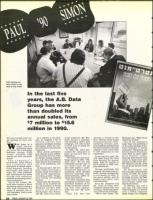

Staff meetings put
heavy stress on new
ideas to help clients.
In the last five
years, the A.B. Data
Group has more
than doubled its
annual sales, from
$7 million to $15.6
million in 1990.
We have tracked every sin-
gle mailing we have ever
done."
hat began as a
small, one-man
publishing house
has grown into a diversified
business serving 2,500
clients, including 1,200
Jewish and other non-profit
groups.
The company' -s
predecessor, Arbit Books,
was a publisher and
distributor of Jewish educa-
tional materials, including
text books and maps of
Israel. Mr. Arbit published
and distributed the books
through such traditional
methods as attending educa-
tional conferences.
Yet he felt limited. Mr.
Arbit knew success in direct
marketing meant creating a
data base containing the
names of potential and ac-
tual customers. And no such
base existed.
W
54
FRIDAY, JANUARY 25, 1991
As a sideline to his busi-
ness, he compiled a list of
Jewish schools and
educators and began mailing
information about his com-
pany directly to institutional
consumers.
Other Jewish publishers
took interest in his method.
He loaned the first list. Then
he started trading informa-
tion. A.B. Data (Arbit Books
Data) became the marketing
arm of the publishing com-
pany.
As demand grew, the com-
pany began providing a
broader range of services to
other Jewish organizations,
including graphic design,
print buying and mailing
services.
Meanwhile, Mr. Benjamin,
founder of the Coalition for
the Advancement of Jewish
Education and then head-
master for Boston's
Maimonides Day School,
met Mr. Arbit at an educa-
tional conference. Mr. Ben-
jamin became a customer,
and through a direct mail
campaign, A.B. Data raised
a record sum of money for
the day school.
In 1981, Mr. Arbit per-
suaded Mr. Benjamin to
pack up and join him in
Milwaukee.
"We realized we had some-
thing unique to offer," Mr.
Arbit says. "We not only
understood and felt part of
our client's work, but we
also could employ a multi-
disciplined approach to
marketing, which included
education, technology, mass
communications, public re-
lations and research.
"No other consulting firm
attempting to directly reach
individual members of the
Jewish community could br-
ing those tools together
under one roof," Mr. Arbit
says.
Today A.B. data also
operates a branch in Tel
Aviv. Between Great Lakes
Communications (tele-
marketing division), part-
time telephone solicitors and
the Israel subsidiary, the total
employee count comes close
to 500 employees at the
corporation.
In the last five years, the
A.B. Data Group has more
than doubled its annual
sales, from $7 million to
$15.6 million in 1990, com-
pany officials say.
Though profitable, the
company has faced some set-
backs, forcing management
to re-evaluate its style. It
has grown quickly, and its
leaders have taken some
risks that failed.
Even Mr. Benjamin and
Mr. Arbit at times have
wondered whether they were
running a shoestring opera-
tion on the brink of collapse.
"We've been lucky," Mr.
Benjamin says. "Most of our
ideas have worked."
One of the company's
major flops was producing a
co-op coupon package of pro-
ducts targeted to Jewish
consumers. Marketing the
Detroit-based Entertain-
ment Book in Israel didn't
prove fruitful, either.
Although they haven't made
money in Israel since open-
ing shop in 1984 in Tel Aviv,
Mr. Benjamin and Mr. Arbit
are not giving up their Israel
venture.
For Israel Cancer, A.B.
Data brought extraordinary
results. In 1985, the cancer
society raised roughly
$145,000 annually. By 1986,
through mass mailings,
Israel Cancer raised more
than $1.25 million.
In addition, just over a
year ago, A.B. Data found
itself entangled in a lawsuit
with a former employee,
Ralph Siegel, who allegedly