

.J1 tuj
PERSIAN GULF CRISIS
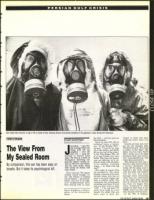
Gas masks have become a way-of life in Israel of late, drawing obvious and painful parallels to the gassing of Jews during the Holocaust.
FIRST-PERSON
STUART SCHOFFMAN
Special to The Jewish News
The View From
My Sealed Room
By comparison, this war has been easy on
Israelis. But it takes its psychological toll.
J
erusalem — Last Fri-
day evening, before the
sirens went off, my
neighbor — let's call
him Uzi — rang my
doorbell to borrow some
tapes. We were in a State of
Emergency following the
previous night's missile -at-
tack on Ibl Aviv and Haifa,
and the video stores, along
with nearly all others, had
been closed.
We're nervous. We expect
another attack tonight, we
say. My mother is feeding
my son dinner — she and my
father, who live in an adja-
cent neighborhood, have
been staying with us since
Stuart Schoffman is literary
editor of the Jerusalem
Report.
the 15th — and her eyes are
full of anxiety.
Come on, says Uzi, this is
milhemet luxus, a luxury
war. "In the Six-Day War,"
he says, "I was 16; we were
all in the shelter, and shells
fell on the roof of the school.
In the Yom Kippur War, all
of us had friends who were
killed. This time, the Ameri-
cans are fighting; we're sit-
ting at home, with the fami-
ly all together, watching
videos — so what's the big
deal?"
He's right of course, from
his perspective. For many
Israelis, veterans of far more
terrible times, this one, at
least in its early stages, has
been a relative relief. You
sometimes feel embarrassed
revealing your fears. It's not
that you don't want to seem
"soft" — I for one know I'll
never be as tough as a real
Israeli. It's rather that you
don't want to show dis-
respect to those who have
suffered more than you
have.
Israelis are born into war:
my son, for example. Like
Wordsworth said, "the Child
is father of the Man." My
father was two when World
War I broke out in his East
European back yard; maybe,
like nearsightedness, bad
times skip a generation.
This being my first war, I
feel but a step removed from
a Soviet immigrant who
walks off the plane and is
handed a gas mask along
with his juice and cookies.
Yet he, too, has been
through worse. Invariably
when they are interviewed
on the radio about landing
here in wartime, the Soviets
say they are happy they
came. Compared to what
seemed in store back in the
USSR, they'd as soon take
their chances with the Jews.
In the War of Indepen-
THE DETROIT JEWISH NEWS
15