

,tei tsi tle
t tO
Death Camp Records
Fill Family 'Dee Gaps
By MIRIAM WEINER
Although you may not be aware
of it, virtually every Jewish family
suffered losses during the
Holocaust. Sometimes the victims
were "distant" family members,
perhaps some even unknown to
you. For all of our ancestors who
came to America, there were the
cousins, brothers and sisters, aunts
and uncles who remained behind
and had children, many later to
become one of the six million
Jewish victims.
Although numerous published and
computerized sources exist for
documenting both victims and
survivors, the actual records
maintained in the various
concentration camps, ghettos and
annihilation centers are a seldom-
used source for the average
genealogist. These records consist
of documents, photographs and
detailed lists compiled from
transport data.
At the Majdanek concentration
camp site in a suburb of Lublin,
Poland, Mr. Edward Dziakosz is the
director of the national museum,
established in October 1944, which
maintains the remains of the camp
along with a permanent exhibition,
archive and various publishing
activities.
`The Files Of The
Auschwitz Museum
Contain In Excess Of 1.5
Million Index Cards —
Each Representing Just
One Document In The
Auschwitz Archives.
According to Mr. Dziakosz, after
the war, files consisting of 100,000
cards were found, arranged in
alphabetical order. The names
originated from transport lists,
clothing, hospital archives and
death cards. These cards include
name of victim, date and place of
birth, nationality and occupation,
date of death (or discharge) and the
source of reference. Some index
cards contain incomplete
information. Copies of documents
are provided upon request to family
members.
Requests for searches should
be sent to Krystyna Madalowa,
Panstwowega Muzeum at Majdanek,
Droga Meczennikow Majdanka 67,
Lublin 20-325 Poland.
The files at the Auschwitz
Museum contain in excess of 1 1/2
million index cards — each
representing just one document in
the Auschwitz archives. These were
cards on file of interest to fellow
genealogist, Gary Mokotoff, whose
family came from Warka, Poland. A
request was made for copies of the
documents described in the card
file. The documents, which arrived
in the mail about three months later,
contain detailed biographical
information for Mokotoff/Mokotow
family members from Warka
including transport numbers and
destination.
'The Recent Disclosure
By Tass Of Identity Cards
For Thousands Of
Auschwitz Prisoners
Provides Another Source
To Learn The Fate Of
Family Members — A
Source Previously Buried
And Virtually
Inaccessible In Soviet
Archives.
Upon receipt of a completed
inquiry form, the Auschwitz archive
personnel will search their records
and send copies of any documents
found, with no charge for the
research or the documents. Address
inquiries to: Panstowowe Muzeum,
32-603 Oswiecim, Poland.
The recent disclosure by the Tass
News Agency of identity cards for
thousands of Auschwitz prisoners
provides another source to learn the
fate of family members — a source
previously buried and virtually
inaccessible in Soviet archives.
According to Valentina
Fatyukhina, head of the Soviet Red
Cross research department, the
deaths of over 74,000 people were
neatly recorded, day after day, hour
after hour, in 46 huge volumes.
Their names, birth dates and the
names of parents were written
down.
The "death books" contained
detailed data of prisoners who
perished at Auschwitz-Birkenau,
with a full page devoted to each
victim listed including circumstances
of death and biographical
information. Previously, the material
was available only to a few
authorized researchers, primarily
government agencies, including the
Office of Special Investigations
(Washington, D.C.) which is best
known for its efforts in prosecuting
Nazi war criminals.
Famous Facts
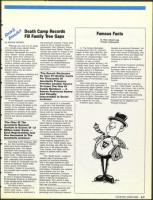
Q. How Jewish was
Fiorello LaGuardia?
A. The former Manhattan
became a practicing Protestant. Yet
Congressman (1917-21, 1923-33),
she married a Hungarian Jew with
mayor of New York (1933-45), and
whom she moved to Budapest. She
fighter for the rights of the under-
kept a kosher home and raised her
dog and the underprivileged, never
children as Jewish even while
thought of himself as a Jew.
continuing to attend a Protestant
However, he was of highly
church.
distinguished Jewish ancestry. His
She and her husband ultimately
mother, Irene Coen, born in Trieste
shared
the fate of millions of
in 1859, was the daughter of Fiorina
European
Jews of the 1930s and
Luzzatto, scion of a Sephardic
40s. They were imprisoned in a
Jewish family that produced
luminaries like Rabbi Moshe Chiam concentration camp where he
perished and from which she was
Luzzatto, Shmuel David Luzzatto
liberated by her illustrious brother
and an Italian Prime Minister, Luigi
Fiorello.
Luzzatti.
Irene Coen and her husband
It should also be mentioned
Archilles Luigi Carlo LaGuardia, a
that the "Little Flower," as the five
non-practicing Italian Catholic, came foot mayor was known, had a facility
to America in 1880. Although Irene
for languages. He spoke about
identified herself as a Jewess, she
seven of them well, including
was very Italian in culture and ran
Yiddish and was always extremely
her home as Italian. Strangely, Luigi popular with Jewish voters.
taught the children Hebrew prayers
out of respect for his wife.
Compiled by Dr. Matthew and
Fiorello's sister, Gemma,
Thomas Schwartz.
Miriam Weiner is a columnist and
lecturer specializing in Jewish
genealogy and Holocaust research.
THE DETROIT JEWISH NEWS
L-7