

Mr. Littmann says.
"Inflation eats into our
spending power."
The real problem, Mr. Lit-
tmann suggests, is that the
government cannot control
spending.
Mr. Littmann routinely re-
fers to government bu-
reaucrats as "bozos," blam-
ing them for implementing
policies that boost taxes and
hurt the economy.
"I see a lot of problems for
Michigan and the global
market," Mr. Littmann
says. "I always assumed
taxes would increase, but I
never thought George Bush
would renege. What is hap-
pening now will seriously
impair the U.S. in the global
market.
"The only way to overcome
problems is with good econ-
omic growth," Mr. Littmann
says.
In the last six years, Mr.
Littmann has outperformed
on the three major variables
of economic forecasting:
GNP, inflation rate and
prime lending rate.
One year ago, he forecast
the economy would be at 1.2
percent real growth, while
others projected 2 percent
growth. University of Mich-
igan economists projected
2.7 percent. Real growth by
the end of the year was mea-
sured at 1 percent.
"That's as close to a
bull's-eye as you can get," Mr.
Littmann says. "I don't
think it's luck."
His forecast deviation for
those three categories was
1.5 percent —closer to the
actual percentages than
most economists. Merrill
Lynch's deviation was 2 per-
cent and Prudential's was
3.1 percent.
Politically conservative,
Mr. Littmann has worked
for Manufacturers for 20
years — 17 years in the
economics department. Mr.
Littmann is a commentator
for the local media and a
regular guest on the lecture
circuit.
He is often interviewed on-
the-air by television
reporters. He is also an ex-
pert source for newspaper
journalists.
Friends and members of
the business community
often call on Mr. Litt-
mann to speak to groups,
and to get a few tips. Among
them are Awrey Bakeries
Chairman Robert Awrey,
builder Harold Beznos,
former Oakland County
Prosecutor L. Brooks Patter-
son, Michigan State Univer-
sity School of Business Dean
Richard Lewis and WXYZ
General Manager Tom
Griesdorn.
"We go to lunch and I pick
his brain and apply it to
business," Mr. Awrey says.
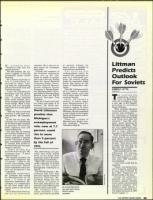
David Littmann
predicts that
Michigan's
unemployment
rate, now at 7.7
at Antioch College, he
hadn't given a thought to
economics as a profession.
Yet during his
undergraduate years, he
worked with economists as
part of a work-study pro-
gram. He started reading
works by economist Adam
Smith, best known for the
theory of laissez-faire capi-
talism.
Then Mr. Littmann enroll-
ed in a history of economic
thought course and read
every major book of classic
economic thought.
Later, he earned a
master's of science degree
from Massachusetts In-
stitute of Technology and a
master's degree in econ-
omics from the University of
Michigan. He also completed
a year of study at the London
School of Economics and Po-
litical Science.
Today, he is author of
Manufacturers Bank's mon-
thly newsletter, "Business
Continued on Page 46
percent, could
rise to more
than 9 percent
by the fall of
1991.
"His observations are gen-
erally very valid, almost
more on the mark than
anything I read in the news-
paper and get out of books."
MSU's Mr. Lewis has plac-
ed Mr. Littmann on several
panels for the school's
management conferences in
Detroit.
For WXYZ-Channel 7, Mr.
Littmann does more than
serve as a regular contact for
business reporters. Mr.
Griesdorn brings him into
the station on occasion to
brief sales associates on the
economic issues affecting the
Detroit media community.
Mr. Littmann wasn't
always interested in econ-
omics. And when he enrolled
An accurate track record
has made David Littmann
Detroit's premier
economist.
Littman
Predicts
Outlook
For Soviets
KIMBERLY LIFTON
Staff Writer
T
he outlook for
assimilation of Soviet
Jews in Michigan,
while not as bright as it was
a year ago, is still hopeful,
according to economist
David Littmann.
"With excellent education
in the basic skills — reading,
writing and arithmetic —
the acquisition of English
language skills should make
most Soviet Jews ideal raw
material," says Mr. Litt-
mann, senior economist for
Manufacturers Bank. "They
are very competitively pric-
ed and should be able to find
jobs in many industries
throughout the Midwest."
Even a moderate economic
slump should not prevent
most Soviet emigres from
finding entry level positions,
he says. "They have so little
to begin with that they ap-
preciate the freedom we
often take for granted."
Other predictions for 1991:
• Recession will continue.
Michigan's economy will
have contracted by 3 - 4 per-
cent when 1990 indicators
are completed.
• Auto sales could drop by
3 percent.
• State unemployment,
now 7.7 percent, could climb
to more than 9 percent by
fall 1991. Expected are
64,000 layoffs in the state.
• Losers are automotive,
chemical, real estate, con-
struction, upscale retailing,
luxury goods, entertainment
and travel industries. Even
children's music lessons, a
discretionary spending item,
will reflect the pinch on 1991
family budgets. 0
THE DETROIT JEWISH NEWS
45