

BUSINESS
BULL'S EYE'
Over the past two
decades, David
Littman's forecasts
have made him
Detroit's premier
economist.
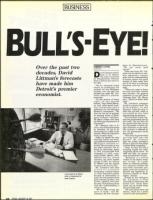
A dart board in his Detroit
office is inspirational for
David Littmann.
44
FRIDAY, JANUARY 18, 1991
KIMBERLY LIFTON
Staff Writer
D
avid Littmann doesn't
want to be famous.
The senior economist
for Manufacturers National
Bank of Detroit just wants to
be right.
Yet an accurate track
record on predicting the
outlook for the Michigan
economy over the past two
decades has made Mr. Litt-
mann Detroit's premier
economist.
"In the process of being
right, he has become
famous," says Justin Moran,
an Ann Arbor-based bank-
ing consultant and a
spokesman for the Michigan
Banker's Association. "He
does the best job of anybody
at keeping track of Mich-
igan's economic conditions.
He offers a better view than
the Michigan Department of
Commerce."
Mr. Littmann, born in Il-
linois, was always fascinated
by statistics. At age 6, he
memorized the names of the
planets. When he learned to
write, he kept a diary.
Today he spends his time
following trends and study-
ing historical annotations of
Michigan's business ac-
tivities. He also looks at how
the state's economy was af-
fected by Hurricane Agnes
in 1972, Chrysler-GM work
stoppages in 1976, reces-
sions of 1958, 1960-61, 1970,
1980-82 and the current
recession, the stock market
plunge of 1987, tax reforms
of 1986-87 and the August
invasion of Kuwait by Iraq.
Mr. Littmann uses such
events for economic
forecasting, a dismal science
in which researchers gather
mounds of information to
make the best guesses about
gross national product, real
growth, inflation and inter-
est rates. Forecasting is done
with the understanding it
will be wrong.
"We are often wrong, but
never in doubt," says Mr.
Littmann, 49, first vice pres-
ident for Manufacturers.
"We are never good
enough."
Those who know Mr. Litt-
mann say his ability to com-
bine experience, common
sense and an understanding
of human nature with great
masses of data make him
one of the best at projecting
business activity in the
state.
"When you want to know
the most up-to-date interest
rate forecast, the general
consensus is you call David
Littmann first," Mr. Moran
says. "David is better than
most."
Mr. Littmann compares
his job to a game of pool. The
government, or the
regulator, holds the stick to
shoot the cue ball, which is
surrounded by pool balls
representing the economy.
The economist closely wat-
ches the government aim for
the break. The cue ball will
hit another ball that will go
into the pocket or follow an-
other direction on the table.
The economy is affected by
how the government shoots
the cue ball.
"How does the government
get that ball into the
pocket?" Mr. Littmann
asks."It's pretty analogous.
Either it goes into the pocket
or off the table completely."
Today, he says, the ball is
bouncing around the table,
completely off the mark. "In
1990 and 1991, the govern-
ment scratched the cue ball.
"Recession is a serious
verdict on the state's econo-
my," he says. "It is predi-
cated on historical perspec-
tive, empirical evidence and
near-term economic pro-
spects, given the current tax
policies and legislative in-
itiatives adopted in Wash-
ington," he says.
Praised by his colleagues,
Mr. Littmann is often
criticized by politicians, like
former Gov. James Blan-
chard, for his candid disap-
proval of high taxes.
"We hear about taxes and
deficits, which are a smoke
screen for the real problem,"