

ZERO HOUR
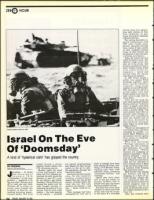
Israeli soldiers were on alert.
Israel On The Eve
Of 'Doomsday'
A kind of 'hysterical calm' has gripped the country.
INA FRIEDMAN
Special to The Jewish News
erusalem — In Israel
the morning of
January 1 5 th
—"Doomsday," in the local
parlance — appeared to be
like any other. Parents went
off to work and sent their
children off to school as
usual, even though the
headline in Haaretz, the
leading morning paper,
warned darkly that Iraq
411
FRIDAY JANUARY 18 1991
might launch a strike
against Israel before the
U.N. ultimatum ran out.
Monday night the mood
turned particularly grim
when the Civil Defense Au-
thorities formally issued the
directive to seal off a room
for use during a gas attack.
President Chaim Herzog ad-
dressed the public over the
radio Tuesday morning, in-
troducing the sense of a war
footing. And the army radio
station — the most popular
in the country — cancelled
all regular programming
and placed its best broad-
casters on the air to carry
the population through the
tense hours ahead.
And tense the hours surely
were, for the country's
leading commentators
agreed that war was all but
certain, probably before the
week was out. The only
question was whether — and
how — Israel would be in-
volved.
That message had been
anticipated for well over a
week as Israelis have been
busy sealing off rooms, wat-
ching civil-defense films,
regaling each other with
macabre jokes, planning
"Doomsday Parties," and
worrying.
Openly they worry about
how to get gas masks on
panicky children, how to
protect their pets, and where
the Iraqi missiles will fall.
Privately they worry about
whether, by some cruel trick
of fate, they may die, by gas,
in the heart of a sovereign
Jewish state two genera-
tions after millions of Jews
died, helplessly, by gas,
across the hostile landscape
of Eastern Europe.
The waiting inevitably in-
spired comparisons with
1967 when, totally alone,
Israelis agonized through
three weeks of high anxiety
as their neighbors massed
troops on their borders and
threatened, in the most gris-
ly of terms, to do them in.
Today the enemy lies over
1,000 kilometers away. The
effective range of his mis-
siles yet to be proven. And
he faces a coalition of close to
half a million troops armed
with state-of-the-art
weaponry — above and
beyond what the Israeli
army has in its arsenals.
In 1967 Israel fought a
public war: people filled
sandbags together, spent
I
days inside shelters
together, sang songs
together to ward off the fear.
This time the war will be a
private affair, with each
family closed in its own air-
tight room to cope with its
terror alone. 10
Until now the mood has
been what columnist Nahum
Barnea called an "hysterical
calm," as people went about
systematically preparing to
avert a horrific death. One
early instinct was to flee, es-
pecially since foreign na-
tionals were counseled to
leave the country and 10
airlines, daunted by
skyrocketing insurance
rates, began to cancel their
flights to Israel.
"There's an atmosphere of
war hysteria here, and we're
4
swamped by people," re-
ported Mark Feldman of a
Jerusalem travel agency
that caters to English-
p speaking clients.
Who was bolting?
"Foreign nationals, of
•4
course, but lots of Israeli
dual-nationals, too," said
Mr. Feldman. "Whole
families are snapping up
tickets to anywhere — Cairo,
Nicosia, Istanbul — just as
long as it got them out of
—4
here." Those too scared to sit
tight but too ashamed to
leave booked rooms in Eilat
to get out of the range of Ira-
qi missiles while keeping
their patriotism intact.
Most Israelis were staying
"4
put, however, and took to
shopping as a form of na-
tional therapy. Despite offi-
cial assurances that the
military threat to Israel was
almost marginal, sales in
supermarkets rose by as
much as 500 percent as peo-
ple readied themselves for a
long war.
After last weekend there