
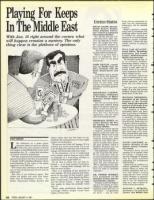

Playing For Keeps
In The Middle East
With Jan. 15 right around the corner, what
will happen remains a mystery. The only
thing clear is the plethora of opinions.
UNITED STATES
FOUAD AJAIVII, director,
Middle Eastern Studies,
Johns Hopkins Univer-
sity's School of Advanced
International Studies.
Nov. 29 (the date the U.N.
authorized force after Jan.
15) to the fifteenth is Bush's
time. He bought this time.
He committed himself to
prove that he had exhausted
every last chance for peace
. . . But he may have to show
our hand after the fifteenth.
Where we go from here, I
have no judgment. All I
know is that we are going
toward war.
JOHN DEVLIN, consul-
tant on Middle East Af-
fairs, formerly with the
State Department and
CIA.
If Saddam hasn't started
to pull out by the fifteenth,
the U.S. shouldn't do
anything. That's pinning too
much on one date. And
anyway, a bad case of nerves
and jitters would be good for
Saddam.
SHOSHANA CARDIN,
chairwoman, Conference
of Presidents of Major
American Jewish Organ-
izations.
The U.S. has to keep all its
options open without losing
sight of its specific objective,
which is that we can't per-
mit Saddam Hussein to re-
tain his full military
capability, and we can't
allow him to keep Kuwait.
SHOSHANA BYREN, ex-
ecutive director, the Jew-
ish Institute for National
Security (JINSA).
STAFF REPORT
L
ike kibbitzers at a poker game,
everyone seems to have an opinion
of what will, won't, should, or should
not happen in the Middle East as the world
approaches Jan. 15 — a date that has taken
on almost mythical proportions.
Will the American-led coalition arrayed
against Iraq fold in the face of a potential-
ly deadly bluff by Saddam Hussein, whose
understanding of the rules of the game
appears so very different?
Will Israel stay content to sit this hand
out, or will Jerusalem pull its own ace out
of the hole?
But this is no ordinary game. The
stakes are global and each chip repre-
sents tens of thousands of lives — or-
dinary Americans, Iraqis, Israelis and
32
FRIDAY, JANUARY 11, 1991
others whose fate has left them to con-
template the consequences of what might
happen in coming days.
No one can say what will happen. If it is
written, it is as yet unrevealed. If it is yet
to be decided, then the free will of those in
charge will determine what is to come.
In the meantime, we try to understand
every nuance and we hang on every shift
in emphasis in a frustrating attempt to
understand what might befall us.
So we turn to those who are best in-
formed — or at least present themselves
as such — hoping their message will be
what we want to hear.
Here is a sampling of the opinions of
such experts. All were asked to put them-
selves in the place of this drama's major
players — the U.S., Iraq, Israel, the Euro-
pean Community, the United Nations
and the Soviet Union — and say what
they might do when the calender reads
Jan. 15.
Some made predictions. Some issued
warnings. Others simply voiced their
hopes, or their fears.
I'd strongly advise against
a massive, armored frontal
assault on Kuwait after the
fifteenth. What if we do get
Kuwait back? The cost
would be tremendous, there
would be very little left —
and we wouldn't have solved
the basic problem, which is
Saddam Hussein and his-
ability to go to war again.
One possibility would be to
go into Iraq from the north.
Or we could start with our
air force knocking out Iraq's
communications and missile
sites and factories as we
issue the next ultimatum:
`We've destroyed your mis-
siles, your communications.
Now it's time to seriously
negotiate.'
DR. CEDRIC SUZMAN,
vice president of the
Southern Center Interna-
tional Studies, Atlanta.
Tuesday is just the beginn-
- ing of a new phase, it's not a
deadline as such. My under-
standing is that after Jan. 15
"all means" — a euphemism
for force — can be used.
Force will not necessarily be
used, but the international
community will be entitled
to use it.
Bush's rhetoric sounds
stupid and ill considered, but
anything softer would seem
to condone the situation or
seem as if we would tolerate
anything except complete
withdrawal. I think the dip-
lomatic activity is going to
continue.
WILLIAM QUANDT,
senior fellow, Brookings
Institution and former
Carter Administration
Middle East specialist.
We shouldn't treat Jan. 15
as an automatic deadline.
Something doesn't need to
happen the next day. All it
means is that after the fif-
teenth, there is an interna-
tional consensus that would
allow military action.
But military objectives
must be determined in com-
plete terms. In starting any
armed operation, you must
know how you want to end
it.
And the most important
thing: If at the last minute
Saddam Hussein blinks and
backs down, I'd let him.
MICHAEL DRISSMAN,
president of the Detroit
chapter of the Jewish
Idea, which advocates the
removal of all Arabs from
Israel and the territories.
The question is whether
President Bush has been
able to get Iraq to withdraw
from Kuwait either in total
or partially. If Iraqi troops
are partially withdrawn
from Kuwait, Bush may try
to strike a deal to avoid war.
If Iraq has not withdrawn
from Kuwait, Bush must at-
tack on Jan. 15. The Presi-
dent must stick to his word.
The minute Bush goes back
on his word, the whole thing
is up in the air again.
DAVID GAD-HARF, ex-
ecutive director of the
Detroit Jewish Commun-
ity Council.
President Bush should
continue to do exactly what
he is doing — trying to con-
vey the message to Hussein
that he means business
regarding his withdrawal
from Kuwait.
Some form of warfare is a
distinct possibility. I would
pursue efforts to settle the
conflict peacefully, but in a
way that doesn't involve
negotiations that would
enable Hussein to basically
retain portions of Kuwait,
and to use the Palestinian
issue as a way to divert at-
tention from the conflict.
STEVEN L. SPIEGEL,
professor of political
science and Middle East