

THEE
Demjanjuk Case
C
ontroversy about Soviet-supplied evidence and
OSI's methods has also swirled around the
case of John Demjanjuk, the Ukrainian im-
migrant and retired Cleveland autoworker accused
of being a sadistic guard at Treblinka. He was
deported to Israel in 1986, found guilty and
sentenced to death. The sentence currently is under
appeal.
Critics of OSI say that evidence exonerating Mr.
Demjanjuk was withheld from his defense by the
Justice Department. Specifically, numerous
Treblinka survivors interviewed by OSI couldn't
identify Mr. Demjanjuk as the camp guard known
as "Ivan the Thrrible." In addition, the critics say,
Mr. Demjanjuk's wartime I.D. card, furnished by
the Soviets, was kept from full examination by the
Demjanjuk attorneys. From what is known about
the card, it isn't at all clear that it is genuine or
even identifies Mr. Demjanjuk, his supporters say.
"I'm convinced they have the wrong guy," says
attorney William Wolf, a Jewish activist in Phoenix.
Mr. Wolf didn't represent Mr. Demjanjuk, but he
has become a forceful opponent of the OSI's
methods and a campaigner for American prosecu-
tion of war crimes.
Mr. Sher rejects the criticisms, asserting that the
Demjanjuk defense team "knew all about those [ex-
onerating] witnesses," he says. "The fact that some
witnesses couldn't identify him doesn't make any
difference."
Mr. Sher declines to discuss the Demjanjuk case
in detail because it is still pending in the Israeli
courts. But OSI officials maintain that because of
the drawn-out proceedings necessary for
denaturalization and deportation, which involve
many levels of the judicial system and have
sometimes gone as far as the Supreme Court, Mr.
Demjanjuk and other defendants receive adequate
protection from superficial prosecution. These of-
ficials note that the courts have ruled in OSI's favor
SE ARCH
demand is only a ploy to slow down his office's work
or end it entirely, but the critics reply that the pro-
cedures could hardly take any longer than they and
now (There are seven different levels of judicial ap-
peal that can be used in denaturalization and depor-
tation cases).
The emigre groups haven't garnered much sup-
port. The American Civil Liberties Union — which
came under fire for its defense of the First Amend-
ment rights of American Nazis — hasn't shown in-
terest in the question of OSI's procedures. "We've
really steered clear of it," says Loren Siegel, special
assistant to ACLU Executive Director Ira Glasser.
"We think the [OSI] investigations are done careful-
ly. When prosecutions are done, it's with sufficient
evidence."
The emigre groups did succeed in meeting in 1987
with Attorney General Edwin Meese, who asked
an aide to look into the option of prosecuting al-
leged Nazis for criminal violations.
The Meese aide, public liaison director Joseph
Morris, studied the question until he and Mr. Meese
left the Justice Department in the summer of 1988.
"Time ran out," Mr. Morris says, explaining that
he reached no definite conclusions. His successor,
Barry Stern, isn't pursuing the matter and the cur-
rent Attorney General, Dick Thornburgh, hasn't in-
dicated any special interest in the subject.
But Mr. Morris says that the outcome of some
cases, like handing over Karl Linnas to the Soviets,
was "morally troubling?' And he believes that "cer-
tain aspects of the [OSI] cases could be criminalized
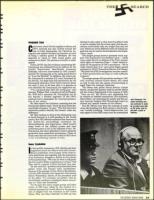
John Demjanjuk: The
retired Cleveland man
was sentenced to death
by an Israeli court after
an OSI probe ruled he
had been a guard at
Treblinka.
in the overwhelming majority of cases.
Heavy Symbolism
I
n their public statements, OSI officials and their
supporters invest the office's work with extraor-
dinary symbolism, even if many of the cases in-
volve individuals who arguably lack the importance
of an Eichmann, Mengele or Barbie in the scheme
of Nazi persecution. "We must do what is still possi-
ble, lest we give Hitler a posthumous victory," Neil
Sher said in a speech in West Germany last year.
He also said that "problems [of prosecution] have
gotten worse and become more troublesome"
because of the passage of time. Martin Mendelsohn,
a former OSI attorney who represents Nazi-hunter
Simon Wiesenthal, admits of the procedure used
by the office: "It's certainly not perfect." But he
nevertheless condemns complaints about due pro-
cess as "false and fraudulent."
For the past few years, emigre groups and other
critics of OSI have called for the creation of a
criminal statute that would allow for the prosecu-
tion of alleged Nazi war criminals in the United
States. Sher and other defenders of OSI say this
THE DETROIT JEWISH NEWS
23