

HEALTH
Speec h Odyssey
RONELLE ROSENTHAL GRIER
or Belinda Bray of
Grayling, Michi-
gan, giving her
daughter the pro-
verbial "apple-a-
day" turned out to be more
difficult than she expected.
Alicia, now 3 years old, has
a severe speech disorder calk
ed apraxia, which rendered
her incapable of talking in-
telligibly. Thanks to William
Beaumont Hospital in West
Bloomfield, Alicia is well on
her way to normal speech
development.
Although she left her Grayl-
ing home and husband behind
with a healthy amount of fear
and reservation, Ms. Bray has
never had a second thought
since Alicia began the Aprax-
ia Program With Language
Experience.
"They're miracle workers,"
she said. "When she started,
Alicia could only say 17 words,
and within the first week, she
had 55 word approximations."
Apraxia is a motor problem
characterized by an inability
to coordinate the oral
movements necessary to pro-
duce intelligible speech
sounds. In many cases, the
apraxic child has no other
developmental problems, al-
though some children will ex-
hibit awkwardness in their
other fine and gross motor
skills.
According to Carole Goff,
director of Children's Services
for Beaumont Hospital's
Speech and Language Pathol-
ogy Department, apraxia is
"the most misdiagnosed,
misunderstood and misman-
aged childhood speech prob-
lem." She believes it is much
more common than people
realize because it is often
mistaken for other problems
such as hearing loss, mental
impairment and even autism.
The APLE program began
unofficially more than 15
years ago, when Ms. Goff
started applying to children
the same rehabilitative
techniques used on adults who
had lost their speech abilities.
When these early treatment
sessions resulted in "progress
in small doses," Ms. Goff
began a more intensive trial
IF
Ronelle Grier is a Detroit
area writer.
72
FRIDAY, DECEMBER 28, 1990
program that involved six
hours of weekly therapy for
each child. "The results were
astounding; the changes in
the children were amazing,"
said Ms. Goff.
Today, the Beaumont facili-
ty in West Bloomfield operates
the only program of its kind in
the country, designed
specifically for the treatment
of apraxia.
News of the APLE program
and its extraordinary success
came to Belinda Bray at a
time when she was ready to
try just about anything to help
Alicia. A school social worker
in a comparatively rural area,
Ms. Bray had done much of
her own research to come up
with the cause of Alicia's
problem.
At one point, Ms. Bray was
referred to Ilse Schwartz, a
speech pathology professor at
the University of Oregon.
After Ms. Bray described
Alicia's condition to her over
the telephone, Dr. Schwartz
sent her a series of articles on
apraxia.
"I read the articles, and I
cried," said Ms. Bray. "I said,
`this is my daughter.' "
After Ms. Bray presented
her findings to officials in the
Grayling school district, Alicia
was evaluated and qualified
for speech services through
the school system. A therapist
drove 30 miles to visit Alicia
at home twice a week, but Ms.
Bray felt the treatment was
insufficient for the severity of
Alicia's problem.
Around this time, Ms. Bray
read a newspaper article
describing how the APLE pro-
gram had dramatically helped
a child whose symptoms
sounded similar to Alicia's.
But coming the 200 miles to
Detroit from Grayling was a
problem. Besides having to
leave her husband, Jim
Lawless, and her home for
almost four months, money
was a big factor. In addition to
the cost of the therapy pro-
gram, only part of which is
subsidized by insurance and
the Grayling school district,
there were rent and other liv-
ing expenses. Ultimately, feel-
ing this was her last chance to
help Alicia, Ms. Bray decided
to use her retirement funds to
pay for the program.
Photos by Gle nn Triest
Special to The Jewish News
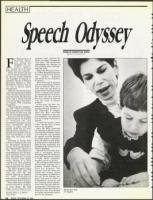
Belinda Bray helps
her daughter.