

FEELING GOOD
aimisa•sanso.••••as•••
II ■ ■ ■ ■ ■ ■ ■ ■ ■ qi
NANCY PAPPAS
Special to The Jewish News
D
inner at the psychiat-
ric hospital featured
chicken livers. A few
hours later, a half-dozen pa-
tients complained of splitting
headaches. Their blood pres-
sure had shot up to alarming
levels. An investigation turn-
ed up an unlikely conflict: the
patients were all taking anti-
depressants, drugs that inter-
fere with the system's normal
breakdown of tyramine — a
substance plentiful in
chicken livers that can turn
nasty if it builds up unme-
tabolized in the system.
After she'd suffered a blood
clot in her lung, a middle-
aged woman was sent to see
Sanford J. Kempin because
the medicine she was taking
to prevent further clots didn't
seem to be working. Kempin,
a blood specialist at Memori-
al Sloan-Kettering Cancer
Center in New York City,
soon discovered the woman's
problem. "She ran a
restaurant upstate, and every
day she'd stop by and have a
bowl of broccoli soup and a
raw broccoli salad," he re-
members. Her medicine work-
ed by reducing blood levels of
vitamin K, which aids in clot-
ting, but the unusually large
amounts of vitamin K-laden
broccoli she ate literally
canceled out the medicine's
effect.
A retired internist was en-
joying a glass of red wine at
a dinner party when his face
suddenly turned bright red
and he felt nauseated. Anoth-
er guest, a pharmacologist,
made the connection. The
man's oral diabetes medicine
was keeping his system from
metabolizing the alcohol
properly. The accumulation
gave the man early symptoms
of alcohol poisoning.
As these folks discovered
the hard way, food and drugs
don't always mix well. What
you eat or drink can impair or
completely wipe out the effec-
tiveness of otherwise useful
drugs. Conversely, drugs can
have unwelcome effects on the
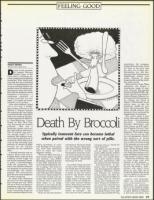
Death By Broccoli
Typically innocent fare can become lethal
when paired with the wrong sort of pills.
body's processing of nutri-
ents. Perhaps it's not surpris-
ing, since both substances
have to share the same
digestive system.
"Food can affect how fast a
drug breaks apart and goes
into solution," says Jeffrey
Blumberg, assistant director
of the Tufts University Hu-
man Nutrition Research Cen-
ter on Aging. "Also, food can
physically block the drug
molecules from getting to the
wall of the gut where absorp-
tion occurs. Aspirin takes five
to 10 times as long to be ab-
sorbed when taken with food
or shortly after a meal than
when taken on an empty
stomach. It can mean the dif-
ference between getting rid of
your headache in half an hour
or three hours."
Those are just the physical
interactions. Particular foods
can also interact chemically
with certain drugs. If the fam-
ily of antibiotics called
tetracyclines encounter calci-
um in the stomach, for exam-
ple, the drug and the calcium
bind together chemically,
canceling out both.
In an ideal world, any time
you got a new medicine some-
one would alert you if it didn't
mix well with a specific food
or drink. In the real world,
however, this doesn't always
happen. Physicians may
simply forget to bring up the
subject or may not realize you
have some unusual dietary
habits. Some drugs come with
advisory labels from the phar-
macist — "Take only with
meals," for example — but
have you ever seen a detailed
warning such as "Avoid too
much broccoli?"
So, before you pop that pill
and go about your daily
meals, coffee breaks, cocktail
hour and snacks, here are a
few facts you should know
about some common drugs
and their interactions with
the contents of your stomach.
Anti-depressants. A par-
ticular type of anti-depres-
sant, the monoamine oxidase
inhibitors (Marplan, Nardil
and Parnate are common
brand names), can have po-
tentially disastrous effects if
the drugs meet up with the
amino acid component tyra-
mine. Present in chicken liv-
ers, tyramine is also found in
chocolate and in foods that
have been aged or fermented,
including Chianti wine, aged
cheeses, beer, pickled herring,
sauerkraut, dry sausages,
smoked fish and meats. If you
eat these at the same time
you take one of these anti-
depressants, you risk dan-
gerously high blood pressure,
palpitations, nausea, even
stroke. Patients on these
drugs should avoid the forbid-
den foods, period.
Blood pressure drugs. These
substances also present a
treacherous range of reac-
tions with food. The thiazide
diuretics (HydroDIURIL, Hy-
groton, Zaroxlyn) and loop di-
uretics (Bumex, Edecrin, La-
six) help lower blood pressure
by ridding the blood of
sodium. Unfortunately, as the
sodium goes, so may the
potassium needed by your
heart, cells and muscles. Your
doctor should monitor your
potassium level and prescribe
supplements if necessary.
Now, here's where it gets
tricky. Some other blood pres-
sure drugs — the combination
diuretics (Aldactazide,
Dyazide, Moduretic) and
those known as ACE inhibi-
tors (Capoten, Prinivil, Vaso-
tee) — block this potassium
depletion. With these drugs,
in fact, you can end up with
too much potassium, which is
also dangerous to proper
heart function. You can get
into trouble with these drugs
if, for example, you use a salt
substitute containing potas-
sium. Before doing so, check
with your doctor. Potassium-
rich foods like bananas won't
cause problems as long as you
limit yourself to a few a week.
Tetracycline antibiotics. Just
as these drugs bind with
calcium in the stomach —
leaving very little drug left
for you, the patient — tetra-
cyclines also attach them-
selves to iron. Stay out of
trouble by taking these drugs
one hour before, or two hours
after, meals or vitamins.
Aspirin and ibuprofen.
These two over-the-counter
anti-inflammatory
painkillers are notoriously
hard on the stomach lining.
(You may recognize ibuprofen
as Advil, Motrin or Nuprin.)
A dose here and there, even
THE DETROIT JEWISH NEWS
F7