

ISRAEL
Drought In Land
Of Milk And Honey
Lack of rainfall and an exploding
population threaten to turn Israel
back into a desolate, water-less desert.
INA FRIEDMAN
Special to The Jewish News
A
millimeter of mud-
like rain fell in Israel
on a recent Thursday
night. Still, it was enough to
make headlines, because
although it has yet to be offi-
cially announced, the coun-
try is in the throes of a
double drought.
By mid-December, the
winter rains — which usual-
ly begin in October —had yet
to begin. Thousands
gathered at the Western
Wall twice in recent weeks
to pray for rain, yet the days
remained dawn blue and
cloudless.
With the country's water
reserves at an unprecedented
low, the minister of
agriculture has issued
apocalyptic forecasts that
could signal the death knell
for the country's agricultural
sector.
Already, there are plans to
declare a state of emergency
and cut water allotments by
25 percent.
But the worst-case
scenario — provided by
American water experts — is
that unless the heavens open
soon, and do so on schedule
for many years to come, the
Middle East may well find
itself at war over water
rather than oil.
The potential volatility of
the water issue was
underscored recently when
Prime Minister Yitzhak
Shamir proposed regional
talks on water-sharing, link-
ing the issue to the question
of Middle East arms reduc-
tion.
One drought plaguing
Israel is "hydrological,"
meaning the nation's
natural reserves contained
in the Sea of Galilee and
underground aquifers are
way down. The second
drought is "agricultural,"
which is what the experts
call a simple shortage of
timely rainfall.
Under the best of cir-
cumstances, Israel is not a
Ina Friedman writes from
Jerusalem.
rain-rich land. And after a
number of years of below
average precipitation — dur-
ing which the population has
grown dramatically due to a
combination of Jewish im-
migration and the Arab bir-
th rate — Israel finds itself
with a water deficit of two
billion cubic meters, the
equivalent of more than a
full year's consumption.
The Sea of Galilee, the
country's main water reser-
voir, is at its lowest point
since measuring began 60
years ago. In an emergency
measure, the government
has halted the pumping of
water out of the lake
through the elaborate
system known as the Na-
tional Water Carrier, which
transports water southward
to help irrigate crops and
replenish the country's
water table.
That decision is already
changing the face of the
Unless the heavens
open soon, and do
so on schedule for
many years, the
Middle East may
find itself at war
over water rather
than oil.
countryside. The crops and
orchards in the Jezreel
Valley, Israel's bread basket
and the home of its veteran
kibbutzim, stand in danger
of drying up. The winter
sowing season is fast ap-
proaching, and much of the
valley has been plowed.
But without rain, farmers
see little point in attempting
to plant wheat and other
field crops. In fact, if it
doesn't rain soon, much of
the agriculture in this rich
and profitable region will
probably be written off as a
loss, and the situation is no
better as one moves
southward to the more arid
parts of the country.
Meanwhile, the Sea of
Galilee, a lyre-shaped splot-
ch of light blue nestled
among greyish, brown-
colored mountains, con-
tinues literally to vanish
into thin air as it loses one
million cubic meters of
water to evaporation each
rainless day.
On the lake's western
shore, the waterline has
receded a dozen or so meters,
forcing swimmers to pick
their way through sharp
black rocks to get to the
water. On the eastern shore,
the waterline has receded
more than 100 meters in
some places, exposing un-
sightly mud flats that drive
away tourists.
To the north, where the
Jordan River normally
comes cascading into the
lake, the river's slimy, dark-
green water moves along
sluggishly, but at least it's
moving. In the south, where
the lake feeds back into the
river, the current has halted
altogether, reducing the
legendary Jordan at that
point to little more than a
stagnant pool.
And there is nothing to be
done about these sad sights.
"We're completely depen-
dent upon the weather," ex-
plained Agriculture Min-
ister Rafael Eitan. "You
can't influence it in any way.
The only solution is to stop
using water."
When Mr. Eitan says stop
using water, he means cut
back drastically the amount
of water allotted for
agriculture. Israel devotes
two-thirds of its annual
allocation of water (1.3
billion cubic meters) to
agricultural purposes, while
charging farmers a fourth of
the price charged city
dwellers.
One crop known to be a
guzzler — cotton — has been
cut back by as much as a
third, even though the price
it brings on world commodi-
ty markets is currently high.
Citrus, on the other hand —
the very symbol of Israeli
agriculture — has not been
reduced, even though its
market value is presently at
a low.
It takes about half a
bathtub of water to grow one
orange. That may pose no
problem in Spain or Florida,
but in Israel, given present
18
.1,
• III
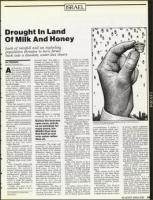
Artwork from the Los Angeles Times by Richard Milholland. Copyright c 1988, Richard Milholland.
Distributed by Los Angeles Times Syndicate.
circumstances, it places a
great question mark over
this veteran branch of the
nation's agriculture output.
The most pressing issue,
however, is not how to re-
adjust the emphasis in
Israeli agriculture, but how
to ensure that the popula-
tion will have an ample
supply of drinking water.
According to a report by
American water expert Dr.
Joyce Starr, the Jordan
River and surrounding
water sources have been so
heavily taxed that, at the
current rate of consumption,
Israel and the West Bank
will deplete all their re-
serves within the next four
years.
Most critical of all is the
situation in the Gaza Strip,
which Dr. Starr has de-
scribed as a time bomb "that
may explode at any moment,
leaving a million people
without water."
Actually, the Israeli
government has been aware
of this problem for some
time. In the summer of 1987,
a report drawn up by a team
of Israeli experts explained
that as the Gaza population
increases (its present annual
growth rate is 4.3 percent),
sea water will increasingly
penetrate the local water
table, eventually rendering
its yield unfit to drink. That
would force Israel to supply
the Strip from its own over-
burdened resources.
Along the rest of the coast,
the dwindling aquifers have
periodically been tainted by
sewage, causing such high
bacteria counts that Israelis
are periodically ordered to
boil their drinking water.
However, despite the great
alarm in Israel, no one is
talking about rationing
drinking water. And in the
meantime, various ideas for
coping with the shortfall are
being bandied about.
Some are more
imaginative than others,
such as the notion of impor-
ting water from Turkey in
huge plastic bubbles that
would be towed over the
Mediterranean. The idea has
been discussed with Ankara,
but the need to build special
THE DETROIT JEWISH NEWS
3