

TRAVEL
SUPER HOLIDAY
SPECIAL
‘2 So o
BROKEN WINDSHIELD
SAVE $25.00
• When you pay cash/or off your deductible • Must be replaced in shop
• Domestic cars only
4300
PURITAN AUTO GLASS
Offer Expires 1/1/91 — By Appointment
$ 5000
OFF ANY DEDUCTIBLE
On Collision Over $500.00
Conditional FREE Loaner Car — Please present ad with order
FREE RUB-OUT with any collision job over $50000
10 YEARS' EXPERIENCE — BODY REPAIR — PAINT WORK
• Corvette & Mustang Specialists • Insurance Claims • Touch Ups
Puritan
Auto Service
355-1200
Lenny's
Body Shop
357-3020
ALL
WORK
GUARANTEED
21545 Telegraph
.111 , t South of Nine '. ■ tile
\t-ti S a.m.-5 p.m. Sat. S a.m.-Noon
4.1.-
N1-1:
a.m.-5 p.m., sat. S a.m.-noon
I
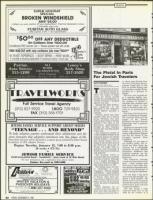
A Jewish bookstore in the Pletzl.
The Pletzl In Paris
For Jewish Travelers
RUTH ROVNER
Special to The Jewish News
T
ILAN/ E ILWO
Full Service Travel Agency
(3'13) 827-9920
1.800 729-9820
FAX (313) 355-170'1
JEWISH FAMILY SERVICE SUPPORT GROUP SERIES
"TEENAGE . . . AND BEYOND"
To help adoptive parents understand their adolescents and the
extra pressures that adoption introduces into this phase of life.
These issues and more will be discussed in a support group conducted by Esther Krystal,
Coordinator of J.F.S. Adoptive Services.
Begins Tuesday, January 15, 7:00 to 8:30 p.m.
10 weeks • $75 Fee
At
JEWISH FAMILY SERVICE
24123 Greenfield Road • Southfield • (Just south of 10 Mile Road)
For more information and a registration form, please contact
Esther Krystal at 559.1500
1
(
: SC HECHTER S
Cu)
( (;t A 1 f
2 Hours More of
Sunstune doily
YOUR HOME AWAY FROM HOME
Reserve Now For Your
WINTER VACATION &
PASSOVER HOLIDAYS
Pliniir i(Hi I Hi [ 1-800-327-8165
111! ,. ,• f)(
1
1 1,
11, 110,1 1 1,
/it;
18111 'A f.1nlllll ke()(
SCHECHTER FAMII Y Management
52
FRIDAY, DECEMBER 21, 1990
YOUR CAR IN ISRAEL
eidan MN
It PERWEEK
RENT-A-CAR
FROM
'EXCCD
6PAI
M31 mmnn
—
Whited Et
Monthly Rates from $750
incl. C.D.W.
USA & CANADA
RESERVAT & PREPYMNT
800-533-8778;
IN NY: 212-629-6090
VALID 1/11-19/12/90 AND 7/1-15/3/91
he monument is stark:
a simple circular struc-
ture of gray marble, on
which the names of death
camps are clearly printed
around the circumference. A
wreath of flowers is propped
against one side.
Against the light of Paris,
the simplicity of the
Memorial to the Unknown
Jewish Martyr provides a
contrast.
Visitors stand and stare
silently. They are a diverse
group: Parisians who have
come to pay tribute to family
members who died in the
Holocaust; schoolchildren
brought by their teachers;
tourists who visit this symbol
of the past.
This memorial, located at
17 Rue Geoffroy 1'Asnier, is an
important stop for any Jewish
traveler to Paris — a reminder
that Jewish history here is
linked to the terrible years of
the Holocaust when part of
France was under Nazi oc-
cupation and thousands of
French Jews were rounded up
and deported.
The museum which is
located at this site is another
reminder of history. Although
it is a modest building, its
rooms are filled with displays
that bring history to life.
The display cases, all neat-
ly identified in three
languages — French, English
and Hebrew — begin with the
early persecution of the Jews
of France. They show pro-
clamations, telegrams, news-
paper articles, all giving the
visitor the sense of impending
danger.
Other displays are re-
minders of the Jews who suf-
fered and often perished in
the camps, particularly Dran-
cy, where many French Jews
were sent. One photo shows a
prisoner being shot in the
back. In another display case
is a primitive wooden Torah,
sculpted by a prisoner at
Drancy.
The worn, torn rag dolls are
in a separate display case.
These were dolls belonging to
the children of Drancy, a
reminder that children once
held these objects as they
tried to maintain some nor-
malcy in an environment of
horror.
But along with the horrors,
there is evidence of heroism.
The museum follows all the
stages of the French
Resistance as it grew from its
beginnings into a powerful
movement.
Displays are devoted to the
rabbis who resisted, to the
women who resisted, to the
names of Resistance fighters
and the key events in the
struggle against Nazi
occupation.
Although it's not open to
the general public, the ar-
chives one floor below the
museum are a remarkable
collection of some 600,000
documents. Professors and
graduate students use the
resources here to study the
Holocaust.
The collection includes
records and documents of all
sorts — from receipts that
Jews had to sign when they
were forced to surrender their
money to the photograph of
Hitler wearing his eyeglasses.
"It was kept a big secret
that he had bad eyesight," ex-
plains a staff member. "He
almost never wore his glasses
because the Aryans were sup-
posed to be so 'pure' and have
no physical defects."
She also brings a huge
loose-leaf book over to the
table by the window. It is