

BACKGROUND
HELEN DAVIS
Foreign Correspondent
A
s the Gulf crisis
moves toward its
final outcome,
Israel's military and polit-
ical analysts believe there is
a high probability that
Iraq's President Saddam
Hussein may seek to sudden-
ly and violently change the
terms of the debate by laun-
ching a missile strike on
Israel.
The vituperative anti-
Israel rhetoric that con-
tinues to emanate from
Baghdad — last week's
renewed threat to destroy
Israel, the insistence on
placing the Palestinian issue
at the top of any agenda of
talks — are interpreted as
signs that the Iraqi leader is
laying the foundations for an
attack against Israel.
According to Professor
Amatzia Baram, Israel's
foremost specialist on Iraq,
there is "a real possibility"
that Iraqi President Saddam
Hussein will lash out at
Israel if he becomes convinc-
ed that a United States-led
strike is imminent and that
he has no chance of survival.
Saddam's strategy, says
Prof. Baram, will be to turn
his weapons on Israel in a
last-minute bid to break up
the Western-Arab military
coalition ranged against him
and to convert the Gulf crisis
into a full-scale Arab-Israeli
war.
Such an act would have
the likely effect of neutraliz-
ing the Arab component in
the Gulf military alliance
and of marginalizing the
United States forces, which
are not expected to intervene
actively in an Arab-Israeli
conflict.
The Iraqi leader must cer-
tainly be aware that such a
move would entail extreme-
ly dangerous consequences
in terms of Israel's response,
says Prof. Baram, but in cer-
tain circumstances, "he
might consider it less
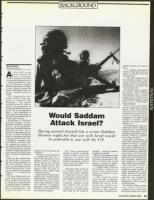
Would Saddam
Attack Israel?
Having painted himself into a corner, Saddam
Hussein might feel that war with Israel would
be preferable to war with the U.S.
dangerous to strike than not
to strike."
"Forced to choose between
a withdrawal and war, I
believe he will initiate a war
against Israel in order to
avoid facing the United
States. He must know that
he will suffer, but he may
prefer to pay the price in
military terms rather than
in political terms."
Israeli sources believe that
Saddam may initially deploy
high-explosive conventional
warheads against Israel,
rather than missiles armed
with chemical or biological
payloads, in the expectation
that Israel will respond with
conventional weapons.
The Iraqi conventional
armory is known to include
cluster bombs, which are
capable of inflicting
substantial casualties, and
fuel-air explosives, each of
which has the effect of a
small nuclear device.
"The basic idea would not
be to destroy Israel," accor-
ding to one source, "because
he (Hussein) knows this
would lead to Iraq's destruc-
tion. Saddam is aware that if
he uses chemical or
biological weapons, Israel
will respond with nuclear
weapons. In such cir-
cumstances, he might decide
that such an act would be
suicidal — and he is neither
stupid nor suicidal."
Rather, his strategy would
be to suck Israel into a long,
draining conventional con-
flict in which Iraq would
possess a number of impor-
tant strategic advantages:
• Unlike Israel, Iraq has
formidable resources in
terms of men, materiel and
money to sustain a pro-
tracted war;
• The Iraqi Air force
would be able to operate
against Israel over friendly
Jordanian skies, while
Israeli jets would be ex-
tremely vulnerable, • par-
ticularly as they would re-
quire mid-air refuelling over
hostile territory en route to
Iraq;
• A straight Iraqi-Israeli
conflict might deter and pre-
empt an attack from the
United States;
• The Arab component in
the anti-Iraq alliance would
be neutralized, with the pos-
sibility that some elements,
notably Syria, would join the
war on Iraq's side.
The Israeli source caution-
ed, however, that Saddam's
assumption that a purely
conventional Iraqi strike
would elicit a purely conven-
tional Israeli response, could
prove to be a catastrophic
miscalculation.
There was no certainty
that an Iraqi strike against
Israel, even using purely
conventional weapons,
would elicit a purely conven-
tional response from
Jerusalem: An Israeli-Iraqi
conflict, he warned, might
quickly escalate into a
nuclear war.
An Iraqi attack with. con-
ventional weapons might in-
itially elicit a conventional
response from Israel, but if
hostilities started to drag on,
he said, "there is a possibil-
ity it will go nuclear."
Iraq has a stockpile of
about 800 enhanced Scud-B
surface-to-surface missiles
which are capable of carry-
ing either conventional or
non-conventional warheads.
These missiles are relatively
inaccurate and relatively
cheap, and they can be laun-
ched from any of the 86 mis-
sile launchers which have
been deployed in western
Iraq, within range of Israel.
By contrast, Israel is
believed to possess a
relatively small number of
highly sophisticated, home-
made Jericho-2 missiles,
which are extremely accu-
rate but very expensive.
They are, moreover, not
designed to carry conven-
tional payloads.
In strictly military terms,
such state-of-the-art
weapons carry both risks
and opportunities for Israel:
THE DETROIT JEWISH NEWS
31