

ISRAEL
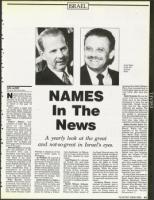
James Baker,
at left, and
Avraham
Sharir.
CARL ALPERT
Special to The Jewish News
N
ames make the news.
Each year at this sea-
son, we present our
selection of the top 10 new
names which made headlines
in Israel in the past 12
months.
Once listed, a name may
not qualify again. These are
new names, which command-
ed top attention here since
last Rosh Hashanah. The
1990 listing is in alphabetical
order.
James Baker,
U.S.
secretary of state. His pro-
posal for an Israeli-
Palestinian conference • in
Cairo was the cause of much
turmoil this past year in
Israel's internal politics, as
differences of opinion emerg-
ed regarding terms and con-
ditions. lb answer "Yes" or
answer "No" to Baker was
front-page news for the better
part of the year.
Yehuda Halevi, new presi-
dent and publisher of The
Jerusalem Post, had a
showdown with rebel mem-
bers of the paper's editorial
staff. Many of the latter
resigned en masse, expecting
to bring the publisher to his
knees. Instead, the paper con-
tinued to appear and has
been transformed from a
mouthpiece of left-wing
politics into a fair and objec-
tive journal in which the news
is, at long last, presented
without political coloration.
Mike Harari, former
member of the Israel securi-
ty services, was named as a
central figure in a number of
mysterious operations, rang-
ing from close connections
with ousted Panama leader
AIRE
In The
News
A yearly look at the great
and not-so-great in Israel's eyes.
Noriega to shipment of U.S.
arms to Contra rebels in
Nicaragua.
Avi Kadish. For a period of
a few weeks, as hundreds of
thousands of Israelis took to
the streets to demonstrate
against the clumsy and not
always moral political system
of the country, Kadish seem-
ed to be headed for leadership
of a massive and irresistible
movement for change. And
then it all faded out.
Rabbi Moshe Levinger, a
radical and outspoken leader
of the settlers in Judea and
Samaria, long known for his
vigilante activities, was
sentenced to five months in
prison for killing a Palesti-
nian shopkeeper in Hebron,
after Levinger and his family
had been attacked by Arab
rioters.
Ami Popper, 21, a derang-
ed Israeli who had been
dishonorably discharged from
the army, went berserk and
fired at random into a crowd
of Arab civilian workmen,
killing seven and wounding
15. His act triggered a renew-
ed round of intifada violence
and was used internationally
as reason to condemn Israel's
policies.
Rabbi Eliezer Schach.
Without a doubt, the public
relations spectacle of the year
was the speech by the
92-year-old rabbi, mentor of
the Degel Hatorah party. He
had it in his power to make or
break the two big, deadlock-
ed political parties by giving
the nod of support to one of
them. He spoke to 10,000
religious followers in, of all
places, the Yad Eliahu sports
stadium. While the nation
held its breath, he milked the
situation for all its worth and
then sat down while his
listeners argued about what
his equivocal statements had
meant.
Avraham Sharir, former
minister of tourism, gave a
not very edifying spectacle of
political opportunism as he
quit the Likud party in
answer to blandishments and
promises from labor's Shimon
Peres, then recrossed back to
Likud again when he got an
even better offer from that
side.
Ruth Trabelsi, 86, was the
center of the year's top emo-
tional story as she refused
permission to have her leg
amputated, though physi-
cians told her she would
otherwise die quickly. The
courts upheld her right to do
as she wished, but in the end
she yielded to persuasion
from the chief rabbi and per-
mitted the amputation. She
died nine days later of
respiratory and heart failure.
Rabbi Ovadia Yosef. The
year's political crisis began in
March. While the 120
members of the Knesset
debated the government's
fate, Rabbi Yosef, former
Sephardi chief rabbi, held the
answer in his hands. Leaders
of both major parties in the
evenly divided parliament
sought his support, but he
finally obstructed the five
members of the Shas Sephar-
di party to abstain in the con-
fidence vote, thus bringing
about the collapse of the
Shamir-led national unity
government.
Some of these people will
have left a mark on history.
Some will be headed for quick
oblivion, despite their
momentary meteoric ap-
pearance. How many will we
remember next year?
By way of test, how many do
you recall of last year's top 10:
Yassir Arafat, Herzl Avitan,
Miriam Ben-Porat, Aryeh
Deri, Abdal-Hadi Suleiman
Ghneim, King Hussein, Yair
Klein, Amiram Mitzna,
Sheikh Abdel Karim Obeid
and Menachem Mendel
Schneersohn. ❑
THE DETROIT JEWISH NEWS
41