

CLOSE-UP
great scholar Maimonides,
the Rambam. Solemn
visitors regularly come to
the tomb, which they rev-
erently kiss and at which
they leave donations.
Continuing north, one
reaches Safed, birthplace of
Jewish mysticism and
home to synagogues that
seem to have escaped the
passage of time. One shul's
ark bears old designs of
purple, green and gold
showing fish, flowers and
grapes. Tzedakah boxes are
everywhere.
In a Sephardi synagogue,
Abuhav, the walls are
covered with bright tur-
quoise, the color of heaven,
to keep away the evil eye.
Seats are decorated with a
flowered pink-and-green
chintz.
Everything in the shul
carries meaning: the three
Torah arks stand for the
three patriarchs; the five
seats on the bimah repre-
sent the Five Books of
Moses; the 10 windows
stand for the Ten Com-
mandments.
The original Abuhav
Synagogue was built in the
16th century. An earth-
quake in 1937 destroyed it
all except the wall where
the arks sit. These arks are
opened only on Rosh
Hashanah, Yom Kippur
and Shavuot. Local legend
has it that a group of men
did otherwise, and they all
perished soon after.
Just before reaching
Israel's northernmost
major city, Haifa, one may
pass through Akko. It's
best to visit the city when
the skies are heavy with
the feel of impending rain.
The waves dance harshly
and the air is filled with
the smell of salt, like the
backdrop of some dramatic
1940s film.
Visitors often stop to eat
at the city's fish restau-
rants, but those looking for
something a little different
may turn to a narrow
passageway just beyond
the sea. Here, numerous
scenes for the film Exodus
28
FRIDAY, NOVEMBER 30, 1990
were made, including Paul
Newman's breakout from
an upstairs window.
And finally, on the road
to Haifa, one will pass a
small house, the Aaronson
Home, which holds none of
the glamour of some of
Israel's larger museums,
but which boasts as much
intrigue as one could wish.
The story begins in 1914
with Aaron Aaronson, a
famous scientist. Mr.
Aaronson and his sisters,
Rebecca and Sarah, were
spies for the British during
World War I.
Aaron Aaronson disap-
peared over the English
Channel. No one has heard
from him since the disap-
pearance.
Both Rebecca and Sarah
fell in love with a man
named Absalom Feinberg.
Absalom loved Rebecca, so
Sarah graciously stepped
back, marrying another
man as it wouldn't be prop-
er if Rebecca, the younger
sister, wed first.
Absalom joined the
Aaronson spy ring. One
afternoon, he went off to
meet the British, who were
approaching from Egypt.
But his guide turned him
in to the Turks, and Ab-
salom was murdered in the
desert.
For years, his body was
thought lost forever. Then
a rumor circulated that he
was buried under a certain
date tree.
The area was dug up and
Absalom's body discovered;
the tree by his body had
grown from dates he was
carrying in his pocket the
day he was killed. He has
since been interred at the
Mount of Olives Cemetery.
Absalom's wife, Rebecca,
managed to escape harm
and lived for many years at
the Aaronson home. Her
sister, however, met a
tragic death.
The spy ring was
discovered when one of the
group's carrier pigeons was
caught. Turkish officials
came for the Aaronson
sisters, capturing only
Sarah. They tortured her
horribly in questioning. At
one point, she asked to be
excused for a moment
before her impending ex-
ecution. Then she walked
to another room, took out a
gun and shot herself in the
head.
E
flat is a city of con-
trasts. Located in
southern Israel, it is
home to Israel's cool, blue
undersea aquariums and
the country's vast desert,
where one can travel on
paths Avraham himself like-
ly traversed.
•• ■ •••••••
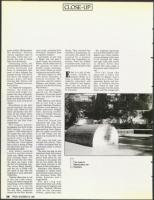
The tomb of
Maimonides, the
Rambam.
The undersea aquarium
at Coral World offers a 180-
degree view, where visitors
can see stingrays that seem
to fly through the water
and ugly tuna that travel
in schools. Silver fish
glisten like stars under a
blue-green satin blanket of
sea.
Not far from the
aquarium is Taba, the
border to Egypt, and a
barbed-wire fence that
separates Israel and Jor-
dan. A kibbutz thrives
here, where in clear view
one can peer into the quiet
desert and the orange-and-