

CLOSE-UP
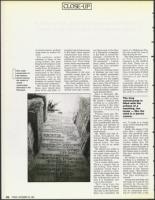
Now under
construction at
Yad Vashem:
stones bearing
the names of
Jewish
communities
destroyed in the
Holocaust.
26
FRIDAY, NOVEMBER 30, 1990
of-a-kind treasure: perfume
made from an ancient for-
mula.
The perfume, called
Abishag in honor of the
young woman who kept
King David company in his
last years, carries a rich,
woody flavor. Its formula is
based on a blend of herbs
mentioned in the Bible,
and creators promise "it is
probably close to the
fragrances used by the
beauties of ancient Israel
to attract men's attention."
The aroma of the per-
fume, once valued more
than silver and gold, re-
portedly had its beginnings
in Ein Gedi, where ancient
communities took advan-
tage of the town's tropical
conditions to cultivate the
balsam tree. From these
trees a balm was extracted,
used to make the alluring
fragrances coveted by
peoples worldwide.
Excavations in the area
revealed vessels from the
6th century B.C.E. in a
facility thought to have
been a perfume workshop.
But those seeking to re-
produce the Ein Gedi
fragrance should beware:
several years ago a mosaic
was discovered on the floor
of a Byzantine synagogue
in Ein Gedi. It carried the
message, "Cursed be he
who reveals the secret of
the community" — a secret
many today translate to
mean the city's greatest
treasure: perfume.
From the alluring aroma
of Abishag, one may turn
to the equally memorable
smell of fresh paint.
Jerusalem is a city replete
with artists, each of whom
has a story. One of these is
Herbert Bluhm, whose
studio is in the newly reno-
vated Jerusalem neighbor-
hood, Nahalat Shiva.
Born in Germany, Mr.
Bluhm came without his
parents in 1937 to Israel.
He joined a kibbutz and
worked as a carpenter,
later serving in the army
where he fought with
forces liberating
Jerusalem.
Twenty years ago, Mr.
Bluhm opened his own
studio. It's filled with jars
and cans holding upside-
down paintbrushes and his
paintings and sketches of
the city. The 120-year-old
walls of the studio are
made of mud.
Mr. Bluhm has had ex-
hibits throughout the
United States, England
and Israel. He considers
himself lucky. "It's not
easy to live as an artist
here," he said.
Mr. Bluhm also works in
the studio's downstairs, a
renovated cistern once fill-
ed with water that now
houses the artist's printing
press from Germany.
It's a round, white room.
There's a square hole at
the ceiling, from which
residents would drop a
bucket to retrieve water.
One of the things that most
pleases Mr. Bluhm about
the underground room is
that it is constantly cool,
even in the summer.
Tall trees line the
walkway to Yad Vashem,
Israel's memorial to those
who died in the Holocaust.
Each tree remembers the
name of a Righteous Gen-
tile who saved the lives of
Jews during the war.
The most recent addition
to Yad Vashem is a
memorial to the children
who died. There are no
photographs here, no
descriptions telling the
horrors of their tortured
lives, no last pairs of shoes
torn and dusty from
journeys to the death
camps.
Instead, a long en-
tranceway stands at the
front of the memorial. It is
filled with the echoes of a
haunting, low moan — like
the wind in a barren cav-
The long
entranceway is
filled with the
echoes of a
haunting, low
moan like the
wind in a barren
cavern.
ern. It leads to a single
room, at first blinding with
its darkness.
Inside, the names of the
more than 1 million chil-
dren who perished, their
ages and places of birth,
are read aloud, over and
over without end. Five
candles reflect onto 150
mirrors, making for what
appears to be thousands of
burning flames. At the top,
the flames seem to cluster,
like stars melting into the
twilight.
On exhibit in the main
building is a collection of
art work by Friedl Dicker,
murdered in 1944 at
Auschwitz, and her
students at the Terezin
death camp. "The children
perished," the display says,
"but their drawings re-
mained."
Among the paintings and
drawings are a picture of a
rainbow by 14-year-old
Hanna Fischerova, numer-
ous sketches of seder tables
and an anonymous draw-
ing of a small bird, a tiny