

BOOKS I
Best
The G
of the
I t
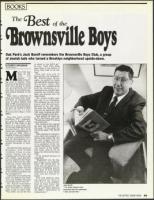
Oak Park's Jack Baroff remembers the Brownsville Boys Club, a group
of Jewish lads who turned a Brooklyn neighborhood upside-down.
ELIZABETH APPLEBAUM
Assistant Editor
M
ost of the boys
slept on roll-
away cots
opened at
night in the liv-
ing room or kitchen. They
hung out at the library, where
they were allowed to check
out one hard book and one
easy book. In the afternoons,
they played stickball in the
street.
They were a collection of
black and white boys, many
children of immigrants,
most of whose fathers had
died of TB or pneumonia or
from lead in the house paint;
all poor, all united in their
dedication to the
Brownsville Boys Club
(BBC).
Now the story of this
Brooklyn, N.Y., organiza-
tion and its founder, Jack
Baroff of Oak Park, is the
focus of a new book, The
Nurturing Neighborhood by
Gerald Sorin. The book
traces the establishment of
the club in 1940, when a
handful of boys got together
to found a recreation center,
and its development as a
mutual-aid society that at-
tracted thousands of mem-
bers.
The Brownsville section of
Brooklyn, with 81,000
residents living in nine
square blocks, was the
roughest part of town in the
late 1930s. Jack Baroff's
parents settled in the tough-
est part of Brownsville, right
under the L train, when they
immigrated from Eastern
Europe. His mother was the
oldest daughter in a family
of 12 children; his father was
the youngest of 13.
Jack's life was ruled by the
block. The kids on your block
were your buddies; the guys
around the corner were not.
Mr. Baroff remembers
passing through a neighbor-
hood controlled by another
gang to get to junior high.
"You either ran all the way
to school or you didn't go,"
he says. "And when those
guys came to our section of
town, they had to toe the
line."
The one way out of
Brownsville was education,
Mr. Baroff says. Every
night, he pulled his books
out and did his homework at
the kitchen table. The
respect the neighborhood
held for education is il-
lustrated in an incident that
occurred one evening when
Jack was pouring over his
school books.
The young couple next
door got in an argument.
The husband ran out of the
house and downstairs,
followed by his wife. Then
the man ran back upstairs
and into his apartment. His
wife came running up after
him and banged on the door.
Jack peeked his head out
of his apartment and said,
"Would you mind? I'm doing
my homework."
The husband then opened
the door and apologized for
the noise. "It was quiet the
rest of the night," Mr. Baroff
says.
After passing an extensive
exam, Jack was accepted to a
science high school. He was
the only student from his
school to go. There, he serv-
ed as president of the Ad-
vanced Chemistry Club and
was captain of the basket-
ball team. And at 16, he
began the Brownsville Boys
Club.
It all started because of
basketball.
"Basketball was the big-
gest thing in our neighbor-
hood," Mr. Baroff says. So
when the city passed an or-
dinance forbidding anyone
older than 16 from playing
basketball at a local school,
Jack and his friends re-
belled.
They took petitions argu-
ing against the move to
every boy in the neighbor-
hood. In three hours, they
had 220 signatures. Mr.
Baroff calls these petitions
the BBC's "declaration of
independence."
Jack Baroff:
"The block became more
important than the nationality.
It was survival time."
THE DETROIT JEWISH NEWS
89