

BACKGROUND
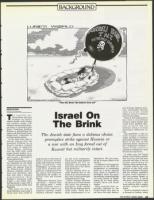
"This will divert the bullets from us!"
HELEN DAVIS
Foreign Correspondent
T
he rapidly de-
teriorating security
situation on Israel's
eastern border with Jordan
and northern border with
Lebanon has provoked grow-
ing fears in Jerusalem that
Iraq's President Saddam
Hussein is destabilizing the
region and that Israel is now
dangerously vulnerable to
an Iraqi missile attack.
At the same time, there is
serious concern that the
pressures building up on
Israel's borders, coupled
with signs of apparent
United States vacilation
over the Gulf crisis, could
propel Israeli leaders to in-
voke their contingency plans
and launch a preemptive
strike against Iraq.
Israeli sources believe that
the hesitation by the Bush
administration has now
made war against Iraq by
the Western-Arab military
alliance unlikely until at
least late December. But
they fear that a military
miscalculation about
Saddam's intentions could
trigger a war before then,
leaving Israel to cope with a
chemical missile strike from
Baghdad.
They point out that an
Israeli decision to pre-empt a
threat from Iraq would be
Israel On
The Brink
The Jewish state faces a dubious choice:
preemptive strike against Hussein or
a war with an Iraq forced out of
Kuwait but militarily intact.
made strictly on the basis of
Israel's perceived security
needs and would not involve
prior consultation with
Washington, an event that
could have profound geo-
political consequences for
the region and long-term
implications for Israel's re-
lations with the United
States.
Hostilities between Iraq
and Israel — whoever fires
the opening shots — would
almost certainly have a
catastrophic effect on
America's carefully crafted
military alliance, ripping
out the Arab component,
which has provided political
legitimation for U.S. in-
volvement, and turning the
Gulf crisis into a full- blown
Arab-Israeli war.
Syrian officials have al-
ready declared that in the
event of an Arab-Israeli con-
flict, their troops would fight
alongside those of Iraq.
Israeli Foreign Minister
David Levy this week denied
that Israel was planning a
preemptive strike against
Iraq, but one military source
noted archly: "Israel has a
deep commitment to in-
dependence. We have learn-
ed not to expect others to do
the job."
In addition to the apparent
hesitation by the Bush ad-
ministration in committing
itself to a strike against
Iraq, there is concern in
Jerusalem about the grow-
ing military constraints that
are being placed on Wash-
ington by its Arab allies,
notably Syria and Saudi
Arabia.
Both countries have re-
portedly signaled to the
United States that they do
not favor the total destruc-
tion of Iraq's military struc-
ture, presumably because
such an event would
enhance Israel's military
power in the region.
Israel is also understood to
fear that a non-military
solution might emerge that
would leave Saddam Hus-
sein in power and his
military means of mass
destruction effectively in-
tact.
One possibility is that an
Arab League initiative
might succeed in somehow
persuading Saddam to back
down in the face of the
American threat. Another is
the "nightmare scenario,"
which would involve a
unilateral withdrawal from
Kuwait by Iraqi forces.
In either case, the United
States would likely consider
that the casus belli has been
removed and that it has no
further justification for
military action against Iraq.
Israelis believe that any
solution to the Gulf crisis
that leaves Saddam Hussein
and his military capability
in place would represent a
real and present danger to
the Jewish state. It would
also pose a long term threat
— in, say, two years — that
Iraq would be able to deploy
nuclear weapons against
Israel.
Israel's immediate concern
is focused on Jordan, where
THE DETROIT JEWISH NEWS
41