
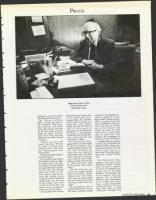

Rabbi Gamze offers a tender
sense of humor and a
warm place to pray.
questions, and so he turns
his back and walks away.
Ms. Warren receives
$507 a month for each of
her residents. With that,
she shelters and feeds
them. She knows everyone
by his first name, and she
keeps her sense of humor
way out in front, her best
offense in an otherwise sad
situation.
"These are our lost
souls," she said. "They're
out there in society, and
nobody knows who they
are. These people have
nothing left.
"But I love these people. I
love all of them."
At a nearby foster home,
Ms. Bender visits an elder-
ly female client. The Jew-
ish clients are like needles
in haystacks of poor blacks.
On this day, Ms. Bender
meets the owner of a cer-
tain house. Angered be-
cause Ms. Bender and a
volunteer have complained
vociferously over the care
of the woman, the owner
curses her to her face and
swears never to accept an-
other Jew into the house.
On the other side of town,
Rabbi Norman Gamze sits
in his Downtown Syn-
agogue office, the radiator
trying hard to bang out
some heat. The rabbi's
hands are cold. In what is
left of this part of
downtown on Griswold and
Clifford, a synagogue
would draw an easy double-
take from anyone not
knowing it's there.
The Downtown Syn-
agogue draws a mix largely
of senior citizens who
couldn't afford to leave the
city and ex-mental pa-
tients who are living in
adult foster care. The shul,
which has been in its cur-
rent location since 1964,
offers evening services dai-
ly. Those who come, come
for the prayer and a cup of
coffee.
"For the most part, you
see here a steady, routine
kind of poverty," Rabbi
Gamze said. "You learn
that many of these people
just want someone to listen
to them, to take them seri-
ously."
The synagogue door is
dead-bolted all the time; in
the past, homeless people
walked in demanding ser-
vices or asking for a han-
dout. Rabbi Gamze cannot
offer a regular financial
flow of funding for the poor
Jews who come in. If they
are in dire straits, the
rabbi can come up with
money for a short hotel
stay or some food. But
largely, the synagogue is
there as a house of worship.
On Rabbi Gamze's desk is
a small cup of quarters he
offers for those using near-
by parking meters. It's also
there to be stolen or
borrowed. The rabbi knows
that, but it doesn't bother
him.
The Downtown Syn-
agogue has about 500
members, Rabbi Gamze
said. It gets a regular
crowd for the Sabbath and
is sold out for the High
Holidays. It's probably one
of the nation's only syn-
agogues with an elevator
that can take congregants
to its second floor sanc-
tuary, a place of beautiful
woods and color. On this
day, Sam Glass, a shul
employee, changes the
THE DETROIT JEWISH NEWS
31