

SPECIAL REPORT
Confusion
Mars First
Reports
Of Killings
Several accounts have been
published, agreeing that neither
side had planned to do battle.
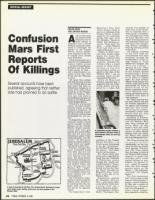
A map of Jerusalem's Old City. The Temple Mount disturbance began
when Arabs began pelting rocks down on Jews praying at the
Western Wall.
42
FRIDAY, OCTOBER 19, 1990
HELEN DAVIS
AND ARTHUR MAGIDA
s the world awaits
the outcome of the
stalemate over Is-
rael's refusal to
cooperate with a United
Nations commission man-
dated to investigate the
deaths at the Temple
Mount, several prelimi-
nary inquiries of the Oct.
8 tragedy have already
been published.
Chief among these are a
report by two independent
human rights groups
—the Israeli organization,
B'tselem, and the Pales-
tinian group, Al Haq —
and comprehensive ac-
counts in the New York
Times and the Washing-
ton Post.
An agree that neither
side had planned to battle
at the Temple Mount and
that there had been no
Palestinian conspiracy to
stone Jews they knew
would be at the Western
Wall for Sukkot. Nor,
they say, was there a
premeditated decision by
police to kill Palestinians
on the Temple Mount.
B'tselem's provisional
report accused Israeli
security forces of using
excessive firepower, of
failing to attempt to calm
the situation and of being
ill-equipped for riot con-
trol.
It alleged that after Pa-
lestinian youths stoned
police outside al-Aksa
Mosque on the Temple
Mount, Israeli security
forces shot tear gas
against the crowd. When
this did not quell the
disturbance, police "fired
indiscriminately into the
crowd." At this point,
states the report, police no
longer faced any signifi-
cant threat to their lives.
B'tselem charged that
police continued firing
even after the riot was
over and Palestinians
were fleeing from the
scene. The group further
claimed that shooting was
also aimed at ambulances
and medical teams, and
that stoning near the
Western Wall "might"
have endangered the lives
of worshippers there, but
police response was "out
of all proportion."
The Palestinian organ-
ization's report primarily
differed from B'tselem's
by asserting that the riot
began after police fired
tear gas for no apparent
reason.
Correspondent Joel
Brinkley's New York
Times account relied in
part on a videotape of the
Temple Mount incident
made by an American
tourist. The tape, wrote
Mr. Brinkley, "leaves no
doubt" that shooting oc-
curred "long after the
Jews . . . (at the Western
Wall) had fled out of
range of the stones."
Despite Al Haq's asser-
tion that Israeli police
began the clash, Mr.
Brinkley reported that
"Palestinians, by most
accounts, initiated the
violence when a small
group of them threw
stones at Israeli
paramilitary police on
guard at the edge of the
Western Wall — not an
unusual event, by the
standards of this land."
Both Al Haq and
B'tselem reported that it
appeared that the Pales-
tinian attack was trig-
gered by a rumor that
A Palestinian woman clutches a
bloodstained stretcher inside Al
Aksa Mosque where her son was
wounded.
members of the Temple
Mount Faithful —an
Israeli group determined
to lay the "cornerstone"
for the Third Temple upon -
the mount — were about
to arrive at the mount.
The Times stated that
when police responded by
firing tear gas, hundreds
of Palestinian youths
charged the "vastly out-
numbered police." Securi-
ty forces, "clearly afraid,"
backed out from the Tem-
ple Mount through the
Mugrabbi Gate, which
leads to the side of the
Western Wall.
Palestinians, reported
Mr. Brinkley, then set
afire a small police office
on the Mount. Inside were
a police clerk and a
janitor. Both were Arabs.
Correspondent Jackson
Diehl's Washington Post
account was similar in
most ways to the Times',
but he reported that a
third group of Palestin-
ians had gone east of the
al-Aqsa Mosque and
began throwing stones on
the road below where cars
and buses were transpor-
ting Jewish worshipers
from the morning service
at the Wall.
All morning, according
to the Post, such an-
nouncements had been
broadcast through the
loudspeakers of the al-
Aqsa mosque as "Come
defend the mosques, the
Jews are coming."
Around 10 a.m., wrote
Mr. Diehl, Islamic leaders
at the mosque started
broadcasting a Koran
lesson over the speakers
in an effort to impose
order. An Arab security
official at the mosque also
told Mr. Diehl that he had
approached the head of
Israeli forces on the
Mount, explained precau-
tions Moslems were
taking and asked police to
withdraw from some of
their positions.
Mr. Diehl reported that
the Arab official told him
the Israelis responded to
his appeal with warnings
against any stone-
throwing by youths.
Jerusalem's police chief
denied that any such
exchange took place.
According to B'tselem,
Palestinians threw stones
over the Western Wall
after they torched the
police office. Al Haq
asserts that the rocks
were actually being
thrown at police officers
lobbing tear gas inside
the Mount from behind
the closed Mugrabbi Gate.
The Times and the Post
accounts differ
significantly on the tim-
ing of the first live bullets
used against Palestin-
ians. The Times reports
that the plaza in front of
the Western Wall entirely
emptied in about five
minutes after rocks
started falling on wor-
shipers. At around 11
a.m. —about 20 minutes
after the first charge
against police on the
Mount — 200 policemen
"stormed" the Temple
Mount.
The Post maintained
that "what is clear is that
once the violence began, it
quickly turned ferocious.
Al Haq and a number of
Palestinian witnesses
said the beleaguered .. .
police almost immedi-
ately opened fire with live