

1885
Max Jacob Collects Used
Bottles, Sells To Local
Breweries
Max Jacob put his sons to work when
they were young boys. He ran his small bot-
tle distribution company, founded as the M.
Jacob Co. in 1885, from a yard behind his
home on East Columbia, allowing the
children to grow up with the business.
At 5 a.m. on every morning but
Shabbat, the eldest of his six sons —
Gustave, William, Ben and Sam — got up,
davened, and went out to the stalls where
Max Jacob kept horses used to transport
wagons for bottle delivery. They cleaned
stalls, groomed the horses and worked in
the bottle yard.
Then, the young Jacob boys went off to
Hebrew school.
Bottles were second nature in the Jacob
household. Max's idea of forming a one-
man recycling company came from his
father, Gaziel, who was a Russian bottle
merchant and real estate developer in the
mid-1800s.
At age 16, a gregarious Max im-
migrated to the United States through
Baltimore on one of the first boats out of
Eastern Europe. Two years later, in 1882,
Max moved to Detroit, where it is believ-
ed he knew someone from his homeland.
Briefly, he worked as a tailor. Then, he
peddled junk. At age 21, with a $15 in-
vestment, just before the Ford Motor Co.
lured workers to Detroit with its princely
$5-a-day-salary, Max started buying used
hand-blown bottles. He sorted, sold and
delivered them — a new concept for ped-
dlers.
Max lost the initial $15, but he didn't
give up. He continued selling bottles, soon
securing accounts at Detroit's 21
breweries and at many patent and
prescription medicine companies.
As his customer list quickly grew, Max
Jacob made his first major purchase — a
top-of-the-line horse and wagon. And as
soon as he could afford to do so, Max sent
for his mother. His father died in
Russia.
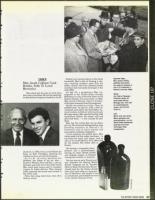
Opposite Page:
Max Jacob's bottles,
gathered and sorted,
are ready for delivery to
one of 21 breweries in
Detroit in the late 1800s.
Above:
Jim Todd of Salasnek
Fisheries shows off
some fresh fish for
Michigan Sen. Phil Hart
as Lowell Salasnek,
center, with the hat,
looks on.
Left:
Martin and Joel Jacob,
Max's grandson and
great-grandson, run the
family bottle distribution
business from their
Farmington Hills
headquarters.
He became a successful entre-
preneur and a philanthropist,
serving on many Jewish boards
and helping masses of Russian
immigrants resettle in America.
He also was an early Zionist and
and attended the Second World
Zionist Congress led by Theodor
Herzl in Basil, Switzerland. He pur-
chased land for the future Jewish
state, (this land today is a large por-
tion of Herzliya), told people it was
an investment, and donated the land
to the Jewish National Fund.
THE DETROIT JEWISH NEWS
27