

Ms. Victor's parents had
blazed the trail she would
follow. Describing them as
political, open-minded peo-
ple who felt they could have
an impact on society, she
recalls her mother, Arlene
Victor, recycling long before
it was fashionable, and her
father, Steven Victor, being
involved in civic and Jewish
philanthropic organizations.
Ms. Victor also remem-
bers someone else who
helped spark her activism —
the family's housekeeper, a
black woman from Detroit.
"She was one of the most
moral, upstanding, in-
telligent people I knew, and
yet she had very little to
show for it," Ms. Victor says.
"I learned early on that we
don't necessarily have what
we have because we've done
anything to deserve it:'
Setting out to make the
world more just, more safe,
Ms. Victor was strongly in-
fluenced by her Jewish
background, especially
lessons learned from the
Holocaust.
"There's a responsibility
that comes with knowing
such evil can exist, that
humans could have stopped
that evil and chose not to.
"At the beginning of my
activism, when it took all
the energy I could muster,
when so many people said,
`Why are you doing this?' it
kept me going, it inspired
me to remember that."
Now, as program director
of Sane/Freeze, Ms. Victor
says she works not only to
change government policy,
but to "empower individ-
uals." She measures her on-
the-job success by how many
people she involves in her
organization and whether
they're in it for the long
haul.
"I'm talking about chang-
ing society. Definitely.
Nothing short of that."
NAT HOROWITZ:
Rainbow Warrior
There are echoes of '60s
esprit in Nat Horowitz's
words and tone. By turns
emotional, sarcastic, rever-
ent or outraged, the 22-year-
old Oberlin College senior
from Ann Arbor packs a few
blunt epithets for those who
would plunder Earth's boun-
ty, as well as a poetic legend
for those who listen when he
comes calling.
Mr. Horowitz is a can-
vasser for Greenpeace Ac-
tion. During five summers
— one in Seattle, one in Los
Angeles, and three in Ann
Arbor — he's done his door-
to-door thing:
"Hi. My name is Nat. I'm
here from Greenpeace Ac-
tion, the environmental
organization. We're going
around the neighborhood
right now on our annual
membership and fund-
raising drive, getting sup-
port for the work we do on
behalf of the environment
both right here and all over
the world.
"Are you familiar with
Greenpeace?"
When he started out, Mr.
Horowitz recalls, many peo-
ple didn't know what an en-
vironmentalist was. More
than once he was taken for
"a weird hippie."
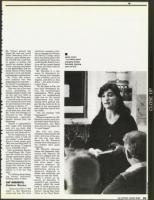
Jackie Victor:
"I'm talking about
changing society.
Definitely. Nothing
short of that."
But over the years,
ecological consciousness has
risen. And most of the peo-
ple who now open their
doors for Mr. Horowitz
already know Greenpeace is
not another lawn spray
company.
Mr. Horowitz discusses
issues and dispenses infor-
mation with listeners. He
says he's pleased that the
three main U.S. tuna com-
panies will no longer buy
fish from those "who
massacre dolphins." He
talks about rain-forest
destruction, saving en-
dangered elephants in
Africa and protecting sea
turtles all over the world.
With a cynical air ap-
parent, he describes "a
wonderful new capitalistic
industry called the waste
trade' in which groovy peo-
ple from the industrialized
nations" unload their toxic
refuse on the Third World,
THE DETROIT JEWISH NEWS ' 29