

A
R E
N
V
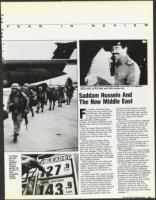
Saddam Hussein (right) became increasingly isolated in the world for his aggression
against Kuwait, but PLO leader Yassir Arafat remained loyal.
Saddam Hussein And
The New Middle East
or months, Israel had been
warning the world about Sad-
dam Hussein. The president
of Iraq, a despot who during
an eight-year war with Iran
used chemical warfare against
civilians, turned his attention to the
Jewish state, which he threatened to
destroy.
But the United States continued
to look the other way, until, in early
August, Saddam Hussein took over
Kuwait in a military move and
threatened to do the same to Saudi
Arabia.
At that point, President Bush
mobilized American troops in the
largest military move of its kind
ever, and convinced Saudi Arabia to
allow the U.S. to station troops in
the Arab kingdom. When they will
leave is anyone's guess, but what is
certain is that the Persian Gulf crisis
has changed dramatically the Middle
East, perhaps forever.
Bitter enemies are now allies and
long-held strategies are now mean-
ingless. Events that appear to bode
well for Israel now could lead to
serious problems in the future, and
vice versa.
At first, Israel felt a sense of relief
that Washington was finally waking
up to the danger represented by Sad-
dam Hussein. Jerusalem also felt a
sense of satisfaction when Yasser
Arafat and Jordan's King Hussein
lined up on the side of Iraq, seeming
to underscore the radicalism of so-
called moderates. And while not
acknowledged publicly, there was
F
The Persian
Gulf crisis
had an
immediate
effect on
American
gasoline and
oil prices, as
world
commodities
markets
panicked.
gratitude among Western nations,
and even in the Arab world, that
Israel had destroyed Iraq's nuclear
reactor in 1981. Otherwise, the cur-
rent crisis would be of nuclear
proportions.
But as the United States improved
its relations with Saudi Arabia and
Syria, there was concern about the
U.S. supplying Arab states with
sophisticated weapons. And there
was a growing sense that the Arab
states may call on the U.S. to
pressure Israel into an accommoda-
tion with the Palestinians, once the
Gulf crisis is resolved.
There is also grave danger seen in
the potential of an Iran-Iraq rap-
prochement, with an ascendancy of
militant Moslems.
The possibility of a war involving
Israel still looms large. While Israeli
citizens were clamoring for gas
masks to protect themselves from
chemical warfare, political and
military leaders seemed anxious for
the United States to attack Iraq.
At year's end, American and
Israeli interests regarding Saddam
Hussein were moving in different
directions. Washington was pressing
for economic sanctions and appeared
prepared to allow Saddam Hussein
to return to the status quo if he
withdrew from Kuwait. But Israelis
want to see Saddam Hussein
destroyed. They fear that if he
remains in power, he will turn his
attention once more to the hated
Zionists, only this time with nuclear
weapons. ❑
THE DETROIT JEWISH NEWS
47