

FOCUS
The Wexner Foundation
Most Dangerous Politician?
Continued from preceding page
Proudly Announces
Its Third Class of
Graduate Fellows
Fellow
Graduate Programs
Yosef Abramowitz
Shoshana Bechhofer
Mark Bleiweiss
Kenneth Carr
Sandra Cohen
Mojgan Javid
Mark Koplik
Susan Levitin
Rebecca Meyer
Hillel Novetsky
Sara Paasche
Rachel Sabath
Jonathan Savett
Miriam Senturia
Marc Sirinsky
Joel Sisenwine
Rachel Tessler
Columbia University
National College of Education
Jewish Theological Seminary
Hebrew Union College —JIR
Hebrew Union College—JIR
HUC-JIR/Univ. of Southern California
Jewish Theological Seminary
Brandeis University
HUC-JIR/Univ. of Southern California
RIETS —Yeshiva University
Jewish Theological Seminary
Hebrew Union College—JIR
Jewish Theological Seminary
Reconstructionist Rabbinical College
University of Judaism
Hebrew Union College—JIR
JTS/Columbia University
The Wexner Foundation was created by Leslie H. Wexner, the
founder and chairman of The Limited Inc., and his mother Mrs.
Bella Wexner. The Foundation is committed to the enhancement
and improvement of Jewish leadership.
The Wexner Graduate Fellowship Program is designed to
attract the most promising and talented Jewish men and women
to pursue careers in professional Jewish leadership, in syna-
gogue/temple, Jewish communal and Jewish educational set-
tings. The program provides full academic tuition, generous
living stipends for graduate studies in Jewish leadership pro-
grams in North America and annual Foundation-sponsored
institutes and learning experiences.
The Foundation welcomes applications and inquiries.
For more information write to:
The Wexner Foundation Graduate Fellowship Program
41 South High Street, Suite 3390, Columbus, Ohio 43215
THE
ATTIC THEATER
IS PROUD TO
ANNOUNCE THE
APPOINTMENT OF
DANIEL KANTER
AS
BUSINESS MANAGER.
166 FRIDAY, SEPTEMBER 21, 1990
Lance Hill, executive director of the Louisiana
Coalition Against Racism and Nazism, says the issue
is not whether David Duke wins the Senate race but
whether he will finish strongly enough to gain
legitimacy.
Beth Rickey, a member of the Republi-
can State Central Committee, was wooed
politically by Rep. Duke for over a year
after she began criticizing him publicly.
"I think he liked me and he's a very
likable person on a very superficial level,"
she says in her fashionable apartment
near downtown New Orleans.
Ms. Rickey relates that last summer
she and Rep. Duke had lunch at a Chinese
restaurant in New Orleans "and we talk-
ed about his bottom line — that race mix-
ing causes the political and economic
problems we have in society. The way to
deal with it, he said, is separate races and
he defines Jewish people as a race. He be-
lieves that the Jewish people use blacks
as mere dupes for their purposes."
Ms. Rickey says that during their con-
versation she felt the pull of Mr. Duke's
verbal ministrations, "pseudo-scientific
arguments" and references to various
scholars.
"He's very persuasive," says Ms.
Rickey, who teaches at Southeast Louisi-
ana University. She says she was aghast
when Mr. Duke denied that the Holo-
caust happened. (Her father helped lib-
erate one of the Nazi death camps.) And
she was amazed when Mr. Duke quoted
Talmudic interpreters as saying it was
permissible for Jews to have sex with lit-
tle boys.
At one point, she says, Mr. Duke drew
a map on a napkin of the Mauthausen
death camp which he had visited and said
that he had inspected it and was convinc-
ed that no extermination of Jews took
place there.
Ms. Rickey says she is shocked by the
lack of knowledge her students have
about the Holocaust and worries that "if
you don't know anything [about it], I can
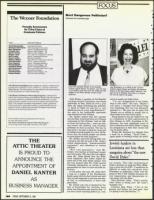
Jane Buchsbaum is an official of the Louisiana
Coalition Against Racism and Nazism and executive
director of the New Orleans Jewish Federation. She
says the key to stopping David Duke is to expose
him and his views to the public.
see how people can believe him.
"I'm very disappointed in the leader-
ship in this state," she says. "Maybe I
was naive. I thought that David Duke
was something that one was inherently
opposed to." She says she is upset that
"people are so willing to accept him at
what seems to be face value today."
Doug Seymour was an undercover cop
at a conference of white supremacists in
New Orleans in 1979. According to Mr.
Seymour, the most significant event of
that conference was David Duke's urging
his compatriots to hide their racism and
run for public office.
Writes Mr. Seymour in a chapter from
a book he is writing: "David Duke ...
again spoke of working within the politi-
Jewish leaders in
Louisiana are less than
sanguine about "the new
David Duke."
cal system. This talk foreshadowed
Duke's decision to cloak his Klan affilia-
tion to form the NAAWP. It would not be
difficult to make the conversion from
Klansmen to politicians, Duke told the
group of 300 to 400. Simply announce the
new organization and disassociate in-
volvement with the Klan."
Says Seymour today, "That's exactly
what Duke is doing now. He hasn't
changed a bit."
Counters Rep. Duke, "I live in the
present and future, not that past. And
I'm going to win this election."
❑