

ICRADITION
ring. He and his wife were pleading to be
released even as they heard the ship's
whistle blowing.
Finally, the officials stamped the
Hazans' passport with "Exit, without
permission to return."
HIAS, the Hebrew Immigrant Aid
Society, resettled the Hazans in Detroit in
a home for refugees. They later found an
apartment on Thatcher Street.
Mr. Hazan took several jobs, making a
career as a furniture salesman. His wife
worked as a seamstress for a dry cleaner.
"In the beginning, we had a hard time,"
Mr. Hazan says. "I remember the snow —
it was up to my knees. I'd never even seen
snow."
Today, Mrs. Hazan describes her chil-
dren as "completely Americanized." They
express little interest in Sephardic tradi-
tions.
"It's not a matter of Ashkenazi and
Sephardi here; it's gentile or Jew," she
says. "I don't care if my children date
Ashkenazim, so long as they're Jewish."
"There was a time you didn't marry
Ashkenazim," adds former Sephardic
Community President David Chicorel.
"But we came to America, the melting
pot. We kept Sephardic traditions at
home. But we learned the American way
at school."
Mr. Chicorel, whose wife is Ashkenazi,
was bar mitzvah at B'nai David and
studied with Ashkenazi rabbis at the
United Hebrew Schools. That's the case
for Sephardic youth today, too, he says.
"Living here, they're naturally exposed
to Ashkenazi ways."
Their children may be uninterested in
Sephardic traditions, but the Hazans and
Mr. Chicorel cling tenderly to the last
remnants of long-ago days. Mrs. Hazan
always prepares her own flavorful
haroset at Pesach.
"I make my haroset with raisins and
dates and nuts that are boiled and
ground," she says. "I always give some to
my children. They don't make it them-
selves. They're too busy."
Mr. Botton says he believes the Sephar-
di community here cannot continue to ex-
ist much longer.
"Do I care? No, not really," he says.
"What's most important is to marry
someone else Jewish and stay active in
your community."
Albert Sasson is the middle of the
sandwich; he's not as old as some of the
longstanding members of the Sephardic
Community, not as young as their chil-
dren.
He's also one of the group's most en-
thusiastic members who already has
compiled a portfolio, complete with charts
and photographs of his genealogy. All the
Sassons are related, he says, making
Albert a cousin of the hair maven, Vidal
Sassoon.
Mr. Sasson is the great-grandson of a
Jerusalem rabbi and the grandson of a
sofer, scribe. His father was born in
Israel, a runaway at 13 who fled to France
and Central America before finally com-
ing as a stowaway to the United States,
where his two brothers lived.
At 13, Mr. Sasson's father received a
scholarship to study at the Sorbonne in
Paris and was an accomplished Torah
reader. He ended up selling clothes in
Detroit and marrying an immigrant from
Turkey.
It wasn't that his father felt strongly
about choosing a Sephardi bride, Mr.
Sasson says. "But he socialized with peo-
ple of the same culture."
The Sassons sent their son Albert to
UHS, though they attended services at
the Sephardic Community. The family
ate mostly Greek, Spanish and Turkish
dishes, and savored traditional Sephardic
meals at Pesach, of which Mr. Sasson has
many good memories.
His parents never told him to date only
Sephardi girls, says Mr. Sasson, who lives
in Huntington Woods. "Jewish is Jewish.
I don't remember any separation or pre-
judice."
He says a unique tie exists among
Sephardim.
"There's a real bonding among Sephar-
dim," Mr. Sasson says. "I've traveled a
lot, and whether I'm in New York, Min-
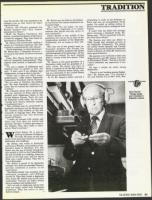
David Chicorel:
"Younger people
aren't interested in
Sephardic customs.
illiam Botton, 35, is just be-
ginning to discover his Sephar-
dic roots. He picks up bits and
pieces of his past from relatives at family
gatherings and weddings.
Mr. Botton, who works in Northville
and lives in Windsor, was raised in a Con-
servative home in Brooklyn, N.Y. His
father was the son of Greek immigrants
who settled in 1910 in the United States.
He met his bride at a wedding, where he
served as the best man and his future
bride was a maid of honor. They fell in
love at first sight.
Mr. Botton is proud of his Sephardic
heritage. As a child, he attended Passover
services, conducted in Ladino, at his
aunt's home.
The Botton family were members of an
Ashkenazi synagogue until William
turned 16. Then they joined a Sephardic
shul, where Mr. Botton says he felt more
comfortable "because you didn't always
have to explain your background."
Still, his wife is Ashkenazi and his chil-
dren are being raised with Ashkenazi
traditions. They are active in their
Reform temple.
THE DETROIT JEWISH NEWS
31