
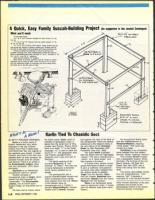

A Quick, Easy Family Succah-Building Project
(As suggested in the Jewish Catalogue)
What you'll need:
riex nes ToP BRACE
4 RE C4L) tRED
12 concrete blocks.
4 2" by 4" by 8' boards: Uprights for each corner, U1, U2,
U3, U4.
7 1" by 2" by 7'6" boards: Top and center braces, T1, T2,
T3, T4, C1, C2, C3.
8 1" by 2" by 8' boards: Roof lattice: These boards may be
laid across top braces to create a square grid. Boards may be
secured to each other and top braces with heavy binding cord.
Choice of fastening materials for securing braces and
uprights: Binding cord, nails, woodscrews or bolts and nuts for
ease in assembling each year (12 bolts 1/4" by 5", 16 bolts 1/4" by
21/2", 28 1/4" nuts, 28 1/4" washers)
Note: Buy all lumber in 8' lengths.
Once frame is in place, plywood, canvas, sheets or similar
materials can be used as walls. Cover the top of your succah
with the traditional schach or branches and other reeds which
still allow you to see the stars at night.
TZ
use zZ rboas
Folk FASTEMLNO
To FLAT SIDE OF 1.)44
2.°)( 4 " 1(
UPRi6i41"
ONE FOR EAL“
COfZAIE EZ
FRONT.
3 CONCRETE BLOCkS
4- x t",c t L i nl EACk4
CoRAER. 10 ANC flok,
'5U KKAit- IL REOutzeD
oPet4
A
WO° /fl A islafigf
By BETTY PROVIZER STARKMAN
Karlin is a family name of
Eastern Ashkenazic root, which
originated in the city of Karlin,
located near Pinsk in Belorussia.
Until World War Two, the majority of
the residents were Jewish. A noted
Chasidic sect lived in this town and
adopted Karlin as their surname. An
obsolete Russian word for Chasid
was Karliner. There is an article in
the Encyclopedia Judaica, (New
York and Jerusalem, 1971), about
this family.
Speisman is an Ashkenazic
occupational name for "grocer."
Another surname of
occupational origin is Vargar, which
comes from the Hungarian for
"shoemaker." The Encyclopedia
Judaica, has an article about
Eugenil Varga, an economist born in
1897.
We have had an inquiry about
L-8 FRIDAY, SEPTEMBER 7, 1990
Karlin Tied To Chasidic Sect
the family name, Verier, which is
probably of geographic origin. It
stems from the small town of Wiry,
located near Poznan, Poland. Since
there is no letter "v" in the Polish
language, "w" is used to make the
sound of "v". The geographic area
near Poznan changed hands
frequently and it was once part of
Germany.
The literal meaning of the
surname Morgenrot, is "red
morning" or "dawn." This was one
of many Ashkenazic ornamental
family names adopted by our
people.
The pomegranate was a
popular Hebrew/Yiddish symbol and
many ornamental family names
were adopted from this fruit. Rimon
is the Hebrew name for
pomegranate and in Yiddish it
became Milgrom/Milgrim. Another
Yiddish form is Granat, adopted
from garnet, the color of the flesh of
the pomegranate. There are several
references to the Milgrom family in
the new edition of the Unbroken
Chain, by Neil Rosenstein (CIS
Publishers, New York, 1990).
The name Slavik originated
from the Polish word for nightingale,
"slowik." This was a nickname for a
"cantor" or a "good singer" and
later became a surname.
In Europe many people carried
goods from place to place in order
to earn a livelihood. Occupational
surnames were often adopted from
the various words for peddler:
Trager from the German, Geier
from the Yiddish, Bedwinek from
the Polish, Kabelac from the Czech,
Peshkov from the Russian.
Elson is an Ashkenazic family
name of patronymic origin. It comes
from the Hebrew male given name,
Eliyahu.
An occupational family name
from the Yiddish/German is
Weisbrod/Weisbrot, meaning
"white bread." This name was
chosen by a baker.
Herbstman is an ornamental
name adapted from the modern
German, herbst, meaning "autumn."
The surname Bruehl is taken
from a geographic location, Bruhl,
Germany. The Archives of the Leo
Baeck Institute, 129 East 73rd
Street, New York 10021, has a
family tree dating from the year
1849.
The family name Linker comes
from the Yiddish/German, "link"
meaning "left." It became a
nickname for a left handed ancestor.
Betty Provizer Starkman is the past
president and founder of the
genealogical branch of the Jewish
Historical Society of Michigan.