

EDUCATION
Are Jewish Day School
Students More Ethical?
IRA RIFKIN
Special to The Jewish News
os Angeles — Jerry
Friedman is an educa-
tional consultant and
Jewish community leader
who believes that Jewish day
schools — be they Orthodox,
Conservative or Reform —
fail to deliver as advertised
when it comes to moral edu-
cation.
At best, he says, the level of
moral education in the aver-
age day school is question-
able. At worst, he adds, it is
a major disappointment.
"A moral and ethical per-
sonality is not an inevitable
by-product of a Jewish educa-
tion," Friedman says. "At
most, students are memoriz-
ing values, not internalizing
them. And we know that
memorization just hangs on
the shelf for a few months
and then is lost."
Friedman's concern is not
that Jewish day schools are
turning out immoral young
people. Nor does he think
that day school students are
any less ethically evolved
than their public school
counterparts from similar
economic and social back-
grounds.
Instead, his disappoint-
ment stems from his belief
that parents should expect
more from Jewish day
schools; that the moral at-
tainment of day school stu-
dents should be higher
because of the emphasis the
schools place on Jewish
ethical values.
"If a quality public school
does just as good a job
teaching ethics and morality,
then aside from the question
of promoting Jewish identity,
is the Jewish day school real-
ly worth it?" Friedman says.
"Jewish schools need to do
more than produce scholars.
The desired goal should be
menschlichkeit."
But for that to happen, ac-
cording to Friedman, day
schools need to move beyond
their traditional ways of in-
stilling an appreciation for
L
Ira Rifkin is assistant editor
of the Baltimore Jewish Times.
ethical thought and behavior
in young people. In today's
complex world, he maintains,
Thrall study, mitzvah projects
and ethical role models are no
longer enough.
What is needed is inno-
vative curricula specifically
designed to increase the stu-
dent's capacity to reach
ethical conclusions on their
own, he believes.
Friedman's assessment of
Jewish day schools is based
on his own research con-
ducted with a sampling of
upper-middle class seventh
graders randomly selected
from three Jewish day
schools — Orthodox, Conser-
vative and Reform — and one
public school. For reasons of
confidentiality, Friedman will
oily say that the study was
conducted in a "large Western
city" (although other sources
interviewed said it was Los
Angeles).
His research showed little
statistical difference between
the moral reasoning levels of
the day school and public
school students. When tested
following a 17-week period
during which Friedman
worked with the students for
one hour each week to in-
crease their ethical reasoning
skills, both day school stu-
dents and public school stu-
dents showed improvement.
Originally, Friedman had
thought that the day school
students would show a
marked improvement over
the public school students,
and that this might reveal
"latent moral sensibilities"
that could be attributed to
their being in a Jewish en-
vironment that stressed ethi-
cal behavior. But this did not
prove to be the case.
"Apparently," he wrote in
the Fall 1987 issue of Jewish
Education, a quarterly jour-
nal in which he first reported
on his study, "the prerequisite
skills of moral reasoning were
not developed in any of the
Jewish day school groups re-
gardless of the hours spent in
moral education."
Friedman maintains that
what he is saying should
come as no surprise, at least
to educators. All he is doing,
he says, is stating publicly —
and with some statistical
back up — what most day
school educators dare only
admit privately.
"No one is going to admit
that their school is failing in
this regard, but off-the-record
(day school administrators
and teachers) all say what I
say."
A "great many" day school
educators are "painfully
aware" that their students
cheat and are otherwise dis-
honest, disrespectful and in-
sensitive to teachers and
peers, he says.
If the 60-year-old Fried-
man's approach to Jewish
education is unconventional,
so is his background. A
native New Yorker, he started
out as an accountant, "had
the mazal," as he put it, to be-
come a highly successful
developer of commercial and
industrial real estate, and did
not obtain the academic cre-
dentials required for serious
consideration in the field of
education until he was in his
mid-50s.
However, he has long been
deeply involved in Jewish
affairs, on both local and na-
tional levels. Friedman cur-
rently serves on the executive
committee of the National
Council of Jewish Federations
and as vice president of the
Jewish Federation Council of
Los Angeles. He is a member
of the board of directors of the
Jewish Education Service of
North America and has
served on various Los
Angeles federation boards
and commissions concerned
with Jewish education, immi-
grant involvement and ref-
ugee settlement, community
planning and other issues.
His interest in Jewish edu-
cation, he explains during an
interview in his small, Bever-
ly • Hills office — which is
filled with Eskimo art and
possesses an exquisite view of
the Santa Monica Mountains
— began in the 1960s when he
lived in Montreal and sought
to enroll his daughter in
school.
"I put her into what was
considered to be the top
Jewish day school. Aca-
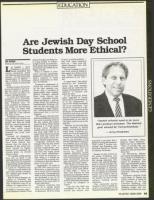
"Jewish schools need to do more
than produce scholars. The desired
goal should be `menschlichkeit.'"
— Jerry Friedman
demically, it was great. But it
lacked a caring environment.
That's when I became con-
cerned," says Friedman, who
describes himself as "liberal
or centrist Orthodox."
Despite his late arrival on
the scene, Friedman has
quickly assumed a leading
role among educators con-
cerned with ethical develop-
ment in Jewish settings. He
lectures and puts on seminars
and workshops at Harvard,
the University of California
at Los Angeles and elsewhere
around the country and in
Israel, and he has attracted
the interest of some of this
nation's leading Jewish
educators.
One nationally known
booster is Alvin I. Schiff, ex-
ecutive vice president of the
Board of Jewish Education of
Greater New York. "Jerry
deserves major attention,"
Schiff says in an interview.
"There is nobody else out
there dealing with Jewish
education with the focus that
Jerry has."
Jay Braverman, elemen-
tary school educational direc-
tor at Yeshiva of Flatbush, a
1,400-pupil Orthodox day ,
school in Brooklyn, New
York, says Friedman's work is
important because it links
traditional Jewish values to
contemporary, every-day
situations involving ethical
choices.
Friedman's analysis of the
moral state of Jewish day
school students is based on
the theories of the late
Lawrence Kohlberg, with
whom he studied at Harvard.
Kohlberg taught that suc-
cessful moral education must
THE DETROIT JEWISH NEWS
93