

BACK TO SCHOOL
c v..6
AVIT" al...11, •
••■■•■ 1•1•041•PAMINN•••
ih..a1 ,11.....qb • ■ •.11110.•nia•Aleale-Warara
AiliV.•-•11
•41..
vra,war
••.,•• ■ ..• 4,11D .111.1.1,7. ■
• ••• ■ •••-.C.
•'4 VAI.
AV.%
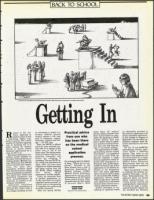
Artwork from the Los Angeles Times by Catherine Kanner. Copyright o 1989, Catherine Kanner. Distributed by Los Angeles Times Syndicate.
G e tt in g In
R
umors to the con-
trary, applying to
medical school is still
a harrowing, highly com-
petitive process. The overall
number of students applying
may be declining but it is
quite common for medical
schools to receive several
thousand applications for a
class of 100 or so.
Med school admissions com-
mittees accept students on
the basis of several factors, in-
cluding grades, Medical Col-
lege Admissions Test (MCAT)
scores and interview impres-
sions. For their, part,
premedical students spend
their first three years racking
up as good grades as possible,
then spend their fourth year
presenting themselves and
their accomplishments as
positively as possible to ad-
missions committees.
Admissions committees
have certain expectations of
premeds. For a start, while it
is no longer necessary, or even.
an advantage, to major in a
science, medical schools
usually require a full year
each of chemistry, organic
chemistry, physics and biol-
ogy — all with labs.
Next, the MCAT is offered
twice per year, premeds usu-
ally take it in spring of the
junior year or fall of the
senior year. The earlier exam
works out better with the ap-
plication timetable and
allows for retaking if
necessary. The new MCAT ex-
am, which was introduced in
April, 1991, will have more
emphasis on verbal reasoning
and essay writing than the
old MCAT. Many students
find taking MCAT
preparatory courses helpful.
- Lastly, an important facet
of premed preparation in-
cludes unwritten but highly
regarded extracurricular ac-
tivities such as volunteering
in hospitals and performing
scientific reasearch.
After the spring MCAM,
Practical advice
from one who
has been there
on the medical
school
application
process.
the premed grapevine begins
to buzz: "Where are you ap-
plying?" Premeds in the
know already have a copy of
American Association of
Medical College's (AAMC)
Medical School Admissions
Requirements and can rattle
off statistics on all 127 United
States medical schools. Other
premeds swear by their copies
of Gorman's Report, which
SHERI FINK
Special to The Jewish News
ranks those 127 medical
schools. Many premeds limit
their choices based on geog-
raphy. By applying to public
in-state schools, they may
have a better shot at admis-
sion and their medical educa-
tion may cost less than pri-
vate or out-of-state schools.
The applications of AAMC-
participating schools consist
of two parts — one completed
now and one later: First, ap-
plicants complete a single
primary application which re-
quires basic biographical in-
formation and a grade report.
AAMC forwards a copy of this
application to all schools in-
dicated on the designation
form. Not many applicants
return the form right on June
15, the earliest date AAMC's
Application Service (AAM-
CAS) accepts them. However,
early application is advisable
because some schools have a
rolling admissions system.
Schools interested in con-
sidering an applicant based
on information provided in
the primary application will
send a secondary application,
at the earliest in August or
September. The secondary ap-
plication requires more de-
tailed information and more
money.
For the 18 non-AAMCAS-
participating schools, appli-
cants follow a different
process. They write or call
directly to the admissions of-
fice of the school for a single,
comprehensive application.
Medical School Admissions
Requirements lists the ad-
dresses and phone numbers of
these schools.
Okay, the premed is ready
to complete the primary ap-
plication. First page — no pro-
blem. Enthusiastically, the
applicant spews out details
about extracurricular ac-
tivities, honors received and
undergraduate employment.
Turning the page, a mathe-
matical formula catches his/
her horrified eye. However,
THE DETROIT JEWISH NEWS
99