

INSIGHT
ZE'EV CHAFETS
Israel Correspondent
I
n what was supposed to
be a routine appearance
last week before the
Knesset Committee on Im-
migration and Absorption,
Rabbi Yitzhak Peretz
dropped a bombshell.
According to Rabbi Peretz,
who is the cabinet minister
in charge of immigrant ab-
sorption, there are currently
seven million people in the
Soviet Union eligible to
receive Israeli citizenship
under the Law of Return
—and the vast majority of
them are not Jews.
The reason for this lies in
the Law of Return, which
grants the right of Israeli
citizenship not only to Jews,
but to their non-Jewish
spouses, children and grand-
children. There are no
precise figures on the
number of such descendants,
but in the USSR, where
intermarriage has been
common for decades, experts
believe that there could be
five to seven million people.
The rationale for the Law
of Return's broad criteria
was (and remains) two-fold.
Some of its originators
argued that the law should
cover anyone who, under the
Hitlerian definition, was
Jewish, and thus in danger
of anti-Semitic persecution.
Others were influenced by
the demands of American
Jewish leaders, who lobbied
for criteria that would take
in the children and grand-
children of intermarried
Jews. "When the definition
was adopted, the problem
didn't seem very serious,"
says Zerach Warhaftig, the
former Minister of Religious
Affairs. "No one dreamed of
a mass immigration from
the Soviet Union."
Now that dream has
become reality, and the pos-
sibility that Israel could be
inundated with non-Jewish
immigrants is being taken
seriously by officials and
lawmakers. Michael
Kleiner, chairman of the
Knesset's Immigration and
Absorption Committee, re-
cently called for an amend-
ment to the Law of Return
that would exclude non-
Jewish grandchildren unless
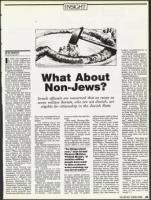
Artwork from Newsday by Gary Viskupic. Copyright a 1989, Newsday. Distributed by Los Angeles limes Syndicate.
What About
on-Jews?
Israeli officials are concerned that as many as
seven million Soviets, who are not Jewish, are
eligible for citizenship in the Jewish State.
they were accompanied by at
least one Jewish grand-
parent.
"I'm talking about the
potential danger of the im-
migration of between five
and ten million gentiles,"
Mr. Kleiner told journalists
here. "These are the descen-
dants of an assimilated Jew-
ish grandparent, and they
have no connection to, or
identification with, the Jew-
ish people."
Mr. Kleiner framed his ob-
jection to the immigration of
millions of non-Jews in
ideological terms. "I'm
prepared to defend the right
of the three million [Soviet]
Jews and their non-Jewish
relatives to come here, but
I'm not ready to fight for ten
million gentiles who will ar-
rive and want to set up chur-
ches," he said.
In addition to the
ideological argument, many
Israelis are concerned about
the financial burden that a
massive, largely non- Jewish
immigration would place on
the country.
There are already doubts
about how Israel can absorb
the approximately one mill-
ion o/im, or immigrants, —
the great majority of whom
are Jewish — now expected
to arrive within the next few
years.
This week, Housing Min-
ister Ariel Sharon asked the
government for $6.5 billion
to provide housing for the
newcomers, and warned
that, if the money is not for-
thcoming, hundreds of
thousands of people could
wind up homeless.
Finance Minister Yitzhak
Moda'i opposed the plan on
the grounds that the country
cannot afford it, and called
"As things stand
now," says Israeli
Finance Minister
Yitzhak Moda'i, "if
another million
people here want
to take a shower
every morning, we
run out of water."
for more modest solutions,
including the possible return
to the infamous ma'abarot
transit camps of the early
1950s. Mr. Moda'i also
pointed out that Israel must
develop and pay for the in-
frastructure to accommodate
the o/im. "As things stand
now," he said, "if another
million people want to take a
shower here every morning,
we'll run out of water."
This concern has made
many Israelis leery of the
huge wave of immigrants,
and unwilling to take in
those whose Jewish creden-
tials are tenuous at best. "I
read in the paper about a
Christian family who
happened to have a Jewish
grandfather 50 years ago,"
said Motti, a Jerusalem stu-
dent. "He got citizenship
here, and the government is
giving him an apartment
allowance. In the meantime,
I can't afford to pay my rent.
I don't mind sacrificing for
Jews, but there's a limit."
Despite the ideological and
economic difficulties in-
herent in a large non-Jewish
aliyah, many Israelis on
both sides of the political
spectrum believe that the
Law of Return should be left
as it is. "The Law of Return
is 2,000 years old, and enac-
ting it was the direct result
of the idea that every Jew,
and every person who could
be subject to persecution be-
cause of a connection to
Judaism, has a national
home," said MK Reuben
Rivlin of the Likud. "To
distort this idea because of
budget considerations is
worse than stupid."
On the left, some commen-
tators have warned that a
change in the Law of Return
could leave Israel open to
charges of racism. Others
are concerned that the
amendment could be used
by the Orthodox parties as a
means of excluding immi-
grants who are not Jewish
according to the traditional
rabbinic definition.
Minister of Interior Aryeh
De'eri of the Orthodox Shas
Party has already given
orders to check on the
number of non- Jews who
have arrived in recent mon-
ths. The usual estimate is
that up to 30 percent are
non-Jews, although the
great majority of them are
married to Jews, or are the
children of mixed marriages.
Another concern is that a
change in the Law of Return
could alienate Western
Jewry at precisely the mo-
ment that Israel is counting
on their financial and polit-
ical support. "[If we change
the law] what will the Jews
of America or Argentina
say?" asked Labor Member
of Knesset Shimon Shitreet.
"There, too, intermarriage is
a critical problem. Intermar-
riage is a widespread
phenomenon in the Jewish
people today. Is the aim to
drive away Jews who want
to return?"
At present, there does not
seem to be a majority for
amending the law, but that
could change, especially if a
large number of non-Jewish
immigrants begin to airive.
Already there are strains
between veteran Israelis and
the newcomers over the
allocation of the country's
scarce resources.
On Monday, the tabloid
newspaper Hadashot called
for a slow-down of immigra-
tion, and there are some
Israelis who want to estab-
lish a quota on aliyah that
would enable the country to
absorb new arrivals without
massive economic and social
upheaval.
"O/im are fine," said
Dorit, a Tel Aviv school
teacher. "But let them be
Jews. If we have any money
left over, we can start taking
care of the rest of the
world." El
THE DETROIT JEWISH NEWS
39