

FINE ARTS
Remington
STEEL
IS
STEVE HARTZ
Staff Writer
s a child, Henry Rem-
ington dreamed he
would grow up to
become a professional artist.
But his dream would have
to wait 65 years. First, Rem-
ington would have to survive
nightmares.
Born in Austria in 1906,
Remington spent most of his
young adult life working at
his parents' general store
and then selling sports
equipment. At 33, he trav-
eled through Europe,
wishing to receive an infor-
mal education in art. But in-
stead — he was given a for-
mal lesson in life.
"I couldn't get a job," said
Remington, who now lives in
Detroit. "Foreigners, then,
were not allowed to work in
other countries. I was pen-
niless."
To earn money, Remington
purchased and sold fabric
used to make clothing.
"That's how I survived. I
was a salesman."
In 1939, the Nazis invaded
Czechoslovakia, and Rem-
ington was thrown into a
small concentration camp.
Remington and several
other Jews, including a
woman, Greta Grossman,
bribed the Nazis so they
could leave the country.
"We spent 119 days on a
small boat with a Nazi flag
so they wouldn't be
suspicious that Jews were
aboard," said Remington,
who squeezed in the boat
with 710 others. "Occasional-
ly we were sent bread and
water, but for most of the days
we went without food. It was
hell."
Remington finally found
refuge in Israel, where he
married Grossman in 1950.
That year, he moved to
Detroit and was hired by
Ford Motor Company as a
designer. A few months after
he began working at Ford,
Remington caught
pneumonia and was
bedridden for several weeks.
As a result, he lost his job.
"When I got better, I
painted homes and held
various sales jobs — anything
to make a living;' he said.
Twenty years ago, Rem-
ington retired to pursue his
dream.
He first made flowers pots,
magazine racks, picture
frames and tables, using
different kinds of wood such
as ebony and walnut. Rem-
ington also built 70 lamps.
Next, he started working
with copper and sterling
silver, sculpting flowers and
using rocks and drift wood as
their bases. He also sculpted
copper-and-wooden vases.
One of his most precious
pieces of Judaic art is a
copper menorah.
Remington's latest project
is designing earrings,
bracelets, necklaces and
charms. He has made more
than 100 pieces of jewelry.
Because Remington
cannot afford fees charged
by most local art fairs, and
art galleries will not be
responsible for the loss or
damage to his art, he
displays his work at his
home.
His handmade furniture,
jewelry, copper and silver
sculptures and Judaic art
work may be the best kept
secret in town.
Although he's mastered
several art courses and
received various art awards,
Remington said, "God gave
me the talent to sculpt; you
cannot learn this. This takes
a lifetime. You need to have
imagination. Everything I
learned is from my imagina-
tion — not art classes."
❑
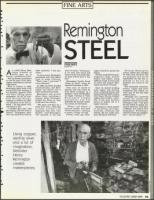
Using copper,
sterling silver
and a lot of
imagination,
Detroiter
Henry
Remington
creates
masterpieces.
THE DETROIT JEWISH NEWS
63