

I WEST f
BLOOMFIELD
I
APPLE
ANAHID DERBABIAN
Special to The Jewish. News
A
pple Island. A deli-
cious name for a 35-
acre island surround-
ed by the waters of Orchard
Lake, in West Bloomfield.
Many moons ago, Indians
named the island Me-nah-sa-
gor-ning, meaning Apple
Place. They saw it as "the
beautiful isle of somewhere."
The island's name may be
derived from the Hawthorne
trees growing fruit resembl-
ing red, ripe apples. Another
theory is that ancient apple
trees on the island today are
believed to have been planted
by Indians, and thus the
name Apple Island.
A different story credits
Johnny Appleseed as the
gardener who planted those
apple seeds, but no historical
facts support this tale.
The West Bloomfield School
District acquired this
"beautiful isle of somewhere"
via donation, for purposes of
scientific and nature study.
Referred to as the Marjorie
Ward Strong Woodland Sanc-
tuary, Apple Island was nam-
ed after the last owner.
"As I see the development
around here, just a few sites
remain for people to enjoy,
and Apple Island is one of
them," said Jerry DiPaola,
director of community educa-
tion for West Bloomfield
Schools.
WB-8
FRIDAY, JULY 13, 1990
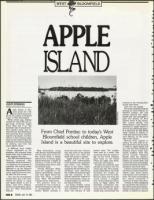
From Chief Pontiac to today's West
Bloomfield school children, Apple
Island is a beautiful site to explore.
West Bloomfield, along
with Toronto and Switzerland
are the only areas in the en-
tire world where a school
district owns an island. Apple
Island measures a length of
3/8 mile, a width of 3/4 mile
and borders more than a mile
on Orchard Lake.
"During Michigan Week,
tours are conducted on the
Island," said DiPaola. Anyone
may visit Apple Island but
must first obtain a permit
from West Bloomfield's
transportation department.
Two pontoon boats are
available for rent to those in
search of adventure, each able
to accommodate up to 15
adults. Rental includes a
driver for each boat. Visitors
may also come to the Island
using their own crafts but
must still secure a permit.
"Apple Island is left unat-
tended, and unfortunately
we've experienced vandalism
and fires," said DiPaola.
Trash on foot paths, illegal
campfires left smoldering, un-
necessary noise disturbing
the wildlife, demolished signs
and the ruination of the
island's shoreline vegetation
from snowmobiles riding up
on shore display the harm Ap-
ple Island endures.
An Indian maiden, whose
tribe inhabited Apple Island
was betrothed to a young
chief, who became ill and
passed away. The maiden
went mad as a result. She
constantly fled the island to
dig up her love's remains,
place them on the island
where his lodge once stood,
and kneel and lament.
Finally, the medicine man
advised the tribe to kill her,
which they did. This outrag-
ed the Great Spirit, who then
furnished the maiden ab-
solute control over the tribe.
Between dawn and dusk she
would assume a tangible
form. By pounding the Indian
drum on foggy nights, she
devotedly summoned war-
riors who brought her love's
remains for her caress. After-
wards, they carried back the
remains to his resting place
by the lake shore.
That was one legend.
The most celebrated legend
belongs to Chief Pontiac, an
Ottawa Indian. He had
always fancied the Apple
Island site and arranged to
plan his attack on Fort
Detroit while at the island.
The attack failed, and
disheartened Chief Pontiac
returned to Apple Island to
live out his remaining years.
It is said that he was killed
while trading in Illinois in
1769 and was buried on Pon-
tiac's Mound, on the south
side of the island.
Moving from legend to
history, we note that an In-
dian reservation set up camp
in 1825 on Apple Island and
on a 107 acre area of land on
Orchard Lake's south side.
Island artifacts from this
period include wampum
(beads used for money),
pewter received from French
traders, an ancient dish, and
a basswood canoe presumably
constructed from the island's
abundant basswood trees.
Indians hunted and fished;
the forest contained squirrels,
rabbits, deer, bears, ducks,
wild turkeys and varieties of
birds. The water surrounding
the island contained a
multitude of fresh-water fish.
A treaty in 1827 transferred
the island from the Indians to
the white man's government.
Indians continued to visit the
island, to behold its natural