
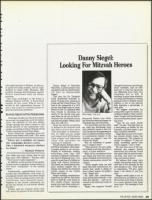

Danny Siegel:
Looking For Mitzvah Heroes
SLOWER GROWTH FOR FEDERATIONS
Although all sides say the newer charit-
ies are not in competition with the federa-
tions, the addition of the new philan-
thropic groups has been a factor in the
slowed growth of the mainstream cam-
paigns, according to Barry Kosmin of the
North American Jewish Data Bank.
Major federation campaigns have col-
lected more money each year. "But since
"There are a number of causes
the campaign doesn't cover,
like a battered women's shelter
in Israel.
— Michael Pelavin
[the 1960s and early 1970s], they've just
kept pace with inflation," Kosmin said.
"They haven't really expanded."
In addition to the growth of the philan-
thropic sector in general, Jewish money is
now more "acceptable" in the outside
world.
Traditionally, organizations have re-
warded big contributions with seats on
prestigious boards that were often closed
to Jews. With an easing of that overt dis-
crimination, more financial major-
leaguers in the Jewish community are
giving big chunks to non-Jewish philan-
thropies.
Kosmin said his research shows that
only about 50 percent of the Jewish phil-
Danny Siegel of Rockville,
Maryland, is proof positive that
one person and one small charity
can have an immeasurable
impact.
This year his Ziv Tzedakah
Fund distributed $165,000 to
about 70 grass-roots charities in
Israel and the United States. The
fund is the outgrowth of a 1975
private trip Siegel made to IsraeL
Before he left, he collected $955
from friends to distribute for
charity in the Jewish state and,
once there, he set out to find lit-
tle known but worthwhile causes
and mitzvah people. Fifteen years
later, he's still at it.
Siegel has become increasing-
ly devoted to his mitzvah work
(see Detroit Jewish News story,
"The Pied Piper of Tzedakah,"
Feb. 12, 1988) and has sought
and helped fund off-the-beaten
track projects and individuals
whose work personifies the
meaning of tzedakah.
His pet projects include Life for
the Old in Jerusalem, where elder-
ly people gather to eat and par-
ticipate in workshops, making
everything from toys and
sweaters to Sabbath tablecloths;
the work of Hadassah Levi, who
cares for more than 40 children in
Israel with Down's Syndrome;
Yad Sarah, an Israeli group that
lends medical supplies free of
charge; and shelters for battered
Jewish women in the United
States and Israel.
Siegel's funding contributions
range from $41,000 for Yad Sarah
down to $100 for such funds as
The Giraffe Project, honoring
people who stick their necks out,
and Daddy Bruce Randolph, a
Pho to By Cr aig Te rkowi tz
■.■
ants rights project in Harlem, an advoca-
cy group for Asian women, and an orga-
nization in Great Falls, Montana, that
combats housing discrimination against
Native Americans were all recent
gr antees.
One local contributor to the Fund is
Michael Pelavin of Flint. A Fund board
member for four years, Pelavin was at-
tracted to the organization because "it
was a way to give in a Jewish manner to
general community problems."
Danny Siegel: "Just do it."
90-year-old Denver man whose
free barbecues feed the hungry on
Thanksgiving and Christmas.
"I'm proud that over the years,
my fund has distributed more
than $800,000 raised in the U.S.
and Canada and has generated at
least an additional million dollars
in contributions directly to the
charities we support," says the
45-year-old SiegeL
Why do hundreds of people
give to Siegel's fund?
"We're haimish," he says, using
the Yiddish word that describes a
warm, at home ambience.
Many of his contributors have
met Siegel and heard him speak
about tzedakah in his lectures in
Jewish communities around the
country.
"These people trust me and
know that their contribution, ho
matter how small, is going to
have a direct impact on people's
lives," Siegel says.
He adds that contributors
know he has little overhead — less
than four percent — and are at-
tracted to his informal, hands-on
approach.
Siegel, who supports himself
through his lectures and writings
about tzedakah, says he tries
hard not to treat his big givers
any differently from those who
contribute $10 or $18. If
anything, he gives more attention
to young contributors by writing
personal notes to Hebrew school
children or bar or bat mitzvah
kids donating a percentage of
their gifts.
The biggest motivation for
young Jews to give to charity, ac-
cording to Siegel, is their concern
about hunger and homelessness,
with environmental issues a grow-
ing worry
"How do you reach Jewish
kids?" he asks. "You take them to
a food pantry or shelter for the
homeless, and then begin to get
them involved Jewishly."
Siegel directs most of his fund-
ing towards Jewish causes, but
not exclusively. "My criterion is
simple," he explains. "If they are
doing something special that
merits support, I try to help."
He says that most of his con-
tributors also support Jewish
federations, but some are "brand
new givers, like bar and bat mitz-
vah kids, and some are adults
who just haven't given."
He believes that many Jews
simply stop giving charity after
their bar or bat mitzvah for the
next decade or two. "They think
to themselves, 'I'll give again
when I can afford it, and just
stop."
Siegel's whole point is not to
wait until you can afford it, or un-
til you have more time to devote
to a cause, because those times
never come. "My message is: Just
do it." D
THE DETROIT JEWISH NEWS
29