

FINE ARTS
THE
CUTTING
EDGE
=s ir i
4 41.•t.;
Kalamazoo artist Mary
Etta Moore is a cut
above the rest.
Special to The Jewish News
W
hen most artists
look at a blank
page they ask,
"What can I put on it?" When
Mary Etta Moore looks at a
page, she asks, "What can I
take away?"
Moore is a papercutter — an
artist who cuts intricate
designs out of paper. The
43-year-old Kalamazoo artist
is one of only a dozen or so
Judaic papercutters in the
United States. Her work,
which usually sells for bet-
ween $30 and $500, has been
exhibited around the country
and is unique among paper-
cuts because of its il-
luminated Hebrew letters
and incredible detail.
"Most papercutters just cut
silhouettes of the letters. I'm
the only one I know who cuts
inside the letters as well," she
says. Moore's letters are
populated by a menagerie of
animals, plants and shapes.
Her figures, too, are unique;
rather than cut round, styliz-
,101 11111P3 4 "4 „40 ,....
.._ 111...,,m)1i4114*, 4+,..44:4154t.
.,,,:www 44,...^..., "....1 Ai& 1,:t ,4", ...,.•
''..4"'-
..1P..1r4;"'"4(lie'r.te.11* rill
IT
" .." .
Z.- &IS. }W., ffer .
wr. aw- lipir,.:
- -Amor
"44';•,..Af_Akilte ' 1 '7'
■ Pr-
4
1. "4 I '0
Ap oi s. r, ., ...6 * ......:1Y4
4'*-
*Iff.4, 4'
, ,14 Iluw
161"' Nr.
,,
Photos by Dan Rosen
MICHAEL WEISS
ed animals in the Eastern
European tradition, she
favors a more naturalistic ap-
proach. And the detail is
phenomenal; for example, she
can cut a leopard an inch high
and include distinct spots.
Moore's work ranges from
the simple to the incredibly
complex. Luach (Calendar), at
$985 is her most expensive
piece to date and features a
reproduction of a mosaic
zodiac from the floor of Beit
Alpha, an ancient synagogue
in Israel. Hineni (Here I Am),
a special order commissioned
for Congregation Beth
Achim's Cantor Max Shiman-
sky, features the text from the
Hebrew prayer "Hineni"
superimposed on the sheet
music for the song, topped off
by a framed portrait of
Shimansky himself.
Some of Moore's works are
available as silkscreens, a
process in which relatively in-
expensive ($15-$40) ink
reproductions can be mass-
produced. One work in pro-
gress that will have to be im-
mediately silkscreened upon
completion is the Hebrew
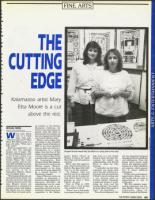
Daughter Miranda helped Mary Etta Moore at a spring show in Ann Arbor.
prayer Eishet Chayil (A
Woman of Valor), for which
Moore has received numerous
requests.
Moore says that papercut-
ting, which derives from an
Eastern European folk tradi-
tion, is a lot like Judaism.
"In Judaism, what you
don't do can be as important
as what you do. In papercut-
ting, what I remove is as im-
portant as what I leave
behind," she says.
Born in Flint in 1947,
Moore was a child prodigy
who excelled in school.
"When I was in 2nd grade,
I was tested reading at a col-
lege level, so I was always
bored in class," she says. For-
tunately, her teacher was
understanding, and allowed
Moore to spend her time
drawing.
"I remember one day when
everybody was doing math
and I was still working on a
drawing I had started earlier.
I think it was of a turkey, and
I was drawing each in-
dividual feather. Somebody
complained because I wasn't
doing my work, and the
teacher told him, You need to
do math. Mary Etta needs to
draw, " she remembers.
The acknowledgement that
art was important continued
throughout Moore's childhood
and adolescence. From 4th
grade until junior high
school, she attended weekly
lessons at a Flint children's
art program, which exposed
her to many different
techniques.
Unlike most contemporary
papercutters, Moore, who is
self taught, did not come to
papercutting by way of
calligraphy.
"My first amateur paper-
cutting experience was cut-
ting Hebrew letters out of
construction paper for
bulletin boards at the Hebrew
THE DETROIT JEWISH NEWS
63