

INSIGHT
O
ZE'EV CHAFETS
Israel Correspondent
T
his week, the long-
anticipated power
stuggle in Israel's op-
position Labor Party reach-
ed a new stage, with the
majority of Labor's
parlimentary faction defec-
ting from party leader
Shimon Peres to arch-rival
Yitzhak Rabin.
On Suiiday, both men held
solidarity rallies of their
supporters. Only four Mem-
bers of Knesset — former
cabinet ministers Chaim
Bar Lev and Avraham Katz-
Oz — and two young back
benchers, attended the Peres
meeting.
By contrast, 20 MKs and
15 heads of regional party
committees showed up at the
Rabin conclave. They in-
cluded a number of promi-
nent doves, such as Aryeh
"Lubah" Eliav and Uzi Bar
Am, who have been strong
critics of the former Defense
Minister. The doves cast
aside ideological objections
for pragmatic considera-
tions. "If we want a large
party, we must enter a polit-
ical coalition with Rabin as
its leader," Bar Am told the
gathering.
This no-nonsense approach
is founded in the widespread
assumption that Peres is an
electoral liability. Last
weekend, a poll published in
the afternoon daily
Chadashot showed him re-
ceiving the support of only
11 percent of the public. By
contrast, Rabin led all
potential prime ministerial
candidates, including Yit-
zhak Shamir, with slightly
more than 24 percent.
The issue of Peres' pop-
ularity has surfaced now
that his party finds itself in
the opposition for the first
time since 1984. Moreover,
many of Peres' colleagues
accuse him of political in-
competence for having
brought down the previous
government of national uni-
ty, in which he served as fi-
nance minister, without be-
ing able to set up a Labor-led
alternative.
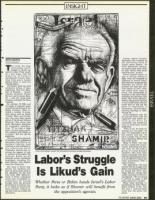
Artwork by Richard Milholtand. CopyrightC 1990, Richard Milholland. Distributed by Los Angeles Times Syndicate.
Labor's Struggl
Is Likud's Gain
Whether Peres or Rabin heads Israel's Labor
Party, it looks as if Shamir will benefit from
the opposition's agonies.
Former cabinet minister
Mordachai Gur summed up
the prevailing mood of
Labor's senior echelon: "In
every democratic country,
the leader steps aside when
he fails. That's what Peres
should do now," he said.
Peres himself shows no
sign of leaving without a
fight. Over the weekend he
appeared on several televi-
sion interview programs and
defended his record. He
pointed out that the elec-
toral failure of 1977, when
the Likud first came to
power, was precipitated by
scandals in the Labor Party,
including the discovery that
Rabin, then Prime Minister,
held an illegal bank account
in the United States. He also
noted that he had led the
party to respectable, if
ultimately unsuccessful,
electoral showings in 1981,
'84 and '88.
At his solidarity rally, the
67-year-old Peres told his
supporters that public opi-
nion polls were an
unreliable and dangerous
way to determine party
leadership.
"First of all, we must de-
termine our own path," he
said. "It's impossible to go to
the country and say, 'we
have a leader, but we don't
have a direction.' Where will
this leader lead?"
Many of Peres' own sup-
porters remained uncon-
vinced. Following his Sun-
day rally, he met with a
group of young Knesset
members who have been
closely associated with him,
and who participated active-
ly in his efforts to replace the
unity government with a
Labor coalition.
The legislators told him
bluntly that the stuggle with
Rabin was hopeless and that
he should step down. One,
Hagai Marom, warned that
a fight could end in Peres be-
ing deposed. "We are trying
to prevent an injury to the
party, and to you," he said.
Many Labor activists, re-
membering the bitter Peres-
Rabin battles of the '70s,
fear that a renewed battle
could tear the party into
pieces.
THE DETROIT JEWISH NEWS
37