

CLOSE-UP
Mobsters
Continued from preceding page
man, since we had nothing
to lose. He called the
gangster's office and I was
invited upstairs. When I
entered, I faced his
secretary. It was like
something out of a movie.
She was blond, wore a low
cut dress with her bosom
half out, and was chewing
gum and filing her nails.
She never even looked at me,
but said, 'Go in; he's expec-
ting you.'
"When I went in, all I saw
were someone's feet on the
desk, a newspaper and cigar
smoke curling up from
behind the paper. After
standing quietly for a few
minutes, I cleared my throat
a couple of times. The paper
was lowered and Sam said,
`Sit down and tell me what
you want? When I finished,
he said O.K., he would help.
Now this Sam was good
friends with the president of
Panama. They were very
close. And Sam contacted
him for us. From then on, all
our ships carrying weapons
to Israel were registered in
Panama and flew under the
Panamanian flag. This was
a very, very big help to us."
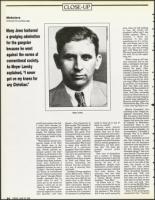
Many Jews harbored
a grudging admiration
for the gangster
because he went
against the norms of
conventional society,
As Meyer Lansky
explained, "I never
got on my knees for
any Christian."
Meyer Lansky
could I have gotten into that
I could have become in-
volved with such people? I'm
not talking about racket
people. I'm talking about
celebrities, politicians, peo-
ple in higher walks of life
and education."
What did the Jewish com-
munity think of all this?
The Jewish man in the
street harbored mixed feel-
ings. Jewish parents ex-
pressed anxiety lest their
children be attracted to the
lifestyle of the gangster and
seek to emulate him.
Despite their fears, however,
many Jews harbored a
grudging admiration for the
gangster because he was a
"slugger" who went against
the norms of conventional
society without caring what
the "goyim" thought. Meyer
Lansky expressed this at-
titude when he said, "I
never got on my knees for
anyone. I never got on my
knees for any Christian?'
Jewish gangsters also
received respect for another,
less familiar, role they
24
FRIDAY, JUNE 29, 1990
played — that of protector of
their people. The funeral of
Chicago Jewish gangster,
Samuel "Nails" Morton, il-
lustrates this point. Five
thousand Jewish mourners,
including rabbis, accom-
panied the hearse to the
cemetery. Local reporters
were astounded. Why would
so many Jews attend the
funeral of a notorious
gangster? One of the rabbis
explained that when Morton
was alive he protected and
defended the Jewish
neighborhood from attacks
by Irish and Polish Jew-
baiters. Attending the
funeral was the communi-
ty's way of showing their
gratitude.
Another Chicago mobster,
Davey Miller, said, "What I
have done from the time I
was a boy was to fight for my
people here in the Ghetto
against Irish, Poles or any
other nationality. Maybe I
am a hero to the young folks
among my people, but it's
not because I'm a gangster.
It's because I've always been
ready to help all or any of
them in a pinch."
Indeed, some Jewish
criminals went so far as to
believe that one of their
gang's functions was to pro-
tect Jewish neighbors and
interests. When one such
gangster was told that there
were no Jewish gangsters in
Milwaukee, his first ques-
tion was, "Do Jews get
pushed around much
there?"
This view of themselves
led a number of leading
Jewish criminals to provide
Israel with much needed aid
during its war of in-
dependence. Despite their
disclaimers, Jewish leaders
accepted and even solicited
this help. Ruben, the
emissary who met with
Bugsy Siegel, also met with
a leading Miami Jewish
gangster, "Sam May?'
As Ruben tells it, "The
contact was made for me by
a Jewish lawyer whose office
was in the same building as
the gangster's. The lawyer
felt it was worth seeing the
Murray Greenfield, who
had been in the "illegal im-
migrant" movement, Aliya
Bet, was sent to the United
States by the United Jewish
Appeal and given the name
of someone in Baltimore.
Greenfield went to the
man's house and was told to
come back at midnight. As
he remembers, "I thought it
strange. But if it helped
Israel, I would do it."
When Greenfield arrived
late that evening, he was
ushered into the basement
recreation room and told to
wait. At about 12:30 a.m.
the door opened and "the
strangest group I had ever
seen entered. The men were
all short and stocky, with no
necks. Their female compa-
nions were all blondes. The
men sat on one side of the
room, the women on the
other." The host asked
Greenfield to tell his story.
When Greenfield finished,
his host said, "O.K., you
guys know why you're here
and what you have to do?'
And then he looked around
the room and said, "Joe,
you're giving $5,000; Max,
you're giving $5,000; Harry,
you're giving $10,000."
Some of the participants
complained that "business