

SPORTS
HORSING
L 11%0 AROUND
rowing up in 1950 De-
troit, David Harold
went horseback riding
at a Jewish-owned stable on
the city's outskirts at Eight
Mile and Greenfield.
A decade later, there was
Outlands, a ranch at the in-
tersection of Lahser and 14
Mile.
Today, he notes a bit sadly,
the only "horses" he finds at
either location are Mustangs
and Broncos, zipping by at 50
miles per hour.
Metropolitan Detroit's ur-
ban sprawl, coupled with ris-
ing insurance costs for ranch
operators, has limited the
number of horseback riding
opportunities in recent years,
Harold and other riding en-
thusiasts say. The difficulty
in finding good, easily ac-
cessible trails is the major
drawback to an otherwise
rewarding, if sometimes ex-
pensive, hobby.
"There used to be no end to
the places you could go riding,
starting with Belle Isle," said
Harold, a urologist. "Now the
phone book lists maybe a
half-dozen, if that. And the
rides to get there are much
longer. There's no public
transportation.
"Land we used to ride on is
progressively being
developed," the West Bloom-
field resident said.
Harold cited the now-
defunct Roy's Ranch as a re-
cent example of a stable clos-
ing down to make way for
developers. Roy's, on Walnut
Lake east of Haggerty, drew
a substantial number of area
riders, he said. It also was a
popular destination with
Jewish youth and community
groups for horseback riding,
hayrides and other activities
well into the 1980s.
But, Harold said, the
owners' taxes skyrocketed as
the prime suburban land in-
creased in value. Eventually,
the site was considered too
valuable and was bought up.
Furthermore, the potential
liability and corresponding
insurance fees faced by ranch
and stable owners who allow
public use of their facilities is
"as bad as the medical mal-
practice situation."
As recently as eight years
ago, Harold said, it wasn't
unusual to see riders trotting
G
through rural neighborhoods
in West Bloomfield and other
suburbs. In fact, in 1982, as
construction workers were
breaking ground for his house
in the Wabeek subdivision,
they were saluted by a couple
on horseback, he said.
Although horses are still
allowed on the streets of
Franklin, virtually every
other municipality in the tri-
county area has ordinances
prohibiting them.
Even suburban riding
facilities that choose to stay
in business are affected by
commercial and residential
development, said Rick
Siegel, a podiatrist who took
up horseback riding three
years ago. Haverhill Farms,
the Walled Lake stable where
Siegel boards his quarter-
horse, sold a portion of its pro-
perty to condominium
developers last year.
"It's becoming more and
more difficult to find a good
place to ride," Siegel said.
Norm Pickvert Jr., manager
at Silver Saddle Riding
Stable in Ortonville, affirmed
that rising insurance costs
are the primary reason fewer
stables rent out horses.
For example, Pickvet said,
liability insurance to cover 10
horses this year will cost his
stable $5,500, which he said
is "up dramatically" from just
a few years ago.
He said the stable takes
precautions to eliminate
potential claims. "We make
sure the horses are saddled
and groomed properly and we
go over all our equipment
every four days to make sure
it's in good shape."
"Nobody ever accidentally
falls off a horse anymore,"
said a manager at Willow-
brook Farm in Novi, who ask-
ed not to be identified. "It's
always the stable's fault,
never the rider's."
Willowbrook carries no
liability insurance and re-
quires riders to sign a waiver
before mounting a horse, the
manager said. He said in-
surance was dropped in re-
cent years when it became
"cost-prohibitive."
"It was either eliminate in-
surance or eliminate
somebody's job," he said.
Encroaching development
was the reason for Silver Sad-
'*K
to
a>
0
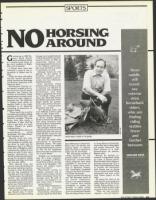
Harold keeps a saddle in his garage.
die's 1989 move to Ortonville.
Before that, the facility was
leasing space in Auburn
Hills, but had to relocate to
make way for the Palace.
The decreasing number of
riding facilities for the
general public is one reason
traditional summer-camp
riding programs have been
expanded to year-round ef-
forts in recent years, accor-
ding to Madonna Hinson,
who coordinates horseback
riding at the Fresh Air Socie-
ty's Camp Tamarack.
Hinson oversees the Spring
and Fall Roundup based at
the Jewish Community
Center, a six-week horseman-
ship program that teaches
youngsters in grades five
through 10 about riding.
Students enrolled in the pro-
gram are bussed each Sunday
from the Maple-Drake Center
to Camp Maas in Ortonville,
where they learn riding skills
and proper horse-care. The
final session is a skill
demonstration for parents,
Hinson said.
Harold, 44, became in-
terested in horseback-riding
as a teen. A Toronto native,
Harold said his first riding ex-
perience came at age 15 at a
Labor Zionist Habonim Camp
in Canada. His fascination
with horses was so strong
that he taught himself riding
techniques and even wrote
high school papers on the
topic.
He spent four years as an
instructor for area camps and
today helps out at the Silver
Saddle Riding Stable in Or-
tonville, where he often rides
as much as four hours a week.
"They are big, powerful,
majestic — but not frighten-
THE DETROIT JEWISH NEWS.
61