

DETROIT
Local Jews Join In May 20
AIDS Candlelight Vigil
ELIZABETH APPLEBAUM
Assistant Editor
A
s a volunteer with the
Wellness Networks, a
local clearinghouse
for information about AIDS,
Peter Cooper hears ques-
tions ranging from the
ridiculous to the tragic.
One woman wanted to
know if she could catch
AIDS from men's pajama
bottoms. Another asked if
she should have her
daughter tested for the
disease; the girl had just
been sexually molested.
Cooper is one of a number
of Detroit-area Jews who
work disseminating infor-
mation about AIDS and help
those with the virus. Among
his projects, Cooper is serv-
ing as a volunteer on the 7th
International AIDS
Cooper has seen a
great change in
the Jewish
community's
attitude.
Candlelight Memorial,
which will be observed in
Detroit 8:30 p.m. May 20 at
the Westminster Presby-
terian Church.
More than 180 cities in 32
countries will participate in
the international vigil,
which is coordinated by the
San Francisco-based
Mobilization Against AIDS.
The Detroit program will in-
clude guest speakers, a
candlelight procession and a
silent vigil. Panels from the
NAMES quilt, which com-
prises hundreds of panels
made for those who died of
AIDS, also will be on
display.
Speaking at the vigil will
be Rabbi Lane Steinger of
Temple Emanu-El, who as a
board member of Wellness
House, a local organization
that provides housing, food,
medical supplies and visitors
for those with AIDS, meets
with individuals diagnosed
with the virus. Regional Co-
Chairman of the AIDS
Committee of the Northeast
Lakes Council-Metropolitan
Federation of Reform Syn-
agogues of the Union of
American Hebrew Con-
gregations, Rabbi Steinger
says he's participating in the
vigil because "AIDS touches
many people, including
Jews, and we can't turn our
backs."
Peter Cooper has been try-
ing to educate the public
about AIDS for the past five
years, since he began vol-
unteering with Wellness
Networks. For two years he
has worked on the group's
hotline, where callers in-
clude everyone from those
asking how the virus is
transmitted to physicians
requesting information on
the newest medicines used to
combat AIDS
"There is no cure," says
Cooper, also a volunteer
with an AIDS support group,
Friends. "The best thing we
have to fight AIDS is edu-
cation."
Cooper also has con-
tributed to one of the most
well-known AIDS projects,
the NAMES quilt.
The first piece of the quilt
was dedicated in 1987 by
San Francisco's Cleve Jones,
who created the panel in
memory of his friend, Mar-
vin Feldman. Since then,
hundreds of panels have
been added and the quilt has
been on display in cities
throughout the country.
Cooper, who wears a
button that says "Fight
AIDS, Not People With
AIDS," created two panels
for friends who died of the
disease. He volunteered to
help display the quilt in
Detroit and in Washington,
D.C.
Cooper also volunteers as a
"buddy" for someone who
carries the AIDS virus. This
work can include everything
from taking the person with
whom he is paired to a movie
to finding him a
housekeeper. Cooper's first
"buddy," who was Jewish,
died last November.
In his five years working
for AIDS education, Cooper
has seen a great change in
the Jewish community's at-
titude toward the disease.
Three years ago, Cooper
asked a local Jewish agency
to make available brochures
describing AIDS. He was
told, "That's not an issue
that concerns us."
Several weeks ago he
called the same agency, ask-
ing that brochures about the
May 20 vigil be placed
around the office. This time,
the director told Cooper,
"Give me 50 copies."
As care coordinator of the
AIDS Care Connection,
Carolyn Forbes arranges for
insurance, home health ser-
vices, nurses, support groups
and other care for those with
the AIDS virus.
Forbes originally worked
as a legal researcher and in
labor relations. Then she
learned of an open position
as hotline/volunteer coor-
dinator for Wellness Net-
works.
"When I saw that, I knew
it was my job. It had my
name on it," she says.
Forbes will never forget
working on the hotline. Men
and women often told her of
their tremendous heartache.
"To enter their lives and be
of some assistance was a
tremendous privilege."
Seven years ago Forbes
didn't know anyone with the
virus, she says. "It seemed
so remote from my life."
Now, she works on a daily
basis with men, women and
children diagnosed with the
AIDS virus, along with their
families. While she sees a
great deal of anguish, Forbes
also is witness to "the truly
heroic way some people re-
spond. There's a very spiri-
tual dimension to seeing
how people affirm their lives
even in the process of death
and dying."
Such support programs,
along with education about
the virus and funding for
AIDS research, is critical for
a number of reasons, Cooper
says.
First, Cooper points to the
stigma attached to those di-
agnosed with the AIDS
virus.
Second, Cooper said, "If we
can catch this in the bud, we
can save a lot of lives. If we
had started doing research
10 years ago . . . "
Cooper also says AIDS ed-
ucation and research is
necessary because the
disease is communicable.
While today persons from all
walks of life have been diag-
nosed HIV-positive, 10 years
ago when the public first
learned of AIDS "most peo-
ple thought it was limited to
gays and iv-drug users, and
who cared if they died?"
Forbes agrees. "People
could write off homosexual
men and the i.v.-drug
users," she says. "They said,
`Oh, they're on the outside of
mainstream society,' or,
`They deserve it.'
"What it really means
when we put labels on people
is that we don't have to be
responsible to them. What
we don't see is that 'they' are
4 us. ,
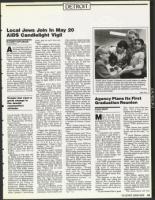
Greater Detroit Chapter of Hadassah will provide stickers for patients
at Children's Hospital of Michigan who have taken their medicine or
completed a procedure. Nurses at the hospital have been providing
the stickers at their own expense. Presenting the first batch of
stickers to Children's patients are Hadassah's Lauren Bruss, Francine
Hack and Arline Gould.
Glenn Triest
Agency Plans Its First
Graduation Reunion
SUSAN GRANT
Staff Writer
M
ore than 60 years
have passed since
Naomi Floch
graduated from United Heb-
rew Schools. But the years
have not dimmed her fond
memories of the school and
the education she received
there.
"I remember the wonder-
ful teachers," said Floch, a
member of UHS' first high
school graduating class in
1928. "The teachers may not
have had the degrees needed
(to teach in today's schools),
but they understood the psy-
chology of an American
child," Floch said. "The
discipline was better. The
teachers would simply not
tolerate misbehavior."
Floch and an estimated
1,100 UHS graduates can
reminiscence about their
school days during a 7:30
P.M. June 11 reunion at
UHS. Humorist and author
Allan Gould, who attended
UHS, will speak about Jew-
ish education.
The reunion is the first
since UHS, now called the
Agency For Jewish Edu-
cation, began graduation
ceremonies, said Sylvia
Iwrey, one of the event's or-
ganizers.
"It just seemed like a good
idea," Iwrey said of the reu-
nion. "It's a way to con-
solidate our identity."
Reunion co-chairman
Joseph Colton, who
graduated in the class of
1931, said he discovered
front-page newspaper stories
about UHS graduation
classes.
"That shows how central
to the community Hebrew
school was at the time," he
said.
"I think Hebrew schools
are undergoing a revitaliza-
tion today," said Colton, who .
continues to take classes at
the Agency For Jewish Edu-
cation. "For a number of
years, it didn't have the
same dynamics that it does
today. Now people recognize
the high school as part of the
community."
Reunion co-chairman Ben
Rosenthal, who graduated in
1965, said the UHS has
become "one of the unknown
assets of the community."
But Rosenthal admits he
didn't appreciate his Hebrew
education until after
graduation.
Ofra Fisher, agency exec-
utive director, said Rosen-
thal isn't the only graduate
to feel that way. She has
heard from 200 graduates
who are eager to come to the
reunion and talk about their
experiences.
Yet, graduates tell her
THE DETROIT JEWISH NEWS
15