
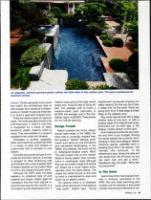

An elaborate, carefully groomed garden softens the brick deck of this outdoor pool. The pool is positioned for
maximum privacy.
known). People generally build pools
that match the architectural style of
their houses; thus, owners of a contem-
porary or modern house are more like-
ly to build a geometric-shaped pool.
There are various types of inground
pools. The most popularly priced is the
vinyl-lined pool, in which a vinyl liner
is supported by a frame of steel,
aluminum, plastic, masonry block or
wood. They are available in a range of
predetermined sizes and shapes.
Fiberglass is another possibility,
either purchased as a preformed shell
in a range of sizes and shapes or
custom-built with a concrete or vinyl
bottom.
Concrete and gunite (a type of con-
crete) are the other options. Concrete
is sprayed on steel reinforcing rods
and finished with a coat of plaster. Both
of these materials can be custom-fitted
to a lot in any shape the buyer wants.
Although the NSPI does not keep
statistics on preferred type of pool
material and shape, Nelson gets the
impression that the most popular in-
ground pool around the country is a
concrete of gunite rectangular pool. A
boards aren't as popular anymore, for
safety reasons. So now you don't have
a 'deep end' (of the pool). Pools are
going from 10 or 12 feet deep to 6 feet
deep at the deepest end."
Play pools may be built with a large
shallow area at one end, or with a
shallow depth of 3 1/2 feet at both ends.
Swimmers can do their laps in the
Design Trends
deeper middle section of the pool.
Nelson predicts two future design
As for features to enhance your pool,
trends nation-wide. In the 1980s, the
the only limit is your budget. Among
trend was to unusually shaped free-
the extras people are currently incor-
form pools in "natural" settings, which
porating in their pool designs, Nelson
meant such items as rock formations
mentions islands, waterfalls and in-
and naturalized landscaping. In the
teresting tiling. But in her opinion, "the
1990s, she believes, the trend will be
ultimate," she continues, "is the
to rectangular-shaped pools. Why?
refreshment area, along one side and
The pool covers now on the market.
with stools built into the pool, so you
Made of sturdy plastic, they normally
can swim over and get a drink."
come in rectangular sizes although
Needless to say, she adds, "We're talk-
they can be custom-made to fit almost
ing expensive!"
any shape (at a much higher price,
naturally, than the stock items). The
In The Swim
covers can either be put on the pool
Swimming is the most popular exer-
by hand or mechanized to open and
cise in America, according to the
close via an electric switch.
The second trend is to shallower NPSI. Not only does swimming rank
pools, which are known in the trade as number one for exercise, it also ranks
"play pools." Nelson says, "Diving number one among Americans for rec-
medium-sized pool of this type would
range from 15-by-32 feet to 20-by-40
feet. The average cost to build a
medium-sized pool nationally is
$17,070; the average cost in the mid-
Atlantic region is $15,000. These prices
do not include decking.
SPRING '90
45