

I TORAH PORTION 1
Paul Borman
David Hermelin
General Chairman
Co-Chairman
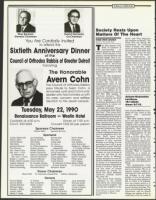
You Are Cordially Invited
Society Rests Upon
Matters Of The Heart
RABBI IRWIN GRONER
Special to The Jewish News
T
Sixtieth Anniversary
Dinner
of the
to attend the
Council of Orthodox Rabbis of Greater Detroit
honoring
The Honorable
Avern Cohn
The Council of Orthodox Rabbis
pays tribute to Avern Cohn, a
renowned Jurist and Community
Leader who has honored us with
his care, concern and selfless
devotion to the Jewish people.
Tuesday, May 22, 1990
Renaissance Ballroom Westin Hotel
Cocktails at 6:00 p.m.
R.S.V.P. 559-5005
Dinner at 7:00 p.m.
Couvert $125.00 per person
Sponsors Chairmen
Marvin Berlin
Leonard Borman
Sponsors
Gustav Berenholtz
Marvin Berlin
Harold Beznos
Max Biber
Leonard Borman
Paul Borman
Hon. Avern Cohn
Mrs. Irwin I. Cohn
(In Memory of
Mrs. Irwin I. Cohn)
Steven Z. Cohen
Rabbi Naftali Deutsch
Joseph Dressner
Harry Eisenberg
Isidore Eisenberg
Leo Eisenberg
Sidney Feldman
Max Fisher
Morris Flail
Dr. Phillip Friedman
Nathan Goldin
Martin Goldman
Martin Goodman
Seymour Greenstein
Samuel Hechtman
David Holtzman
David Hermelin
Dr. Howard Jacobs
Mrs. Hannah Karbal
Michael Karbal
Murray Katz
Burton Rosen
Paul Kohn
Fred Ruby
Irving Laker
Asa Shapiro
Ed. Levy,Jr.
Jack Shenkman
Dr. Lawrence
Soberman, Milgrom
Loewenthal
& Cooper Families
Mrs. Ann Newman
Jerome Soble
Irving Nusbaum
MaX Stollman
Martin 011ender
Phillip Stollman
Royal Oppenheim
Marvin Tamaroff
Irving Palman
Phillip Tewel
David Pollack
Gary Torgow
(In Memory of Morris Selwyn Weiss
& Rose Pollack)
Dr. Arnold Zuroff
Benjamin Rosen
Donor Chairman
Morris Flatt
Dr. Lawrence Loewenthal
Nathan Soberman
Donors
Hyman Beale
Jerome Beale
Gerald Borsand
Michael Egren
Franklin J. Ellias
Joseph Fetter
Melvin P. Foster
Al Gamer
Max Goldsmith
Rabbi Ernest E.
Greenfield
Samuel Havis
Peter Heiman
Leonard Herman
Herbert Kaufman
Dr. Sidney Lesser
Sam Novetsky
Graham Orley
Ronald Rogers
Dr. Jack Schwarcz
Abraham Selesny
Jack Shanfield
Michael Solarz
Henry Sperber
Howard Tapper
Morris Weiss
Mark Weitz
he 19th chapter of the
Book of Leviticus is
unsurpassed in
biblical literature. Part of this
week's Torah portion, it ex-
presses a moral sublimity and
spiritual height that is un-
matched. The laws contained
here are not simply a duplica-
tion of laws described
elsewhere, but rather present
a new refinement and depth
revealing the moral and
spiritual foundations of the
social order.
Thus, the Ten Command-
ments contain the fundamen-
tal principle "thou shalt not
murder." But what is our
responsibility when we see
our neighbor drowning, or at-
tacked by wild beasts, or the
victim of a robbery; do we
have an obligation to save his
life? The 19th chapter of
Leviticus declares "Thou
shalt not stand by the blood
of thy neighbor," a com-
prehensive declaration of our
responsibility to rescue our
neighbor in distress.
Consider this verse: "Do not
put a stumbling block before
the blind." This means don't
abuse the ignorance of a man
by misleading him because in
a metaphorical sense, if he is
unaware, he is blind. Don't ex-
pose a person who is weak to
those temptations that may
cause him to sin. The rabbis
provided illustrations. Don't
lend money to a borrower
without witnesses because he
may be tempted to deny the
loan. Don't leave your
valuables lying about in the
presence of your servants
because in so doing, you are
providing them with a great
temptation to steal. Don't of-
fer a person who has an addic-
tion to alcohol his first drink.
These are not the kinds of
laws one will find on the
statute books of Western
society, because it is very dif-
ficult to establish the act and
its intent. It is impossible to
bring witnesses and tangible
forms of evidence. These are
not the sorts of crimes
punishable by statute. In-
stead, the Torah addresses
character, attitude, motive
the inner life.
This theme finds sublime
expression in two exalted
rules about the relationship
of man and his neighbor. "Do
not hate thy neighbor in thy
Irwin Groner is senior rabbi
of Congregation Shaarey
Zedek.
heart," and "Thou shalt love
thy neighbor as thyself." The
Torah does not specify the
punishment for violating
either of these. The rabbis
point out that these are mat-
ters that cannot be dealt with
in the public arena, for they
are "issues of the heart."
These imperatives are
directed to the conscience. No
judge will subpoena you if you
violate them; no court will
summon you if you disobey
them; no earthly punish-
ments will be levied upon
you. But each of these admo-
nitions is linked with the ex-
hortation to "fear the Lord"
because God alone can judge
our conduct. He alone knows
the secrets of the soul. Before
Him are revealed the dark
and mysterious paths of our
hopes, fears and intentions.
Know, therefore, that in the
love or hate of your fellow
Achare-Kedoshim:
Leviticus
16:1-20:27,
Amos 9:7-15.
man, in your affection or con-
tempt for him, there is One
above who exercises
judgement.
This 19th chapter should
lay to rest once and for all a
classical libel that holds
Judaism to be a religion seek-
ing to regulate everything by
legislation. This libel has
been perpetrated in part by
the mistranslation of the
word "Torah" as "law."
Torah is not law. Torah, if we
can translate it at all,
means guidance, instruction,
teaching. Law and Torah are
not synonymous because law
cannot answer every phase of
life, cannot govern every rela-
tionship. What is required
ultimately is a moral at-
titude, an ethical sensitivity,
a mature conscience — all of
which are developed and
nurtured by a life dedicated to
Torah.
This fundamental truth
needs restatement in our age
and to our society. We try to
improve human welfare by
enacting new laws and devis-
ing changes in our legal
system. A law can do much,
but there are many spheres of
life in which it is helpless.
Law can compel action or it
can exercise restraint, but it
cannot develop attitudes. The
law is an instrument of great
importance, and we should
change our system of law in
conformity with the needs of