

INSIGHT
Why Shamir May Opt
For A Unity Government
The Likud leader probably will threaten
to form a narrow coalition without Labor
while hoping to drag them into the fold.
ZE'EV CHAFETS
Israel Correspondent
T
el Aviv - For almost
two months, Israeli
politics have resembl-
ed a giant ferris wheel, with
the two major parties
trading places at the top,
and the rest of the country
dragged along for the ride.
This week, it was the
Likud's turn to reach the
pinnacle, while Shimon
Peres and the Labor Party
plunged to the bottom.
The dizzying ride began
when Peres, supported by
Rabbi Aryeh De'eri of the
Orthodox Shas Party,
brought down the national
unity government of Yit-
zhak Shamir. At the time, it
was generally assumed that
Peres could use the same
votes that defeated Shamir
to set up an alternative co-
alition. That scenario was
upset when 96-year-old
Rabbi Eliezer Shach made it
plain that he favored the
Likud, forcing De'eri and the
other Orthodox doves to
reverse themselves and sup-
port Shamir.
After Rabbi Shach's deci-
sion, which led to a
stalemate between the two
major parties, Labor hit
bottom; but Shimon Peres,
who enjoys a reputation for
unflagging energy and op-
timism, reached the top
again by convincing ex-
Likudnik Avraham Sharir
to cross party lines, in return
for the promise of a cabinet
seat.
Sharir's defection seemed
to give Peres a bare
majority, and he informed
President Chaim Herzog
that he could, indeed, set up
a ruling coalition. Few
doubted Peres' word - after
all, no leader in Israeli his-
tory had ever defaulted on
such an official announce-
ment - and it was the Likud's
turn to plummet.
Then, two members of the
Orthodox Agudat Yisrael
Party bolted the Labor coali-
tion, and suddenly Peres
once again dropped, while
the Likud, which had been
preparing itself for the
parliamentary opposition,
found itself rising. It reached
the top with the decision by
Sharir to rejoin his old party
(once again in return for a
cabinet seat). Suddenly,
Shamir and his colleagues
found themselves at the top
of the wheel. With luck, they
will be able to get 61, or
perhaps even 62, votes in the
120 member Knesset -
enough to form a govern-
ment.
For the Likud, it is a famil-
iar situation. Shamir could
It is, to put it
mildly, a difficult
dilemma. The unity
government was a
disaster, unable to
make decisions or
even to speak in a
single voice. Peres
carried out what
amounted to a
separate foreign
policy.
have put together a similar,
narrow majority after the
last national election in
1988. At that time, however,
he opted to reach out to
Labor, forming a broad
Government of National
Unity. Now, the prime min-
ister is groping with the
problem of whether to try to
set up another unity coali-
tion, or to go it alone.
It is, to put it mildly, a
difficult dilemma. The unity
government was a disaster,
unable to make decisions or
even to speak in a single
voice. Peres carried out what
amounted to a separate for-
, eign policy, particularly by
encouraging the American
government and the Egyp-
tians to pressure Shamir
into entering negotiations
with the Palestinians. In
talks with his inner circle,
the prime minister has made
it clear that he does not want
a repetition of the chaos that
reigned in the last coalition.
The problem is, he is unen-
thusiastic about the alter-
native. A narrow govern-
ment would be based on
ultra-nationalist right- wing
parties, such as Moledet,
which favors the deportation
of Arabs from the West Bank
and Gaza, and Techiyah,
which wants Israel to annex
those territories in violation
of the Camp David accords.
There is no chance that
Shamir would go along with
such policies, since neither
Israeli opinion nor the
American government
would tolerate them. In a
narrow government he
would be forced to fight cons-
tant battles with the super-
hawks.
Shamir would also find
himself at the mercy of
Rabbi Shach, an unpredic-
table partner with dovish
views on the future of the
territories, and a hard-line
religious agenda. Moreover,
Rabbi Shach recently called
into question the Jewishness
of secular Israelis (who make
up the bulk of the Likud's
electorate) and most people
here are not eager to see the
rabbi in an influential role
in any future government.
There are also problems
within the Likud itself.
Avraham Sharir, having
demonstrated that he will
sell himself to the highest
bidder, would have to be
watched closely. The highly
erratic Yitzhak Modal, who
carried out an open flirtation
with Labor, has already
been promised the post of
Finance Minister. There are
three candidates - Ariel Sha-
ron, Moshe Arens and David
Levy - for the remaining two
senior jobs of defense min-
ister and foreign minister,
and the loser is certain to
make trouble. In a govern-
ment of 61, Shamir would be
vulnerable to threats by
every dissident.
As if these problems
weren't enough, a narrow,
right-wing government
would almost certainly run
afoul of the United States.
Such a coalition could not
conceivably go along with
the Baker peace initiative,
or agree to talks with pro-
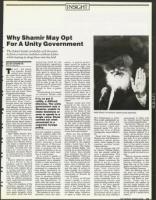
Rabbi Shach: His decision created a party stalemate.
PLO Palestinians in Cairo.
This would undoubtedly an-
tagonize the Bush Ad-
ministration, something
that Israel, which des-
perately needs U.S. aid to
settle the wave of Soviet
immigrants, cannot afford to
do.
Faced with this dilemma,
Shamir may well threaten to
establish a narrow govern-
ment, while hoping to put
together another broad-
based coalition.
If so, his primary ally will
be Labor's Yitzhak Rabin,
who has already called for
such a partnership. The
Shamir-Rabin ploy, used
once before in 1988, is sim-
ple. Shamir announces his
ability to set up a narrow
government. Rabin, warning
of the consequences of such a
hard- line, clericalist
cabinet, convinces Labor
that patriotism requires
entering into partnership
with the Likud. Peres, al-
ready weakened from his
humiliating failure, and
afraid of losing control of the
party to the more popular
Rabin, goes along. This, in
turn, enables Shamir to
declare that the next
government will be a copy of
the last one, thus making it
unnecessary to fight with
the Likud's senior figures
over cabinet appointments.
Naturally, Sharon and
Levy, who respectively want
to become minister of
defense and foreign affairs,
have already objected to a
unity government that
would perpetuate the status
quo ante. It is not unlikely
that they would mount a
challenge to the prime min-
ister in the party's central
committee to prevent a new
unity government, but
Shamir's advisors believe
that he could
win such a con-
.
test.
There is, of course, another
possibility. The two major
parties could agree to new
national elections, in the
hope that one or the other
might win a decisive victory.
This is unlikely, however.
After the dizzying ride of
the past six weeks, the
public seems fed up with pol-
iticians in general, and with
Shamir and Peres in par-
ticular. Under the cir-
cumstances, the leaders of
the two major parties will
probably prefer to choose the
lesser evil, even if it means
sitting together, motionless,
at the top of a stalled ferris
wheel. D
THE nupnn- AMISH NFIAIR
27