
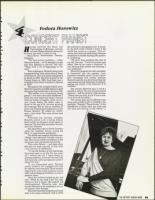

Fedora Horowitz
LJ
111•0111
aving survived the Nazis and
Communism in Romania, and war
in Israel, Fedora Horowitz learned at
an early age what it takes to last.
Perseverence. Stubbornness. Tenacity.
Diligence.
"You have to have backbone — either
from your family — or the strength you get
just from fighting to survive," she says.
"There were a lot of beginnings in our
lives."
Born in Romania, Horowitz moved with
her parents from their native town of Yassy
to Bucharest. Then the family immigrated
to Israel in 1958. Horowitz arrived in the
United States in 1969. And there was a
transition from North Carolina to Detroit
in 1973.
Throughout the tempest-tossed years,
Horowitz's parents provided lessons in good
character that would echo in her later life:
"My mother is an enormously strong
person. I saw that since early childhood. I
think the most important thing I learned
from my family is honesty. I grew up in a
very honest family. My father came to
Israel at the age of 55, not even knowing
the language. But he had an ambition to
learn and obtained good employment at the
Finance Ministry. He helped my mother
open a little shop. They were always hard
workers."
Following her parents' example,
Horowitz proved to be a strong, ethical,
hard worker too, forging a music career in
America. The first step was easier than the
ones that followed.
She spent four years in North Carolina
where her husband, Avram, earned his
Ph.D. in experimental psychology.
The South was receptive, Horowitz says.
"People were extremely friendly and car-
ing." She was an artist-in-residence at the
university and concertized extensively.
Then came Detroit — and deep crisis.
She says her work was met, at first, with
a fair amount of indifference.
"It was the hardest of the beginnings,
the lowest point in my life. For two years,
all I wanted was out. I wrote letters re-
questing auditions. I did and I did and I did.
And basically, nothing happened unless I
played for free."
At one discouraged point, Horowitz
almost traded in her arpeggios and trills
for software and terminals. She'd actually
signed up for a six-month computer course,
sadly acknowledging she'd have no time to
practice piano.
Then her husband looked at her and
said, "What do you need it for? The only
thing you love is music." His support and
encouragement, Horowitz says, were
crucial elements in her toughing it out un
til success came through.
Horowitz cancelled computers and went
back to her piano keyboard. And in 1979,
H
■■
•
she received a turning-point call. A lawyer
for the Ford estate wanted to know if she
would like to put on a concert. "Put on"
meant more than just performing. Horowitz
would have to handle mailing lists, publici-
ty, marketing.
"I'd never done anything like that in
my life," she says. "I went to a printer and
asked, 'How do you make a brochure?' It
was starting from scratch and learning a
new profession."
Horowitz's program not only succeeded,
it blossomed into the popular Lyric
Chamber ensemble series. As the ensem-
ble's managing and artistic director,
Horowitz says she was determined that her
organization be both democratic in decision-
making and ethical in the treatment of its
members.
Her success, Horowitz says, is not of a
monetary nature. The arts are guaranteed
insecure — and the artist is a risk-virtuoso.
"Every time you play, it's as if you're nak-
ed in front of the public."
The curtain goes up, the defenses come
down, and a simple truth is revealed in the
spotlight: "Success," Horowitz says "is the
satisfaction of doing what you want and
love most and sharing it with others." ❑
THE DETROIT JEWISH NEWS
29