
Notes In The Western Wall
Continued from Page L-1
submitted on a slip of paper called
in Yiddish a kvittel.
Even death was not an
impediment to the effectiveness of a
particularly charismatic leader.
Some Chasidm placed kvitlech on
the grave of a deceased rebbe so
that the rebbe in heaven should
pray on their behalf.
As the Jewish population of
Eretz Yisrael began to expand at
- the beginning of the 18th century,
and as more Jews were able to
travel, the Kotel, known to most
Jews only in legend, became again
a real place. The Kotel was the only
in Jeruslem, many come to the
pulled kvitlech from the Kotel and
They probably were emulating
Kotel to behold a fragment of the
set
them
afire.
the Moroccan-born mystic, Rabbi
From 1948 until 1967, when the former majesty of the Temple, others
Chayim ben Moshe Ben-Attar
to pray and study. And some leave
Old City of Jerusalem was under
(1696-1743), who spent the last year
behind a note to God.
Jordanian
occupation,
Jews
were
of his life in Jerusalem. His best
barred
from
the
Kotel.
The
old
known work was the Or Ha-Chayim,
kvitlech that were left withered and
a commentary on the Chumash
Phillip Applebaum is a
turned to dust.
(Pentateuch), widely studied in
historiographer and a past president
Now
that
Jews
and
all
others
Chasidic circles. Today, the Or Ha-
are free to visit their sacred shrines of Young Israel of Oak-Woods.
Chayim often is included in editions
of the Chumash published with
. ..'-•
commentaries.
Many stories of Rabbi Ben-Attar
circulated among his followers,
,
including tales of the rabbi's
.. .
,
1. .t
missives believed that because of
1
• ".
< .0
the Wall's sanctity, the messages
I
e•
, ,./.
t I s
A ., t
•
would be given special divine
,,::/.411/6,,,,,,.*‘.\ t
attention.
400, ■ .,', ■
His letters, always on behalf of
vo
a fellow Jew in need of help,
•;'# '..*:-
• -4;'4, 444b)
addressed God in feminine terms.
• • - ,
.,.......
''.ir 4 #11. • 4.
-.,-..4...0
.',
'4,
.,:s'...
The mystics believed that in
1/f
1/4 =. .e.v.S.
.: ' V:•,,
,-., -1,•,•..•
requesting assistance, they stood a
id /.. c, ,:-:.:...0....
._11
** 1,: ■4 0.,
—
:••• ■ %*
better chance of evoking a positive
' rij ' r
.711 ■ •
‘ 4• \ 4% \
s s0:-
,
Si■
II
■
.'/;-#• e
r
,•,,,.•
1(ici
divine response by appealing to
4
0 •'%
, W‘46
' ' •
G;•• ■ \,
God's motherly attributes of nurture
•
%,:.•'.:* / ''''.‘‘,
‘. '•, ' ;f0;
...I •,; •V
t :' .2 , ' '.:*
‘/A11-"•-•
and compassion.
/ P •
•
•
• :0:1,
•
Thus, when the Chasidic faithful
'...".
•
I4s: .
the
supplicant's
kvittel,
wrote a
•. . t
< • •
' • •• ....
name was stated as the son or
. • .S.IN
s***** •
%:;i4
f.
daughter of the mother, rather than
• S.
,
... t e. •,. • 144
4.'4
the father, as is the standard form of
\----..-----s"---.
••*...
•• • 0 b•.;•••
1 •%...et •%
address. Today, this is still the
• 0.1
"•.°
• • 0
1
• . ' 4
custom, as in the recitation of the
, ".. *4,0 •
■ , ...Wifr
„;„%.
••
■
•
Mi-Sheberach prayer for the sick.
i i ';Ot0. 4
vt-
*rile*
. 4
Gradually, Jews other than
.' 4..
*i.e.
•
: 7, :;.4***
Chasidim adopted the practice of
..
-,
• 4,
1 ■4 4
placing a kvittel in the Kotel. As
. ', 4 .
L
.
P
.0
1•II:.
V:,
r*
Z S4 ■4 :4
Jerusalem became accessible to
.
• 7
,4•;.4
1#,*
■ •,
••■ ••••i,.#e•
more and more Jews, pilgrims often
dr_ , 4 . , 4 I !„ %• ■ s dp
,• -.. .....„-....4 -
. : ■ :°) * . : .
:::A°01#04#%# Ve
\ *
brought their own kvittel or kvitlech
' '..° ..e' ■ ■ t #‘, .../e !: % ' A
entrusted to them by others.
Even gentiles became aware of
the custom, sometimes to the Jews'
1
f / : ...`
-M ■:;■ /
detriment. During the outbreaks of
anti-Jewish violence in Jerusalem in
the 1920s and 1930s, Arab rioters
" '
• '.s.
.
,
:-
:
.
,
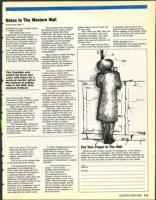
'The Chasidim who
visited the Kotel also
came with hopes for a
restored Jewish nation.
But instead of putting
nails in the Wall, they
inserted kvitlech:
part of the ancient Temple
accessible to Jews, and they made
it the focus of their longings for
redemption and liberation.
Many Jews who came to pray
at the Kotel began the practice of
inserting wooden nails in the
crevices between the blocks of
stone to fulfill the words of the
prophet Yeshayahu: "And I will
fasten him as a peg in a sure
place" (Isaiah 22:23).
The Chasidim who visited the
Kotel also came with hopes for a
restored Jewish nation. But instead
of putting nails in the Wall, they
inserted kvitlech.
,
.., ,,,,, .., .... ,,..... , :..,..
.
...,,.
''''.4
.
4
.
------
....;„,
- -...-
;:.. '....
.
■ 0
;i i)
•,.
. .
This is one of the earliest steps
in the American-Israel kinship.
A noble message passed on to
all generations when Gorky
(1868-1936) the famous Russian
novelist, wrote in 1902, when
Theodor Herzl was mobilizing the
pioneering Zionist forces as an
expression of commitment to Jewish
liberation:
The New Exodus presently
dedicated to the redeeming of
Soviet Jews from oppression into
freedom in Israel revives interest in
a prominent Russian author's
support of Zionism ninety years ago.
Advocacy of the Zionist ideal by
Maxim Gorky retains timeliness now
when there is a Pamyat anti-
Semitism and a threatened "lust for
pogroms" as an admonition that
there also were libertarian Russians
who defended the Jewish cause.
"I am told Zionism is a
Utopia. I do not know;
perhaps. But inasmuch as I
see in this Utopia an
unconquerable thirst for
freedom, once for which the
people will suffer, it is for me a
reality. With all my heart I pray
that the Jewish people, like the
rest of humanity, may be given
spiritual strength to labor for
its dream and to establish it in
flesh and blood."
part of the world. This country
(America) has done much; I
wish it may do more, and
annul every narrow idea in
religion, government and
commerce."
Put Your Prayer In The Wall
Would you like to have a prayer or message put in the Western
Wall? Just write your message in the coupon below and mail to
L'Chayim, do The Jewish News, 27676 Franklin Road, Southfield, MI
48034. We will turn them over to some person or group who will visit
Israel soon and ask them to perform this mitzvah on your behalf.
Name
(optional)
Message
THE DETROIT JEWISH NEWS
L-3
Scanned image of the page. Keyboard directions: use + to zoom in, - to zoom out, arrow keys to pan inside the viewer.
April 27, 1990 - Image 159
- Resource type:
- Text
- Publication:
- The Detroit Jewish News, 1990-04-27
Disclaimer: Computer generated plain text may have errors. Read more about this.