

INSIDE WASHINGTON
Soviet Jewry Groups
Oppose Refugee Bill
Washington is often awash
with high school students
participating in various pro-
grams that give them a taste
of politics and government.
But Rabbi Sidney Schwarz
directs a program with a
distinctly Jewish twist.
Schwarz is the founder and
director of the Washington
Institute for Jewish Leader-
ship and Values. The group's
Panim el Panim High School
in Washington program at-
tempts to integrate Jewish
values with the realities of
the modern public policy
process.
The program grew out of
Schwarz's experiences as a
Jewish community relations
practitioner and a Jewish
educator. "What I was
noting," he said, "was that
the two worlds in which I
was working really did not
have the kinds of linkages
that I felt would be healthy
for both."
Traditional Jewish learn-
ing, Schwarz suggested,
tends to be "overly
parochial." On the other end
of the spectrum, community
relations work within the
Jewish community is gen-
erally not steeped in a
knowledge of Judaism.
JAMES D. BESSER
Washington Correspondent
T
hese are tricky times
to be a Jewish legis-
lator — and few issues
present as many political
minefields as the current
question of refugee admis-
sions.
Several Jewish legislators
have prepared legislation
that would have the effect of
raising the number of refu-
gees admitted to this coun-
try, an emergency response
to the unprecedented flood of
Soviet Jewish emigres.
The proposed legislation is
a response to strong com-
plaints from constituents
about restrictive U.S. refu-
gee policies that have made
it much harder for Soviet
Jews to get into this country.
But most Soviet Jewry
:=, groups are opposing any at-
tempts to raise the refugee
ceilings under current condi-
tions. And in quiet but insis-
tent input to the legislators,
they are expressing concerns
about features of the legisla-
tion that would provide
loans to cut down on the fed-
_. eral money required to help
resettle the newcomers —
something many Jewish ac-
tivists see as a precedent
that may speed up the
"privatization" of the refu-
gee process.
Legislators are caught in
an uncomfortable squeeze.
"Out in the districts,"said
an aid to one top Jewish
legislator, " we have all
these Jews who can't under-
stand why the United States
can't take more Soviet Jew-
ish immigrants. It's very
hard to tell them that there's
a delicate question of equity
among various groups of
potential refugees — not to
mention the question of the
federal budget."
But most Soviet Jewry
groups are forcefully in-
sisting that now is not the
time for an increase. Al-
ready, a high proportion of
refugees admitted to this
country are Soviet Jews — a
fact that has generated com-
plaints from American sup-
porters of other groups of
potential refugees.
And the Jewish commun-
ity is already stretched thin
in supporting the Soviet
Jews already coming to this
country, and providing vast
amounts of funding to help
settle Soviet Jews in Israel.
Currently, Rep. Chuck
Schumer (D-N.Y.) has a bill
"So the essential notion
was to link the two up," he
said. "The goal is to develop
a future cadre of leadership
for the Jewish community."
Participants in the pro-
gram hear from experts in a
wide range of public policy
areas. But then they study
the same issues through the
lens of Jewish sources.
Last year, some 175
students from 15 com-
munities participated in the
year-round program; this
year, about 300 will par-
ticipate from over 35 com-
munities.
The group has an im-
pressive advisory board that
cuts across political and
ideological lines — including
Tom Dine, executive director
of the American Israel
Public Affairs Committee
and Rabbi David Saperstein
of the Religious Action
Center of Reform Judaism.
"I think it's a marvelous
opportunity for Jewish high
school students to get an in-
depth view of some of the
most important issues facing
our country," said Jonathan
Kessler, a longtime political
activist and a member of the
group's board of trustees.
Public Signing Urged
For Hate Crimes Act
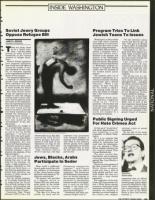
Artyncic by Man Mature,. Copyt:091.0 1990. Matt Mahurin. Distnbuted by Loa Angelts Tomas Syndca ta.
almost ready to go. But after
consulting with Soviet
Jewry groups, Schumer
agreed to hold back on his
legislation as long as the
rapid exodus of Jews from
the Soviet Union continues.
Rep. Stephen Solarz
(D-N.Y.) also has a bill that
combines loan guarantees
with increased numbers. A
hearing was scheduled for
next week on the measure;
Jewish groups have urged
the congressman to hold off,
and indicated that at least
for now, they could not sup-
port the bill.
Jews, Blacks, Arabs
Participate In Seder
What would a traditional
Jewish seder sound like with
the addition of statements
by Rev. Jesse Jackson, black
spirituals and poems by Pa-
lestinian nationalists?
The answer was provided
in a Passover service on
Capitol Hill last week spon-
sored jointly by the Jewish
Committee for Israeli-
Palestinian Peace and the
New Jewish Agenda.
"The idea is to bring the
Jewish, the black and the
Palestinian communities
together," said Franca
Brilliant, one of the seder's
organizers. "The Jewish and
the Palestinian communities
have an obvious interest in
the ceremony. And the black
community is participating
because we felt it was impor-
tant to reach out and build
bridges to the black com-
munity — especially in a
place like Washington."
Palestinian and black par-
ticipants helped write it.
.
In this age of "sound bites"
and photo opportunities, vi-
sual symbolism is a hot
commodity in official Wash-
ington.
So it is no surprise that
some Jewish activists were
miffed by indications last
week that the administra-
tion was opposing a White
House signing ceremony for
the recently passed Hate
Crimes Statistics Act.
The issue involves Sen.
Paul Simon, who is locked in
a ferocious re-election battle
against Rep. Lynn Martin, a
Republican.
Simon was a key sponsor of
the hate crimes bill. And a
White House ceremony
would give him a shot of
badly-needed publicity that
could bolster his race in a
state with a large Jewish
population.
But supporters of the hate
crimes bill have pointed out
that a White House signing
ceremony would point to the
importance of the bill, which
mandates the collection of
statistics on crimes based on
the victim's race, religion,
national origin or sexual
orientation.
By the end of the week,
administration sources were
Paul Simon:
Election battle.
suggesting that no official
ceremony would be held.
Jewish groups quietly began
contacting Republican legis-
lators sympathetic to the
hate crimes package, asking
them to lean on the White
House to have that decision
reversed. ❑
THE DETROIT JEWISH NEWS
NATIONAL
Program Tries To Link
Jewish Teens To Issues