

TEENS
C- 7
Special to The Jewish News
J
Cr,
ewish teenagers
are much the same
whatever their cul-
tural backgrounds.
They like music
and movies. They're into
sports. They have many of the
same heroes and similar life
goals. They think education is
important, but homework can
be a drag.
So concludes a very special
group of Detroit Jewish young
people — some 50 American
and Soviet high schoolers
who meet every Sunday in a
new Teen to Then program,
sponsored by the Agency for
Jewish Education.
Although they're all
Detroiters now, the Soviet
newcomers are often conve-
niently referred to in the com-
munity as Russian teens — as
opposed to American teens.
But on Sunday at 11 a.m., in
this group there's little
distinction.
"There are no cultural bar-
riers when it comes to
volleyball and basketball," ex-
plains Teen to Teen Program
Coordinator Susie Rosenz-
veig. "On the gym floor,
you're accepted or rejected
based only on your merits as
a player."
The program is geared
around pressure-free, social
and sports activities enjoyed
by youth the world over.
When the teens met for the
first time this winter, they
talked about their favorite
foods, their heroes, where
they'd like to travel — typical
teen talk.
"All week long these kids
are involved in academics.
Eventually we plan to do
some religious, cultural, and
educational programming,
but not just yet, it's too soon,"
Rosenzveig says.
So the teens take field trips.
Each Sunday they bus in a
different direction. They've
gone bowling. They went to a
pinball arcade and to Green-
field Village and the auto
show. They go to the Jewish
Community Center for sports.
And they also play New
Games.
"New Games are a series of
non-competitive, conceptual
activities," says Rosenzveig.
"They are frequently non-
verbal sharing experiences,
as we did the first week when
we 'formed one large, balanc-
ed circle by sitting on each
other's knees.
The Teen to Teen program
is an outgrowth of an AJE
high school class that began
last fall and focused on com-
munity awareness. "Its agen-
da was an overall exposure to
Glenn Triest
ATCHING
High school students are participating
in a unique acculturation process for
Soviet Jewish newcomers.
the various Jewish communal
agencies," says Rabbi Bruce
Aft, principal of AJE's Com-
munity Jewish High School.
Then a couple of situations
took the class in a somewhat
different direction. Jewish
Resettlement Service was
looking for a group ex-
perience for an outgoing
17-year-old, a recent arrival
from the Soviet Union who
wanted to meet Jewish
American teens. Just a few
weeks after settling in
Detroit, Samira Yakubova
joined the high school class.
At the same time, American
teens returning from Project
Discovery in Israel were of-
fered the chance to par-
ticipate in the class as a local
community project.
"Acculturation of the Soviet
teens was an obvious out-
growth of our initial concept,"
Rabbi Aft says. "The kids
were immediately eager to go
in that direction. The idea
took off like wildfire."
The program is funded by
the AJE, along with a Max
M. Fisher Jewish Communi-
ty Foundation grant through
United Jewish Charities/
Jewish Welfare Federation,
and a Jewish Community
Council Youth Committee
scholarship for social action
programming.
Rosenzveig, who had been
teaching_ the class, was a
"natural" as coordinator for
Teen to Teen Rabbi Aft says.
She holds bachelor's and
master's degrees in elemen-
tary education, early child-
hood development and special
education. But more to the
point are some 25 years of
work within the Detroit
Jewish community and a
positive personality that just
won't quit.
"Susie is such an en-
thusiastic person," says Rab-
bi Aft. "When we first decid-
ed to bring the new Russian
teens into the class, Susie did
her homework. She's very
dedicated to the kids and to
the program, and now we look
at it as the epitome of com-
munity outreach."
Rosenzveig and Rabbi Aft
went to Berkley High School,
which enrolls many of the
new Soviet students. With the
cooperation of Berkley ad-
ministrators and their bi-
lingual coordinator, Laura
Gogola, Rosenzveig and Rab-
bi Aft explained to the
students about the opportuni-
ty to join the Sunday morning
program. A bus would pick
them up in front of Northgate
Apartments in Oak Park and
take them to the UHS
building from 11 a.m. to
1 p.m.
Hopeful for a good, initial
response, neither Rabbi Mt
nor Rosenzveig nor the
American teens expected that
more than 25 Soviet youth
would get off the bus in
Southfield that first Sunday
morning in January.
The new Detroiters need op-
portunities such as this to feel
part of our community,
Rosenzveig explains. "For the
most part, they're very ap-
preciative and excited about
every new experience. They
haven't had some of the lux-
uries of American youth, and
they take nothing for
granted.
"You can't generalize too
much about them. Just as
with the Americans, their in-
dividual personalities are
always coming through. Some
are timid and some are more
outgoing. Some have very
good English skills; others
don't. But they all help each
other out. They're making a
real effort to move ahead with
their lives."
Typical of the young people
in the program is Alex Gor-
don, a 14-year-old who moved
to Oak Park with his family
a year ago. A varsity swim-
mer at Berkley High School,
Alex says the teen program
gives him something to do on
the weekends. "There was
lots more to do in Riga than
there is in Oak-Park."
Last summer's camping ex-
perience at Camp Maas was
one of the best things to hap-
pen to Alex since his arrival.
"That's when my English
really improved. I used to
think that Americans were
different. But now I try to
talk to everybody, and I see
that we're all the same. I sug-
gest that everyone go to
Camp Maas if they can."
Also 14 is Gil Moskovitz,
one of the American teens
who joined the class in
September "to find out about
helping out in the communi-
ty." The West Bloomfield
eighth grader says that all of
the teens in the program are
"pretty much the same. They
just speak different
languages."
Sarah Poger, 18, a senior at
Churchill High School in
Livonia, agrees. "Kids are
basically the same all over.
It's not until they get to be
adults that they form stereo-
types. You don't realize how
much the Russian teens are
like us."
Sarah came into the class
as an outgrowth of her Project
Discovery experience. Sarah
almost immediately "paired
up" with Samira Yakubova,
and the two girls have chosen
to get together outside of the
teen program. They went to
the Paul McCartney concert
together and are fast becom -
ing friends.
Bound for the University of
Michigan in the fall, Sarah
explains that when she and
Samira go to a concert or take
a field trip "on their own," she
pays for both of them and is
reimbursed out of Teen to
Teen program funds.
Samira hopes more Soviet
.
THE DETROIT JEWISH NEWS 111
GENERATIONS
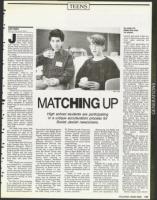
Ilya Leytes and
Robbie Wine enjoy
the program.
JUDY MARX