

PASSOVER
DAVID LANDAU
Spoecial to The Jewish News
J
erusalem — With ra-
dio jingles incessant-
ly advertising clean-
ing products, no one
in Israel can be
unaware of the advent of the
Pesach festival.
For most Israeli Jews, even
non-observant ones, the
biblical precept that "for
seven days there shall be no
leaven found in your houses"
is the excuse for a thorough
spring cleaning.
Jerusalem, even in the
1980s, still echoes with carpet
beating at this time of year.
Balconies are full of clothes
being aired and books are be-
ing shaken free of dust and
bread crumbs.
One barometer of the
season can also be seen in
some supermarkets, where
the prices of floor washes,
oven sprays and furniture
polish have been slashed. But
some items go up in cost at
Passover time, raising the
question of whether the holi-
day costs are inflated.
Marlene, chief cashier at a
Jerusalem branch of the Coop
Supermarket chain, said this
week's prices are generally no
higher for Pesach than the
rest of the year.
Many employers and work
committees try to ease the
financial burden of the holi-
day with cash grants and gifts
and even payment of an extra
half-month's salary for the
festival.
The biggest product of the
season, of course, is matzah.
The standard five-and-a-half-
pound brown paper package
of matzot costs just over $5 at
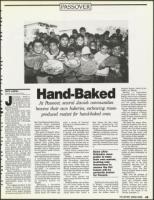
Hand-Bake
At Passover; several Jewish communities
become their own bakeries, eschewing mass-
produced matzot for hand-baked ones.
the Coop Supermarket chain,
whereas better packaged
matzot in cellophane bags
within cardboard boxes cost
exactly double.
But many of Israel's ultra-
Orthodox community are not
satisfied with regular, square,
machine-baked matzot. The
Ger Hasidim have already
ordered their round hand-
baked matzah from Moshav
Komemiyut at $20 a kilo (2.2
pounds), with a higher price
for the matzot made of hand-
ground flour.
The Lubavitch Hasidim at
Kfar Habad have been steadi-
ly producing their smaller,
round hand-baked matzot for
some weeks now — but most
of those will be given out free
in packages of three ready for
the seder — to soldiers and
public figures.
Some ultra-Orthodox Jews
prefer to bake their own mat-
zot, trusting only themselves
to ensure the flat loaves will
be perfectly kosher for
Pesach.
Yeshayahu, a Jerusalem
rabbi, already has his matzot
stored away carefully in a top
closet in his apartment. He
baked them two weeks ago
with a group of learned
friends at a matzah bakery in
Bnei Brak.
One of the group drew the
pure water for the dough from
a spring, and kneaded and
rolled the dough together for
no more than 18 minutes to
prevent it from rising. Their
matzot were the first in the
oven that day so there was no
danger of contamination from
bits of left-over dough from
previous batches.
Other ethnic communities
also prefer to bake their own
matzot.
Zadika, a nursery school
assistant from Castel just out-
side Jerusalem, described
how her elderly father col-
lects pure water from the
spring at the nearby village of
Motza, kneads his own dough
and bakes the family's matzot
on a tin plate over an open
fire in his garden.
These Iraqi matzot are
large, round and flat, but soft
like pita.
Zadika's father also collects
his own bitter herbs for the
seder from the Jerusalem
hills, while her mother roasts
and pounds sesame seeds and
mixes them with "silan" a
date honey, for the sweet
charoset symbolizing the
mortar used by the Jewish
slaves in Egypt.
Different communities have
different traditions concern-
ing which foods they may eat
on Pesach.
Whereas Zadika's family
eats rice that her mother has
carefully cleaned three times
over, other communities shun
i t.
Some ultra-
Orthodox Jews
prefer to bake
their own matzot,
trusting only
themselves to
ensure the flat
loaves will be
perfectly kosher
for Pesach.
Zadika's favorite seder dish
is "kubeh" — torpedo-shaped
fried shells made of ground
rice stuffed with minced
meat. During the rest of the
year, she makes kubeh of
burghul dough, which is for-
bidden on Pesach.
Shoshi, a Jerusalem
housewife from a Moroccan
family, eats no rice on Pesach,
but does use pulses, whereas
many Ashkenazis use neither
rice nor pulse vegetables
because of the European rab-
binical injunction against us-
ing any food that swells.
Most of those Ashkenazis
could not imagine a Pesach
without kneidlach — balls
made of finely ground matzah
meal and eggs boiled in
chicken soup.
Yet there are many ultra-
Orthodox families who use no
matzah meal and are even
careful not to let their matzot
get wet, for fear of creating
leaven from the water and
particles of unbaked dough in
the cracks of the matzah.
Yeshayahu's wife makes her
Pesach cakes for their seven
children out of potato flour
and uses no processed foods at
all on the festival.
And potatoes are the Pesach
staple in Mea Shearim, the
center • of ultra-Orthodoxy in
Jerusalem.
Already a month before the
holiday, scores of little boys
with earlocks and black
stockings are to be seen
trundling barrows full of
potatoes through the
alleyways from the Bet
Yisrael market back to their
large families.
Well over 90 percent of
Israelis, according to a Bar Il-
an University survey some
years ago, celebrate seder
night, and with all the
diverse customs and tradi-
tions, it is surely the date of
the most varied culinary in-
terest in the whole of the
Jewish calendar. ❑
THE DETROIT JEWISH NEWS
45